Compound interest
Interest on interest, known since ancient times.
Last updated

Unknown author Unknown author or not provided · Public domain
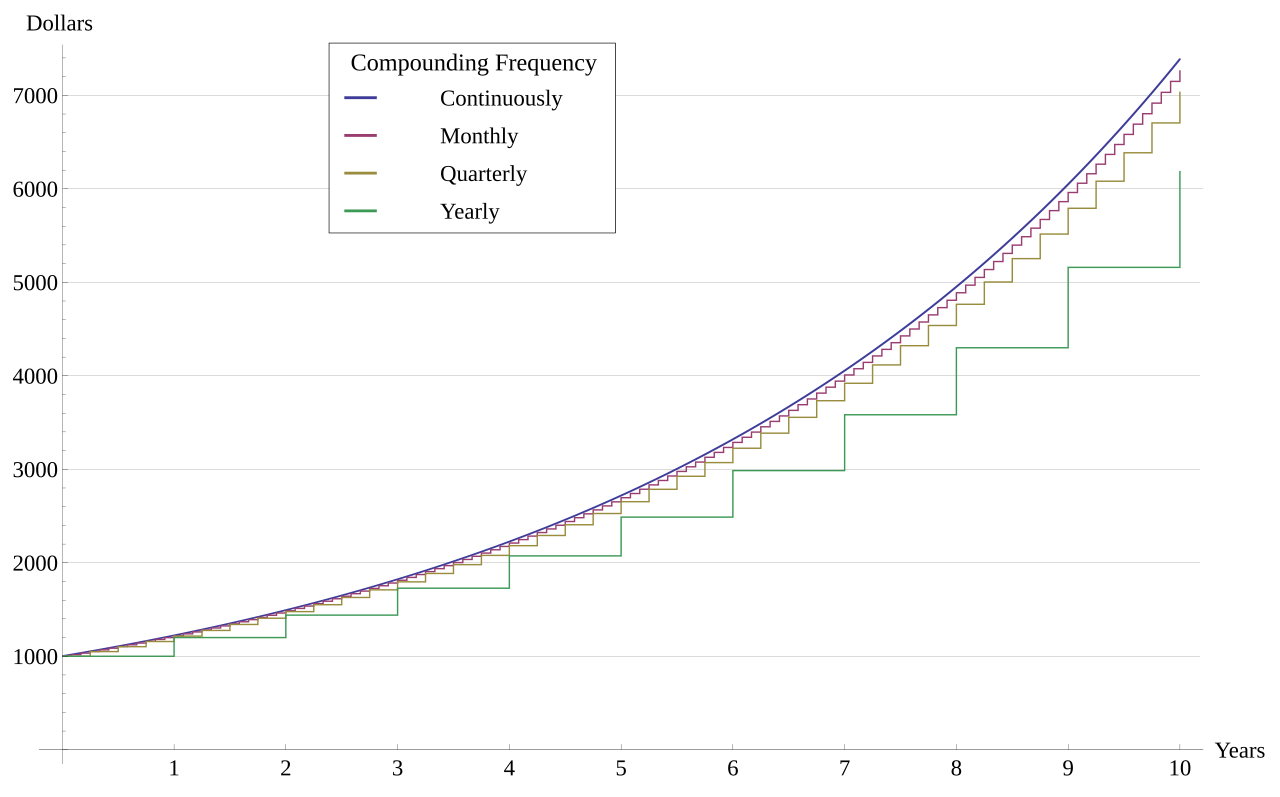
Compound interest is interest calculated on the initial principal and also on the accumulated interest from previous periods.[1][2] The total accumulated value is given by the formula A = P(1 + r/n)^(tn), where P is principal, r is the annual rate, n is compounding frequency, and t is time in years.[1][3] Compound interest generates a higher final amount than simple interest over the same period.[2]
Quick Facts
- Field
- Mathematics, finance
- First traces
- Clay tablet from Babylon, about 2000–1700 B.C.
- Early table
- Francesco Balducci Pegolotti
- Pratica della mercatura
- about 1340
- Landmark book
- Richard Witt, Arithmeticall Questions, 1613
Facts from the source article.
Key facts and history
Luca Pacioli's Summa de arithmetica (1494) gives the Rule of 72 for finding the doubling time of an investment.[4] Lenders who charged compound interest were historically viewed as practicing the most severe form of usury, and such practices faced strong condemnation under Roman law.[5] Published in 1613, Richard Witt's Arithmeticall Questions was the first book dedicated entirely to compound interest, a topic then called anatocism.[6] Witt's volume contained tables computed at 10% and other rates, designed for applications like appraising property leases.[6]
What the cited sources add
That guide notes that using a nominal annual rate divided evenly across compounding periods may cause slight discrepancies in the effective annual rate.[2] A version of the formula for different compounding and payment intervals uses a variable p to represent the number of periodic payments.[2]
References
- Wikipedia, "Compound interest" (CC BY-SA 4.0), which cites: "Compound Interest Formula", qrc.depaul.edu; Investopedia Staff, "Continuous Compounding", Investopedia, 2003-11-19 (we also read that source) en.wikipedia.org
- "Compound Interest Formula - Explained", www.thecalculatorsite.com. facts only, no text reused. thecalculatorsite.com
- Wikipedia, "Compound interest" (CC BY-SA 4.0), which cites: JAMES CHEN, "Compounding Interest: Formulas and Examples", Investopedia, 2024-08-01 (original not read by us) en.wikipedia.org
- Wikipedia, "Compound interest" (CC BY-SA 4.0), which cites: Evans, "Francesco Balducci Pegolotti, La Pratica della Mercatura", 1936, p. 301–2 (original not read by us) en.wikipedia.org
- Wikipedia, "Compound interest" (CC BY-SA 4.0) en.wikipedia.org
- Wikipedia, "Compound interest" (CC BY-SA 4.0), which cites: Lewin, "An Early Book on Compound Interest - Richard Witt's Arithmeticall Questions", Journal of the Institute of Actuaries, 1970, p. 121–132; Lewin, "Compound Interest in the Seventeenth Century", Journal of the Institute of Actuaries, 1981, p. 423–442 (original not read by us) en.wikipedia.org
Each numbered sentence above was checked against the source it cites before publication. Sentences citing Wikipedia adapt text from the English Wikipedia article Compound interest (contributors), used under CC BY-SA 4.0; this entry is available under the same licence. Other sources were used for facts only; no text or images are copied from them.
More in Economic Concepts & Models
Sources
Compiled from Wikipedia and the sources listed below. Text from Wikipedia is available under CC BY-SA 4.0; this entry is adapted from it.
- Wikipedia: Compound interest (CC BY-SA 4.0).
Spotted an error? Know more?
Reader corrections go straight into our review queue. Suggest an edit · How this site is sourced