Earth science
Study of Earth's physical, chemical, and biological systems and interactions.
Last updated
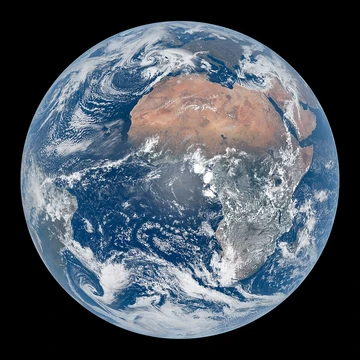
Earth science, also known as geoscience, encompasses all natural science fields related to planet Earth. It examines the physical, chemical, and biological compositions and interactions of Earth's four spheres: the biosphere, hydrosphere/cryosphere, atmosphere, and geosphere (or lithosphere). This branch of science can be generalized into planetary science, a more recent field.
Quick Facts
- Atmospheric nitrogen content
- 78.0%
- Atmospheric oxygen content
- 20.9%
- Atmospheric argon content
- 0.92%
- Earliest groundwater exploitation
- 3000 BC
Facts from the source article.
Geology
Geology investigates Earth's structure, substance, and processes, focusing largely on the lithosphere, including the crust and rocks. It examines physical characteristics and processes in the lithosphere and how geothermal energy affects them, incorporating aspects of chemistry, physics, and biology. Historical geology applies geology to interpret Earth's history and changes over time. Subfields include geochemistry (chemical components and processes), geophysics (physical properties), paleontology (fossilized biological material), planetary geology (extraterrestrial bodies), geomorphology (landscape origins), structural geology (rock deformation forming mountains and lowlands), resource geology (energy from minerals), environmental geology (pollution effects on soil and rock), mineralogy (mineral formation, crystal structure, hazards, and properties), petrology (rock formation and composition), petrophysics (physical and chemical rock properties), and petrography (rock typology and classification).
Earth's interior
Plate tectonics, mountain ranges, volcanoes, and earthquakes arise from physical and chemical processes in Earth's crust. Beneath the crust, the mantle is heated by radioactive decay of heavy elements and consists of magma in semi-perpetual convection, which drives lithospheric plate movement. Divergent boundaries create new crust, convergent boundaries return crust to the Earth, and transform boundaries involve plates sliding past each other without creating or destroying lithospheric material.
Earthquakes often occur near convergent boundaries where crust is forced into the Earth through subduction. Plate tectonics resurface the Earth: seafloor spreading creates new crust from magma cooling at fissures, while subduction returns oceanic crust to the mantle. Volcanoes primarily result from melting of subducted crust material that rises to the surface.
Hydrology
Hydrology studies the hydrosphere and water movement on Earth, emphasizing human use and interaction with freshwater supplies. Its study of water movement relates closely to geomorphology and other Earth science branches.
Applied hydrology involves engineering to maintain aquatic environments and distribute water. Subdisciplines include oceanography (oceans), hydrogeology (groundwater mapping and contaminant analysis), ecohydrology (ecological systems in the hydrosphere, including physical and biological studies of aquatic ecosystems and human effects), and glaciology (cryosphere, glaciers, ice and snow coverage, glacial freshwater access, hazard mitigation, resource extraction beneath frozen land, and climate change effects). Groundwater resource exploitation dates to 3000 BC, and hydrogeology as a science developed from the 17th century.
Earth's spheres
Earth science conceptualizes the surface as several distinct spheres: lithosphere (rocks), hydrosphere (water), atmosphere (air), and biosphere (life). Some include the cryosphere (ice) as part of the hydrosphere and the pedosphere (soil) as an active intermixed sphere. Geology describes the rocky lithosphere and its historic development, with subdisciplines including mineralogy, petrology, geomorphology, paleontology, stratigraphy, structural geology, engineering geology, and sedimentology.
Physical geography studies Earth's seasons, climate, atmosphere, soil, streams, landforms, and oceans, with branches such as geomorphology, biogeography, environmental geography, palaeogeography, climatology, meteorology, coastal geography, hydrology, ecology, and glaciology. Geophysics and geodesy investigate Earth's shape, forces, magnetic and gravity fields, core and mantle, and tectonic and seismic activity, often supplementing geology in mineral and petroleum exploration.
Seismologists use geophysics to understand plate tectonics and predict seismic activity. Geochemistry studies chemical compounds and isotopes in geologic environments, with subdisciplines including aqueous geochemistry, cosmochemistry, isotope geochemistry, and biogeochemistry. Soil science covers the outermost crust layer subject to soil formation (pedosphere), with major subdivisions of edaphology and pedology.
Did You Know?
- Atmospheric science initially developed in the late-19th century as a means to forecast weather through meteorology.
- Atmospheric chemistry expanded in the 1970s in response to acid rain.
- The magnetic field, created by internal core motions, produces the magnetosphere that protects Earth's atmosphere from the solar wind.
More in Earth
Sources
Compiled from Wikipedia and the sources listed below. Text from Wikipedia is available under CC BY-SA 4.0; this entry is adapted from it.
- Wikipedia: Earth science (CC BY-SA 4.0).
Spotted an error? Know more?
Reader corrections go straight into our review queue. Suggest an edit · How this site is sourced