Clearwater Lakes
Last updated

via Wikipedia: Clearwater Lakes · see source
Lac Wiyâshâkimî, called the Clearwater Lakes in English and Allait Qasigialingat by the Inuit, is a single body of water on the Canadian Shield in Quebec near Hudson Bay. Its eastern and western parts are separated by a dotted line of islands. It is the largest, northernmost, and second-largest natural lake in Quebec after Lake Mistassini. The lake's Cree name refers to its clear water, and in 1896 explorer and geologist Albert Peter Low of the Geological Survey of Canada highlighted the extraordinary clarity and depth of its icy waters as a probable explanation for that name.
Impact craters
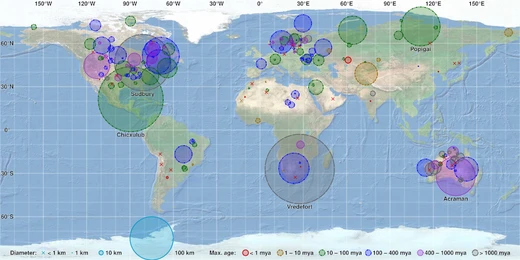
The Clearwater Lakes occupy the near-circular depressions of two eroded impact craters, known as astroblemes. The eastern crater is 26 km in diameter, and the western crater is 36 km in diameter. Both were long thought to have formed simultaneously at 290 ± 20 million years ago, a doublet impact crater theory proposed by Michael R. Dence and colleagues in 1965, possibly from a binary asteroid. However, repeated 40Ar/39Ar dating of impact melt rocks indicates Clearwater East formed about 460–470 million years ago (Middle Ordovician), while Clearwater West formed 286.2 ± 2.6 million years ago (Early Permian).
Both are complex craters with distinct central peaks, though the eastern peak is covered by lake water and sediments; bathymetric surveys and core drilling confirm its presence. The two structures also differ in their natural remanent magnetization signatures and in the geochemical fingerprints of the impacting meteorite found in their impact melts.
Did You Know?
- The lake's Cree name, Wiyâšâkamî, means 'clear water' and is the source of the French calque Lac à l'Eau Claire.
- There are 25 lakes in Quebec named 'Clearwater Lake' (26 if Petit lac à l'Eau Claire is included).
- The western basin's central islands host arctic flora, making them an arctic enclave surrounded by boreal species.
- The lakes are part of Tursujuq National Park, Quebec's largest national park at 15549 km², opened in 2012.
More in Earth Impact Database
Sources
Compiled from Wikipedia and the sources listed below. Text from Wikipedia is available under CC BY-SA 4.0; this entry is adapted from it.
- Wikipedia: Clearwater Lakes (CC BY-SA 4.0).
Spotted an error? Know more?
Reader corrections go straight into our review queue. Suggest an edit · How this site is sourced