Collegium Aureum
German chamber orchestra pioneering historically informed performance without conductor.
Last updated
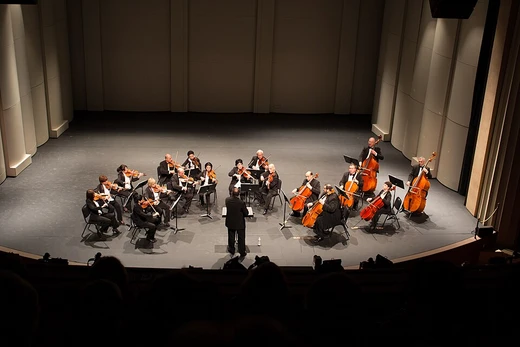
Collegium Aureum was a chamber orchestra founded in Cologne, Germany, in 1962. It later concentrated on historically informed performance, typically playing without a conductor. The ensemble recorded for three decades and undertook international concert tours.
History
Collegium Aureum was founded by the record label Deutsche Harmonia Mundi as a group of instrumental soloists. Their goal was to record music from the early period up to the 18th century using what was first called a "gerechtes Klangbild" (fair sound image) and later known as historically informed performance. They played Early, Classical, and early Romantic music on period instruments with historical techniques, choosing suitable venues.
The ensemble rehearsed and recorded at Schloss Kirchheim in Swabia, in its Renaissance Zedernsaal hall, whose golden ratio proportions inspired the name Collegium Aureum (Golden Colleagues). Franzjosef Maier was concert master, with members including harpsichordists Bob van Asperen and Gustav Leonhardt, flutists Hans-Martin Linde and Barthold Kuijken, oboist Helmut Hucke, violinist Reinhard Goebel, violist Franz Beyer, and timpanist Wolfgang Preissler. They performed without a conductor, led by the concert master. The group began recording in 1962, then gave concerts and made radio and television productions.
They toured England, France, Japan, Latin America, Northern Africa, the Netherlands, the USSR, and the Near East. After three decades of recording, they disbanded in the 1990s, with several recordings later reissued on CD. A 2016 reviewer described their playing as "smooth, elegant and thoughtful." Their 1971 recording of Bach's Christmas Oratorio with the Tölzer Knabenchor, conducted by Gerhard Schmidt-Gaden, was praised as a vigorous exploration of the Nativity with "gratifying eloquence throughout."
More in Early Music Orchestras
Sources
Compiled from Wikipedia and the sources listed below. Text from Wikipedia is available under CC BY-SA 4.0; this entry is adapted from it.
- Wikipedia: Collegium Aureum (CC BY-SA 4.0).
Spotted an error? Know more?
Reader corrections go straight into our review queue. Suggest an edit · How this site is sourced