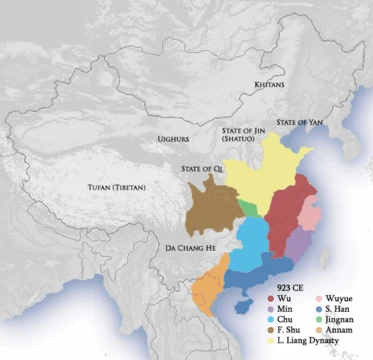
Sixteen Kingdoms
Last updated
Most of these states were established by leaders from tribal groups known collectively as the "Five Barbarians".[1] The Sixteen Kingdoms period is often considered to have started in 304 AD, when Li Xiong, a Ba-Di chieftain, claimed the title of King and established the state of Cheng-Han in Sichuan.[1]
Quick Facts
- Period
- 304–439
- Location
- Northern China
- Founding peoples
- Xiongnu
- Xianbei
- Di
- Jie
- Qiang
- Ended by
- Northern Wei (Tuoba Xianbei)
- Key event
- Battle of Fei River (383)
Facts from the source article.
What happened
Non-Han peoples had been resettling into northern China since the Western Han dynasty, often serving as frontier auxiliaries.[2] The War of the Eight Princes (291–306) exhausted the imperial army and led Jin princes to rely on tribal auxiliaries, giving these groups military power.[3] In 304, Li Xiong, a Ba-Di chieftain, founded the state of Cheng-Han in Sichuan, marking the conventional start of the period.[1] After Liu Cong's death in 318, the Han-Zhao split, and Shi Le, an ethnic Jie general, founded the Later Zhao in the east.[4]
Shi Le's successor Shi Hu ruled tyrannically but supported Buddhism, employing the monk Fotu Cheng as an advisor.[5] The Former Qin under Fu Jiān unified northern China by 376 but was shattered after its defeat at the Battle of Fei River in 383.[6] Liu Yuan, a Xiongnu noble from the Five Divisions, rebelled in 304 after convincing his prince he would rally his people to fight, then returning home to Shanxi and declaring his intent to restore the fallen Han dynasty; his regime, later renamed Zhao, is designated by historians as the Han-Zhao (304–329).[7]
What the cited sources add
Grousset further states that Liu Yuan openly declared his intent to restore the fallen Han dynasty when he launched his rebellion.[7][8]
References
- Wikipedia, "Sixteen Kingdoms" (CC BY-SA 4.0), which cites: Kleeman 1998, p. 5 (original not read by us) en.wikipedia.org
- Wikipedia, "Sixteen Kingdoms" (CC BY-SA 4.0), which cites: Cosmo, "Military Culture in Imperial China", Harvard University Press, 2009, p. 104 (original not read by us) en.wikipedia.org
- Wikipedia, "Sixteen Kingdoms" (CC BY-SA 4.0), which cites: Jacques Gernet, "A History of Chinese Civilization", Cambridge University Press, 1996, p. 180 (we also read that source) en.wikipedia.org
- Wikipedia, "Sixteen Kingdoms" (CC BY-SA 4.0), which cites: Pulleyblank, "The consonantal system of Old Chinese. Part II", Asia Major, 1963, p. 246–248; Haw, "Beijing – A Concise History", Routledge, 2006, p. 201 (original not read by us) en.wikipedia.org
- Wikipedia, "Sixteen Kingdoms" (CC BY-SA 4.0), which cites: Zürcher 2007, p. 181-183 (original not read by us) en.wikipedia.org
- Wikipedia, "Sixteen Kingdoms" (CC BY-SA 4.0), which cites: Rogers 1968, p. 111-118; Rogers 1968, p. 111-118 (original not read by us) en.wikipedia.org
- Wikipedia, "Sixteen Kingdoms" (CC BY-SA 4.0), which cites: Grousset, "The Empire of the Steppes", Rutgers University Press, 1970, p. 56 (we also read that source) en.wikipedia.org
- Open Library record, ISBN 0813513049 ("The Empire of the Steppes"). CC0 (metadata); book content not read. openlibrary.org
Each numbered sentence above was checked against the source it cites before publication. Sentences citing Wikipedia adapt text from the English Wikipedia article Sixteen Kingdoms (contributors), used under CC BY-SA 4.0; this entry is available under the same licence. Other sources were used for facts only.
More in Dynasties And Kingdoms
Related in Dynasties And Kingdoms
Links follow this subject's own source article.
Sources
Compiled from Wikipedia and the sources listed below. Text from Wikipedia is available under CC BY-SA 4.0; this entry is adapted from it.
- Wikipedia: Sixteen Kingdoms (CC BY-SA 4.0).
Spotted an error? Know more?
Reader corrections go straight into our review queue. Suggest an edit · How this site is sourced