Dull Gret
Last updated
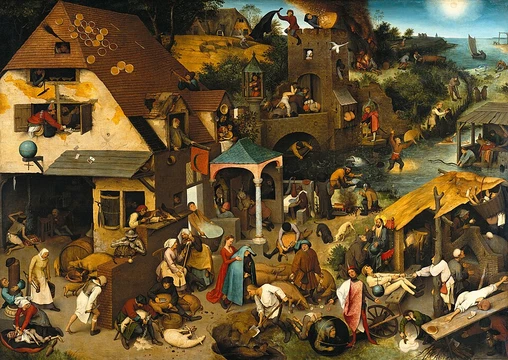
Dulle Griet, also called Mad Meg, is a figure from Flemish folklore famously depicted in a 1563 painting by Pieter Bruegel the Elder.[1][2] At the Museum Mayer van den Bergh in Antwerp, the painting is displayed; it portrays a virago named Dulle Griet commanding a female army to raid Hell.[1]
Key facts and history
A 2018 restoration revealed the painting was made in 1563, shortly after Bruegel moved to Brussels.[3][4][2] Previously the date was illegible and scholars assumed it was painted one or two years earlier.[3] The Kunst Historisches Museum notes that "Dulle Griet" was a term for a proverbial evil, cantankerous wife who oppresses her husband and fears no one.[5] Margaret Sullivan concludes that Bruegel allegorizes the zeitgeist's "madness and folly" in the painting.[6]
Sullivan explains that "dulle" had two meanings: "mad" and "foolish" or "stupid"[6] The name Griet had pejorative connotations throughout Northern Europe.[6] Fritz Mayer van den Bergh, an art collector, found the piece at a Cologne auction in 1897, paid a very low price for it, and recognized the painter a few days afterward.[7]
What the cited sources add
The Bruzz article reports that restorer Depuydt discovered the painting was likely painted in 1563 in Brussels.[4] The VRT article quotes restorer Karen Bonne stating that imaging techniques confirmed the 1563 date, making it a "Brussels painting" rather than an Antwerp one.[2] That source describes the painting as showing a "breastplated woman with a sword in one hand in front of the mouth of hell".[8]
References
- Wikipedia, "Dull Gret" (CC BY-SA 4.0), which cites: ""Dulle Griet" on a Raid before the Entrance to Hell", Kunst Historisches Museum (we also read that source) en.wikipedia.org
- Islamaj, "Schilderij "De dulle griet" is twee jaar jonger dan gedacht", VRT, 1 March 2018. facts only, no text reused. vrt.be
- Wikipedia, "Dull Gret" (CC BY-SA 4.0), which cites: "De Meesterwerken: 'Een feministisch schilderij'", Bruzz, 16 November 2017; Islamaj, "Schilderij "De dulle griet" is twee jaar jonger dan gedacht", VRT, 1 March 2018 (we also read that source) en.wikipedia.org
- "De Meesterwerken: 'Een feministisch schilderij'", Bruzz, 16 November 2017. facts only, no text reused. bruzz.be
- ""Dulle Griet" on a Raid before the Entrance to Hell", Kunst Historisches Museum. facts only, no text reused. khm.at
- Wikipedia, "Dull Gret" (CC BY-SA 4.0), which cites: Sullivan, "Madness and Folly: Peter Bruegel the Elder's Dulle Griet", The Art Bulletin, 1 March 1977, p. 55–66 (original not read by us) en.wikipedia.org
- Wikipedia, "Dull Gret" (CC BY-SA 4.0), which cites: "Pieter Bruegel the Elder The Dulle Griet", Percy Lund Humphries & Co Ltd, 1900 (original not read by us) en.wikipedia.org
- "Comics & Graphic Novels :: Graphic Novels :: Dull Margaret", www.fantagraphics.com. facts only, no text reused. fantagraphics.com
Each numbered sentence above was checked against the source it cites before publication. Sentences citing Wikipedia adapt text from the English Wikipedia article Dull Gret (contributors), used under CC BY-SA 4.0; this entry is available under the same licence. Other sources were used for facts only; no text or images are copied from them.
More in Dutch folklore
Sources
Compiled from Wikipedia and the sources listed below. Text from Wikipedia is available under CC BY-SA 4.0; this entry is adapted from it.
- Wikipedia: Dull Gret (CC BY-SA 4.0).
Spotted an error? Know more?
Reader corrections go straight into our review queue. Suggest an edit · How this site is sourced