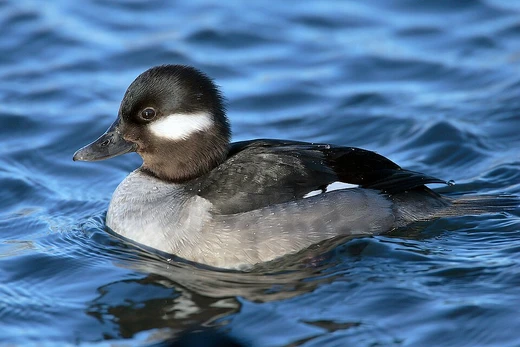
Marbled duck
Last updated
The marbled duck or marbled teal (Marmaronetta angustirostris) is a medium-sized duck found in southern Europe, northern Africa, and western and central Asia. Its scientific name derives from Greek and Latin terms meaning 'marbled duck' and 'narrow-billed'. This species is notable for its nomadic tendencies and its preference for temporary shallow waters in dry regions.
Scientific classification
- KingdomAnimalia
- PhylumChordata
- ClassAves
- OrderAnseriformes
- FamilyAnatidae
- GenusMarmaronetta
- SpeciesMarmaronetta angustirostris
Named by (Ménétriés, 1832)
Sources: Wikipedia taxobox: Marbled duck (CC BY-SA 4.0) · order, family and genus agree with WoRMS AphiaID 1037318 (CC BY 4.0)
Conservation status
Near Threatened (NT)
- LC
- NT▲ this species
- VU
- EN
- CR
- EW
- EX
Source: IUCN Red List assessment · GBIF copy of the Red List category
How big is it?
Largest length in the source, 0.42 m, next to a 1.8 m person.
Diagram: drawn by Codexery, schematic shapes to scale (not a likeness). Length: Wikipedia: Marbled duck
Where the marbled duck has been recorded
Each dot is a place where the species has been observed and reported (40,822 records, half-degree grid) — not a modelled range. 70 inland records left out (institution coordinates).
Map: drawn by Codexery. Data: GBIF occurrence search (records CC0 / CC BY) · Natural Earth basemap (public domain) · place coordinates: Wikipedia (CC BY-SA 4.0)
Distribution, habitat and breeding
The marbled duck once bred widely across the Mediterranean, but its range has shrunk to scattered sites in southern Spain, southern Italy, northwest Africa, and the broader Levant. Further east, it persists in the Mesopotamian marshes of southern Iraq, Iran’s Shadegan Marshes (the most critical location globally), and isolated areas in Armenia, Azerbaijan, South European Russia, western India, and western China. This species is nomadic; in some regions, birds leave breeding areas and have been spotted during winter in the Sahel zone, south of the Sahara.
It favors temporary, shallow waters—fresh, brackish, or alkaline—with thickly vegetated shores in otherwise dry landscapes. It also nests in coastal lagoons, slow rivers, or man-made reservoirs. A typical clutch holds about 12 eggs, laid in a nest hidden in dense vegetation at the water’s edge, usually on the ground but sometimes higher in reeds or on reed huts. These ducks are social, even while nesting.
Outside breeding season, flocks are often small, though large wintering groups occur; the biggest known winter concentration is in Khuzestan, Iran. In 2011, Iraqi ornithologists recorded a single flock of at least 40,000 marbled ducks on the lakes of the Iraqi marshes. They are common in captivity but remain nervous and easily startled.
Description and diet
The marbled duck measures between 39 and 42 cm in length. Its plumage is a pale sandy brown with diffuse off-white blotches, a dark patch around the eye, and a shaggy head. Females are slightly smaller than males, but otherwise the two sexes look the same. Young birds resemble adults but have more off-white blotches.
When flying, the wings appear pale with no clear pattern, and the secondaries lack a speculum. Feeding happens mainly in shallow water, where the duck dabbles or tips forward to reach food. Adult marbled ducks eat mostly seeds from plants like Scirpus and Ruppia, along with a good number of invertebrates—such as aquatic insect larvae and pupae, tiny crustaceans, and even ants, which is unusual for a duck—plus green plants like Potamogeton. Their gizzard helps break down seeds, and the lamellae in their bill let them filter zooplankton.
Young ducks rely mainly on invertebrates; they may eat small seeds but lack the large gizzard needed to process the bigger seeds adults eat.
More in Ducks
Test yourself
Three questions drawn from this entry’s sources. Pick an answer to check it.
Answers checked against the source article
Sources
Compiled from Wikipedia and the sources listed below. Text from Wikipedia is available under CC BY-SA 4.0; this entry is adapted from it.
- Wikipedia: Marbled duck (CC BY-SA 4.0).
- Classification: the source article's taxobox; order, family and genus checked against WoRMS, the World Register of Marine Species (CC BY 4.0).
- Conservation status: IUCN Red List assessment.
- Occurrence records: GBIF (CC0 / CC BY). Basemap: Natural Earth (public domain).
- Word definitions: the Codexery glossary, each quoted from its Wikipedia article.
Spotted an error? Know more?
Reader corrections go straight into our review queue. Suggest an edit · How this site is sourced