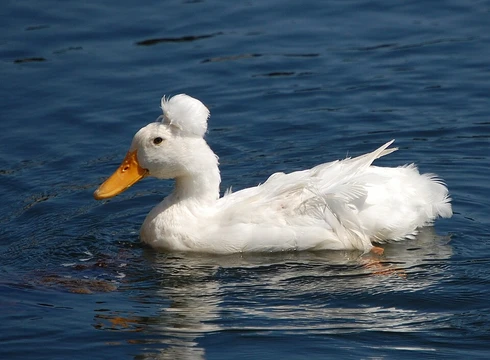
Call duck
A small, noisy historic duck breed from the Netherlands.
The Call is a historic breed of small domestic duck, believed to have originated in the Netherlands in the seventeenth century. It is much smaller than similar breeds, with a round head and very short bill, and is known for the piercing high-pitched call of the ducks, from which its name derives. Historically, it was used as a decoy duck to attract wild ducks into traps.
Quick Facts
- Country
- Netherlands
- Distribution
- Ireland, Netherlands, United Kingdom
- Use
- ornament, showing
- Latin
- Anas platyrhynchos domesticus
Facts from the source article.
History
The use of decoy ducks to trap wild ducks in the Dutch Republic is documented from the seventeenth century, with naturalist Francis Willughby describing the techniques used in Holland in the 1660s. Small ducks resembling the modern Call appear in paintings by Melchior Hondecoeter from about the same period. The Call reached the British Isles by the mid-nineteenth century, with an early description by James Joseph Nolan in Dublin in 1850. It was among four duck breeds in the first poultry standard of William Bernhardt Tegetmeier in 1865. In the twenty-first century it is endangered; in 2017 the Stichting Zeldzame Huisdierrassen classified it as bedreigd based on 750 ducks and 400 drakes among about 100 breeders. By 2026 its DAD-IS conservation status was listed as 'at risk/endangered'.
Characteristics
The Call duck is a small breed; drakes can be slightly heavier than ducks, and females a bit lighter. In the Netherlands, around twenty color varieties are officially recognized, with a similar number acknowledged by British waterfowl and poultry organizations. The Entente Européenne lists nineteen recognized colors and eleven additional unrecognized ones. In the United States, the grey and white varieties were included in the American Poultry Association’s first Standard of Perfection in 1874, and six more colors were added between 1977 and 2007.
More in Duck Breeds
Spotted an error? Know more?
Reader corrections go straight into our review queue. Suggest an edit · How this site is sourced