Duchy of Brittany
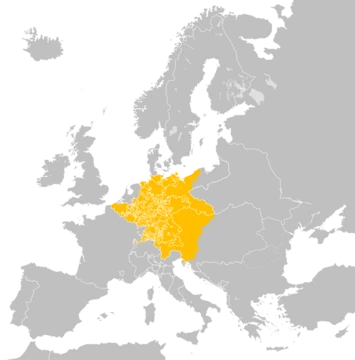
A medieval duchy on the northwestern peninsula of France, never part of the Holy Roman Empire.
Last updated
The Duchy of Brittany was a medieval feudal state on the northwestern peninsula of France, lasting from around 939 until 1547. Its western coast faced the Bay of Biscay, its northern coast the English Channel, with the Loire River forming a looser southern border, and Normandy and other French provinces to the east. The duchy formed after Viking forces were driven from the area in about 939. During the 10th and 11th centuries, it was politically unstable; the dukes held little real authority beyond their own personal lands.
12th century
Relations with the neighboring Duchy of Normandy were mixed—sometimes they were allies, other times enemies, as seen in the Breton–Norman War. In the mid-12th century, Henry II of England invaded Brittany and, through a treaty with Duke Conan IV, became Count of Nantes in 1158. Henry’s son Geoffrey later became duke by marrying Constance, the hereditary duchess. The Angevin dynasty controlled the duchy until their northern French empire fell in 1204.
Role of the Catholic Church
The French Crown then kept influence over Brittany for the rest of the 1200s. Monastic orders, backed by the Breton nobility, spread across the duchy in the 11th and 12th centuries, and the first mendicant orders appeared in its major towns during the 13th century. In the 14th century, a civil war—the Breton War of Succession—erupted between rival claimants, with England and France backing different sides.
16th century
The duchy’s independent sovereignty began to end with the death of Duke Francis II in 1488. His daughter Anne inherited the duchy, but King Charles VIII of France had her existing marriage annulled and married her himself, thereby taking the title Duke of Brittany. The ducal crown was formally united with the French crown in 1532, when the Estates of Brittany voted for the union after the death of Queen Claude of France, the last sovereign duchess. Her sons, Francis III (Duke of Brittany) and later Henry II of France, would have created a personal union upon their father’s death in any case.
Legacy
After the French Revolution and under the various republican governments since 1792, the duchy was replaced by the French system of departments, which continues under the Fifth Republic. Today, these departments have been grouped into administrative regions, but the modern region of Brittany does not cover the entire medieval duchy. A movement for the reunification of Brittany seeks to restore the historic duchy’s full territory as a region within the French Republic. The Duchy of Brittany that emerged in the early 10th century was shaped by earlier polities.
Before the Roman Empire expanded into the area, Gallic tribes occupied the Armorican peninsula, dividing it into five regions that later formed the basis for Roman administration and survived into the duchy’s era. These Gallic tribes—called the Armorici in Latin—had close ties with the Britonnes tribes in Roman Britain. Between the late 4th and early 7th centuries, many Britonnes migrated to the Armorican peninsula, blending with locals to form the later Britons, who eventually became the Bretons. The reasons for these migrations remain unclear.
This movement from Britain gave Brittany its name. Brittany then fragmented into small, warring kingdoms (regna) competing for resources. The Frankish Carolingian Empire conquered the region during the 8th century, beginning around 748 and taking all of Brittany by 799. The Carolingians tried to create a unified administration centered on Rennes, Nantes, and Vannes, using local rulers, but the Breton kings’ control remained weak.
Carolingian technology and culture began to influence Brittany, and the local church started to follow the Frankish model. The greatest influence on the later duchy, however, was the formation of a unified Breton kingdom in the 9th century. In 831, Louis the Pious appointed Nominoe, Count of Vannes, as ruler of the Bretons and imperial missus at Ingelheim. After Louis died in 840, Nominoe rose against the new emperor, Charles the Bald, emboldened partly by new Viking raids on the empire.
Charles created the Marches of Neustria to defend Western Francia from both Bretons and Vikings. Erispoe then fought Charles the Bald, who believed a quick attack would defeat the new Breton leader. Erispoe won at the Battle of Jengland, and under the Treaty of Angers in 851, Brittany’s independence was secured.
The new kingdom proved fragile and collapsed under Viking attack. In 853, the Viking Godfried left the Seine with his fleet, sailed around the Breton peninsula, and sacked Nantes. Erispoe allied with another Viking leader, Sidroc, who betrayed him, leading to Erispoe’s defeat. A weakened Erispoe ruled until 857, when he was assassinated.
His cousin and rival, Salomon, Count of Rennes and Nantes, succeeded him. Viking raids continued. Alan I successfully defeated one wave of Vikings around 900, expanding the kingdom to include not only the Breton territories of Léon, Domnonée, Cornouaille, and the Vannetais, but also the Frankish counties of Rennes, Nantes, Coutances, and Avranches, as well as parts of western Poitou and Anjou. Alan I’s military success brought a period of peace from Viking invasions, with few raids recorded from 900 to 907. After Alan I’s death in 907, the kingdom faced further challenges.
Lore & Background
The duchy was established after the expulsion of Viking armies from the region around 939. In the 10th and 11th centuries, it was politically unstable, with the dukes holding only limited power outside their own personal lands. The Duchy of Brittany had mixed relationships with the neighbouring Duchy of Normandy, sometimes allying itself with Normandy, and at other times, such as the Breton–Norman War, entering into open conflict. Henry II of England invaded Brittany in the mid-12th century and became Count of Nantes in 1158 under a treaty with Duke Conan IV.
Henry's son, Geoffrey, became Duke through his marriage to Constance, the hereditary Duchess. The Angevins remained in control until the collapse of their empire in northern France in 1204. The French Crown maintained its influence over the duchy for the rest of the 13th century. Monastic orders supported by the Breton aristocracy spread across the duchy in the 11th and 12th centuries, and in the 13th, the first of the mendicant orders established themselves in Brittany's major towns.
A civil war broke out in the 14th century, as rival claimants for the duchy vied for power during the Breton War of Succession, with different factions supported by England and France. The independent sovereign nature of the duchy began to come to an end upon the death of its duke, Francis II, in 1488. The Duchy was inherited by his daughter, Anne, but King Charles VIII of France had her existing marriage annulled and then married her himself. As a result, the King of France acquired the title of Duke of Brittany.
The Ducal crown became united with the French crown in 1532 through a vote of the Estates of Brittany, after the death of Queen Claude of France, the last sovereign duchess. Her sons Francis III, Duke of Brittany and then Henry II of France would in any case have created a personal union on the death of their father. Following the French Revolution, and as a result of the various republican forms of French government since 1792, the duchy was replaced by the French system of departments which continues under the Fifth Republic of France. In modern times the departments have also joined into administrative regions although the administrative region of Brittany does not encompass the entirety of the medieval duchy.
Political Transformation Across Eight Centuries
Austria's political identity shifted dramatically over more than a millennium, cycling through distinct titles and structures that reflected changing power dynamics. The final entry in this sequence, the Ostmark Reichsgau of Nazi Germany, represents a period of foreign occupation rather than autonomous governance. This unbroken chain of political redesignations reveals how deeply Austria's identity was tied to its relationship with broader imperial and continental power structures.
The Babenberg Succession and Its Decisive Battles
This succession war produced two notable engagements that shaped the region's military narrative. These two battles, separated by less than two decades, illustrate the sustained military pressure that succession disputes placed on the ducal territories. The fact that both engagements are specifically named within the broader list of Austrian wars underscores their significance in establishing the military traditions that would later define the Archduchy and, eventually, the empire. The Babenberg Succession thus serves as a foundational chapter in understanding how Austria's armed forces developed their strategic identity during the medieval period.
The Coalition Wars and Austria's Continental Front
The War of the Third Coalition, spanning from 1803 or 1805 to 1805 or 1806, is referenced through its dedicated Front: Austria listing, indicating a sustained campaign rather than a single decisive battle. The fact that three of these four coalitions are catalogued by front rather than by individual battle suggests that Austria's involvement was characterized by extended, multi-theater operations rather than isolated engagements. This pattern reveals an archducal military strategy oriented toward sustained continental defense during the Napoleonic era.
Fragmentation and Occupation in the Twentieth Century
The final decades of Austria's political history, as reflected in this military listing, reveal a troubling pattern of institutional instability and external domination. The rapid succession of political entities spanning barely two decades suggests profound difficulty in establishing a stable sovereign identity. The source's cross-references link this period to both Archduke Franz Ferdinand and Adolf Hitler, connecting the empire's end to the figure whose assassination helped trigger the First World War and to the dictator who ultimately erased Austrian sovereignty. The military history of this era is thus inseparable from questions of national survival and political continuity.
Reader's Guide
The Duchy of Brittany was never a part of the Holy Roman Empire, so it is presented here only as a historical reference. Its origins trace to the expulsion of Vikings in 939 under Alan Barbetorte. The duchy's history includes periods of instability, Norman and Angevin influence, and eventual union with the French crown through marriage and inheritance.
More in Duchies And Electorates Of The Holy Roman Empire
Sources
Compiled from Wikipedia and the sources listed below. Text from Wikipedia is available under CC BY-SA 4.0; this entry is adapted from it.
- Wikipedia: Duchy of Brittany (CC BY-SA 4.0).
Spotted an error? Know more?
Reader corrections go straight into our review queue. Suggest an edit · How this site is sourced