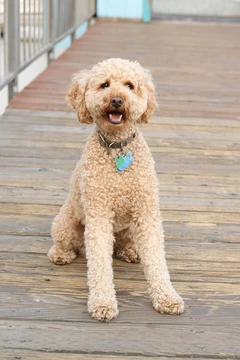
Dog crossbreed
Crossbred dogs from two or more recognized breeds, often for working or companionship.
A dog crossbreed, also known as a designer dog, results from crossing two or more purebred dogs. These dogs are a type of mixed-breed, not a recognized breed, and they usually do not breed true. However, some historic crosses, like the Cesky Terrier, eventually became established breeds. They are distinct from canid hybrids, which involve different species like wolves.
Quick Facts
- Earliest known working crossbreeds
- 14th century or earlier
- Example of historic crossbreeding
- Lord Orford's Greyhounds improved by crossing with Old English Bulldogs
Facts from the source article.
Working crossbreeds
Working dog crossbreeds date from the 14th century or earlier, including the lurcher and longdog. Historically, crosses between different dog types were more accepted before modern purebred breeds existed, aiming to combine qualities or perfect a type for working purposes. Lord Orford's Greyhounds, for instance, were improved by crossing with Old English Bulldogs, a practice later adopted by other breeders. Crossbreeding also shaped sled dogs: the Mackenzie River husky, a 19th-century freighting dog from European and Native American crosses, and the Alaskan husky, bred for racing. In the 1980s, Nordic-style sled racing in Scandinavia led to the eurohound and greyster, crosses of German shorthair pointers with Alaskan huskies and greyhounds. The Mackenzie River husky has largely been replaced by mechanized travel, while Alaskan huskies remain the most common type for competitive sled dog racing. Other historical examples include the bull and terrier and crosses between foxhounds and Old Spanish Pointers that later produced the English Pointer.
Designer dogs
The designer dog fad, traced by the Encyclopædia Britannica to the late 20th century, began when breeders crossed purebred Poodles with other purebred breeds to obtain a hypoallergenic coat and other desirable traits. Resulting puppies are given portmanteau names from syllables of the parent breeds, such as Schnoodle (Schnauzer and Poodle) or Shepsky (German Shepherd Dog and Siberian Husky). Other crosses, like the Puggle (Pug and Beagle), are also labeled this way, and complex crosses with multiple breeds in recent ancestry, such as the German Chusky (German Shepherd Dog, Siberian Husky, and Chow Chow), appear. Like children in a family, a percentage of designer dogs with the same breed ancestry look similar, though crossbreeding does not produce as uniform a phenotype as purebred breeding; even pups in the same litter can differ. Designer dogs are usually bred as companion and pet dogs. Working and hunting dogs deliberately crossbred for a purpose are not generally given portmanteau names but referred to by type names like eurohounds or lurchers. An exception is the Labradoodle, which has a portmanteau name but is also used as a Guide or Assistance dog.
Health and genetic defects
Crossbreeding can reduce the expression of recessive detrimental alleles by increasing the chance that a harmful allele is inherited from only one parent. Some crossbred dogs from two purebred parents may exhibit heterosis, or crossbreed vigor, but this advantage can be diluted when two crossbreeds are bred together, narrowing the gene pool. The best way to maintain crossbreed vigor is through breeding purebred animals of separate breeds, as vigor is typically seen only in the first generation cross. The health of crossbred dogs depends on healthy parentage. Studies of longevity show some advantage for crossbreeds over purebreds, with crossbred dogs having a far lower chance of exhibiting disorders common in the parent breeds and substantially higher genetic health. However, data from over 1,000 US veterinary hospitals shows minimal difference in life expectancy between mixed breed and pedigree dogs. A review of Japanese cemetery data found the Shiba Inu had a greater life expectancy than crossbreeds, though crossbreeds still outlived the average pedigree. A Swedish study of over 200,000 insured dogs found higher morbidity in most pedigrees than mongrels, though several Scandinavian native working breeds had lower morbidity. Some health issues not common in either parent breed may be more common in the crossbreed, such as prolapsed nictitating membrane gland in the Puggle and Jug, which is more frequent than in both parent breeds, illustrating genetic complexity and challenging the theory of hybrid vigour. Overall, designer dog breeds had lower rates of PNMG.
Registration and recognition
Crossbreed dogs are not recognized by traditional breed registries such as the American Kennel Club, United Kennel Club, or Canadian Kennel Club, even if both parents are registered purebreds. If crossbred dogs are bred together over time with well-documented ancestry, they may eventually be considered a new breed by major kennel clubs, as happened with the Cesky Terrier. New breeds require a breed club that documents ancestry from founding dogs, and the kennel club must be satisfied that the dogs are pedigreed before accepting them. Some minor registries and internet businesses register dogs as any breed the owner chooses with minimal documentation, sometimes allowing the owner to create a designer breed name.
More in Dog Crossbreeds
Spotted an error? Know more?
Reader corrections go straight into our review queue. Suggest an edit · How this site is sourced