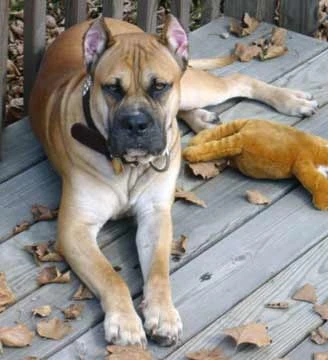
Alano Español
Last updated

via Wikipedia: Alano Español · see source
The Alano Español or Spanish Bulldog is a Spanish breed of medium to large sized dog of alaunt or bulldog type. It has at various times been used as a war dog, for bullfighting, for the management of cattle, for hunting and as a guard dog. In the later twentieth century it became an endangered breed; a recovery project was launched, and numbers have since recovered. It was officially recognised under national law in 2004.
History
No one knows exactly where the Alano Español came from. One idea is that it descends from dogs the Alani, a Central European nomadic people, brought to Spain during the fifth-century Migration Period. The first written mention of the breed is in a chapter of the 1300s Libro de la Montería de Alfonso XI, which describes hunting dogs called Alani with beautiful colours. These dogs traveled with Spanish explorers and were used as war dogs to subjugate Native American peoples and recapture slaves.
The fierce war dog Becerrillo, owned by Juan Ponce de León, may have been this type. Francisco de Goya’s 1816 etching series La Tauromaquia shows such dogs in a bullfighting ring. Starting in the late 1800s, the Alano declined for several reasons: dogs were banned from bullrings in 1880, bullfighting on foot became popular, hunting methods changed with imported foreign breeds, extensive livestock management decreased in some areas, and slaughterhouses modernized and stopped using dogs.
The breed nearly vanished. In the 1980s, a surviving population was found in the mountains of Enkarterri/Las Encartaciones in the Basque Country. A breed standard and stud-book were created, and a recovery project began with the Real Sociedad Canina de España and municipal governments including those of Alanís de la Sierra, Archidona, Cazalla, and El Ronquillo. Two breed societies exist: the Asociación Nacional de Criadores de Alano Español (founded 1995) and the Sociedad Española de Fomento y Cría del Alano Español.
The Spanish Ministry of Agriculture officially recognized the breed in 2004, adding it to the list of indigenous Spanish breeds alongside the Pastor Garafiano, Ratonero Valenciano, Ratonero Mallorquín, and Ca Mè Mallorquí. It is not recognized by the Fédération Cynologique Internationale. The Cimarrón Uruguayo of Uruguay is thought to derive mainly from the Alano Español.
Characteristics
The Alano Español is a large, brachycephalic dog with a powerful, square head. Its short, thick coat, which is never velvety, is commonly brindle in any shade, including grey or blue, and may have black. Other acceptable coat colors are fawn, from sand to red, with or without black, and black-and-brindle, where the tan areas are brindled.
A black mask on the face is optional, and the nose is always black. White markings on the neck, chest, or paws are allowed, but too much white is not preferred. The muzzle is short, ideally about 37% of the head’s length, with a slightly concave lower jaw; a mild underbite is tolerated.
Ears are set high and hang down if not cropped. The skin is very thick, with folds on the neck and some wrinkles on the face. Because it was bred for pack hunting, this breed gets along well with other dogs.
More in Dog Breeds Originating in Spain
Related in Dog Breeds Originating in Spain
Links follow this subject's own source article.
Sources
Compiled from Wikipedia and the sources listed below. Text from Wikipedia is available under CC BY-SA 4.0; this entry is adapted from it.
- Wikipedia: Alano Español (CC BY-SA 4.0).
Spotted an error? Know more?
Reader corrections go straight into our review queue. Suggest an edit · How this site is sourced