Yamuna in Hinduism
Hindu river goddess and twin of Yama.
Last updated
Yamuna is a sacred river in Hinduism and the main tributary of the Ganges, also worshipped as a goddess. She is the twin sister of Yama, the god of death, and is associated with the deity Krishna as one of his eight principal consorts. Bathing in or drinking her waters is believed to remove sin.
Family and names
Yamuna is described in Puranic literature as the daughter of the sun god Surya (though some accounts say she was the daughter of Brahma) and his wife Saranyu (Sanjna in later texts), the goddess of clouds. She is the twin sister of Yama, the god of death, and her other brothers include Vaivasvata Manu, the twin Ashvins, and the planet Saturn (Shani). Surya is said to have favored her above his other children. Because she is Surya's daughter, she is also called Suryatanaya, Suryaja, and Ravinandini.
A tale explains the origin of her name Yamuna: Sanjna closed her eyes in Surya's presence, unable to bear his heat and light; Surya felt insulted and declared that their son would be called Yama, meaning restraint. Sanjna then tried to keep her eyes open but flickered them, angering Surya again, who proclaimed that her daughter would be Yamuna. Since Sanjna had attempted to keep her eyes open, Yamuna was blessed to be worshipped as a goddess and remembered through time.
The name Kalindi may derive from her association with Yama (Kala) or from the mountain Kalinda, her earthly source. The Vamana Purana tells how Shiva, distraught by the death of his wife Sati, jumped into Yamuna, turning her waters black with his sorrow. Another legend says the river became dark after Krishna defeated and banished the serpent Kaliya into its waters.
Association with Yama
In Vedic beliefs, Yami is considered the twin sister of Yama, and together they form a divine pair of creator deities: Yama is the Lord of Death, while Yami is the Lady of Life. The Rig Veda contains a hymn addressed by Yami to Yama, describing various drinks offered to dying sacrificers in the afterlife. In the Brahmanas, however, she retains the central role of being Yama's twin sister. In the Purushamedha rite of the Shatapatha Brahmana, a mother of twins is sacrificed to Yami, while twins are offered in the Taittiriya Brahmana.
A dialogue hymn between Yama and Yami (RV 10.10) presents them as the first two humans; Yami tries to convince her twin brother to have sex with her, arguing that Tvashtar created them as a couple in the womb and that Dyaush and Prithvi are famous for their incest. Yama refuses, citing their ancestors and the strict ordinances of Mitra-Varuna. By RV 10.13.4, Yama is said to have chosen to leave offspring, but Yami is not mentioned. Because creation began with continuous daytime, Yami could not understand the passage of time; the gods created night to separate two days, allowing her to recover.
The festival of Bhau-beej, celebrated by a brother and sister, honors the divine siblings, with a sister's prayer requesting her brother to eat her offerings to please Yama and Yamuna.
Association with Krishna
In the story of Krishna's birth, his father Vasudeva carried the infant across the Yamuna River and asked her to part the waters. She opened a path, and this was the first time she saw Krishna, whom she would later marry. Wanting to touch the baby's feet, she did so where the river ran deeper, and afterward the waters grew still. Krishna spent much of his youth in Vrindavan along the Yamuna's banks, playing his flute and spending time with Radha and the gopis.
The Bhagavata Purana tells that when Krishna was grown, he visited his cousins, the five Pandava brothers, in their capital Indraprastha on the Yamuna. One day he went hunting with Arjuna. Tired, they bathed and drank from the river, where they noticed a beautiful girl walking by the shore. Arjuna spoke with her, and she said she was Kalindi, daughter of Surya, living in a house her father had built in the river.
She had been performing austerities, hoping to marry Vishnu. Krishna, as Vishnu's avatar, agreed to wed her.
They brought Kalindi back to Indraprastha, then traveled to Dvaraka, where the marriage took place. According to the Bhagavata Purana, she bore ten sons: Shruta, Kavi, Vrsa, Vira, Subahu, Bhadra, Santi, Darsa, Purnamasa, and Somaka. The Vishnu Purana says she had many sons, with Shruta as the eldest.
Religious significance
Yamuna is one of the holiest rivers in Hinduism, second only to the Ganges. Her confluence with the Ganges and the mythical Sarasvati River is called Triveni Sangam, a highly sacred pilgrimage spot. Other pilgrimage sites along her banks include her source Yamunotri, Mathura, and Bateshvar.
The Mahabharata mentions Yamuna as one of the seven tributaries of the Ganges, and drinking its waters is described as absolving sin. The epic also references the river as a backdrop for events such as sacrifices, austerities, and a suicide. Various Puranas narrate the greatness of bathing in the Yamuna; the Padma Purana tells of two brothers who lived sinful lives and died, with the younger brother granted heaven because he had bathed in the Yamuna for two months while living in a sage's ashram.
Did You Know?
- Yamuna's iconographic depiction is seen on temple doorjambs paired with Ganga since the Gupta era.
- The Agni Purana describes Yamuna as black in complexion, standing on her mount the tortoise, holding a water pot.
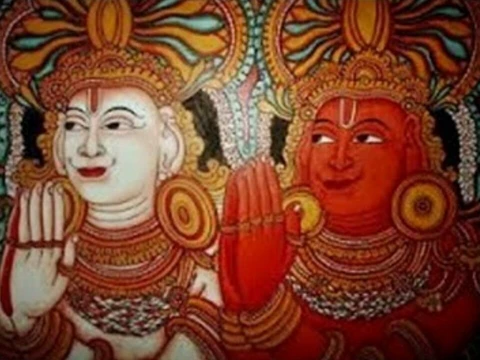
- In an ancient painting she is shown as a beautiful maiden standing on the banks of the river.
More in Divine Twins
Sources
Compiled from Wikipedia and the sources listed below. Text from Wikipedia is available under CC BY-SA 4.0; this entry is adapted from it.
- Wikipedia: Yamuna in Hinduism (CC BY-SA 4.0).
Spotted an error? Know more?
Reader corrections go straight into our review queue. Suggest an edit · How this site is sourced