Pompeii
Ancient Roman city buried by Vesuvius, preserved as a time capsule.
Last updated
Where it is
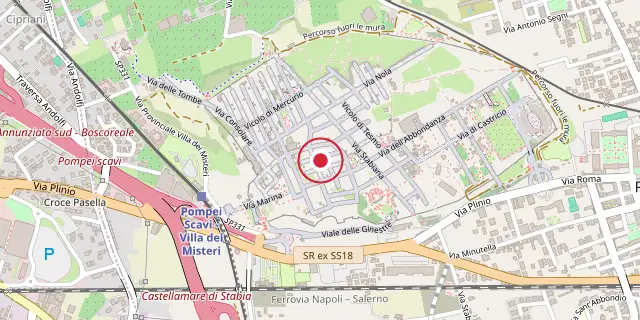
Coordinates: 40°45′00″N 14°29′10″E (40.7500, 14.4860) · Open in OpenStreetMap
Coordinates and connected clubs: the infobox of Wikipedia: Pompeii (CC BY-SA 4.0). Map: drawn by Codexery from OpenStreetMap tiles.
At the time of its destruction, Pompeii was a prosperous settlement with an estimated 10,000 to 20,000 inhabitants.[1] Designated a UNESCO World Heritage Site, Pompeii draws roughly 2.5 million tourists each year, making it one of Italy's top destinations.[2]
Last updated 2026-09-28 from the source article.
Key facts and history
The first stable settlements on the site date to the 8th century BC, when the Oscans founded five villages in the area.[3] In AD 79, Mount Vesuvius erupted, covering the city in up to 12 layers of tephra reaching a total depth of 6 m.[4][5] The eruption lasted two days, and most inhabitants likely escaped, as only about 1,150 bodies have been found on site.[4][6] A 2010 study showed that exposure to pyroclastic flows at least 250 °C hot caused instant death, even for people sheltered inside buildings.[5]
The city was not completely buried, and survivors and thieves came to salvage valuables soon after the eruption.[7] Giuseppe Fiorelli took charge of excavations in 1863 and devised the technique of injecting plaster into voids left by decomposed bodies.[8][9] Around the start of the 6th century BC, the separate hamlets combined into one town, which then got a defensive wall built from tufa stone.[10] Veterans who had fought for Sulla received plots of land within the city and its surroundings, while those who had resisted Rome lost their property.[11]
A powerful earthquake struck on 5 February AD 62, causing extensive destruction in Pompeii; in the years that followed, most repair work was carried out by private owners.[12][13]
What the cited sources add
Gabriel Zuchtriegel, director of the Pompeii site, stated that without concrete, iconic structures such as the Colosseum and the Pantheon would not exist.[14] In May 2018, the BBC reported the discovery of a man in his 30s who was decapitated by a boulder while fleeing the eruption, found on the first floor of a building.[15] The same BBC report notes that the skeleton showed signs of a bone infection in his leg, which would have made walking difficult.[15] The Pompeii site, rediscovered only in the 16th century, has seen a burst of recent archaeological activity aimed at halting decay and neglect.[14]
References
- Wikipedia, "Pompeii" (CC BY-SA 4.0), which cites: .; "Pompeii – Archaeology, Roman, Ruins Britannica", www.britannica.com; Pompeii building site reveals ancient Roman construction methods. NBC.; Wilson, "Settlement, Urbanization, and Population", Oxford University Press, 2011, p. 171–172 (we also read that source) en.wikipedia.org
- Wikipedia, "Pompeii" (CC BY-SA 4.0), which cites: New frescoes discovered at Pompeii, buried by volcano. The Washington Post.; "Dossier Musei 2008", Touring Club Italiano; "Visitors to Pompeii archaeological park Italy", Statista (original not read by us) en.wikipedia.org
- Wikipedia, "Pompeii" (CC BY-SA 4.0), which cites: Arnold De Vos; Mariette De Vos (1982). Pompeii, Herculaneum, Stabia, Rome: Giuseppe Laterza & figli Publishing House. (original not read by us) en.wikipedia.org
- Wikipedia, "Pompeii" (CC BY-SA 4.0), which cites: Martin, "Past eruptions and future predictions: Analyzing ancient responses to Mount Vesuvius for use in modern risk management", Journal of Volcanology and Geothermal Research, May 2020; Vogel, "Analysing the Rural Landscape around Pompeii before the Eruption of Somma-Vesuvius in AD 79", ETopoi, Journal for Ancient Studies, 2012, p. 377–382; Andrew Wallace-Hadrill, "Pompeii: Portents of Disaster", BBC History, October 15, 2010; Sigurdsson, "The Eruption of Vesuvius in A. D. 79: Reconstruction from Historical and Volcanological Evidence", Ameri en.wikipedia.org
- Wikipedia, "Pompeii" (CC BY-SA 4.0), which cites: "New victims from Pompeii emerge from the excavation of the House of the Chaste Lovers", Pompeii, 16 May 2023 (original not read by us) en.wikipedia.org
- Wikipedia, "Pompeii" (CC BY-SA 4.0), which cites: E. De Carolis, G. Patricelli and A. Ciarallo, 'Rinvenimenti di corpi umani nell'area urbana di Pompei', RStPomp, 1998, vol. 9, pp. 75–123. (original not read by us) en.wikipedia.org
- Wikipedia, "Pompeii" (CC BY-SA 4.0), which cites: John J. Dobbins, Pedar W. Foss, The World of Pompeii, , p. 125; Mary Beard, Pompeii; The life of a Roman city, Seuil, 2012 p. 24 (original not read by us) en.wikipedia.org
- Wikipedia, "Pompeii" (CC BY-SA 4.0), which cites: Nappo, "Pompeii: Its Discovery and Preservation", BBC, 17 February 2011 (original not read by us) en.wikipedia.org
- Wikipedia, "Pompeii" (CC BY-SA 4.0), which cites: Gracco, "Orto dei Fuggiaschi", Pompei Online, 28 April 2017 (original not read by us) en.wikipedia.org
- Wikipedia, "Pompeii" (CC BY-SA 4.0), which cites: The World of Pompeii, Edited by John J. Dobbins and Pedar W. Foss, , p. 84; Touring Club Italiano, Guida d'Italia – Naples and surroundings, Milan, Touring Club Editore, 2008.; P. G. Guzzo, "Alla ricerca della Pompei sannitica", in Studi sull'Italia dei Sanniti, Milan, 2000, pp. 107–117. See also the discussion in Guzzo (ed.), Pompei. (original not read by us) en.wikipedia.org
- Wikipedia, "Pompeii" (CC BY-SA 4.0), which cites: Beard, "Pompeii", Profile Books LTD, 2008; Butterworth, "Pompeii – The Living City", St Martin's Press; 1st edition, 2005 (we also read that source) en.wikipedia.org
- Wikipedia, "Pompeii" (CC BY-SA 4.0), which cites: "Patterns of Reconstruction at Pompeii", University of Virginia (original not read by us) en.wikipedia.org
- Wikipedia, "Pompeii" (CC BY-SA 4.0), which cites: The World of Pompeii, Edited by John J. Dobbins and Pedar W. Foss, , p. 173 (original not read by us) en.wikipedia.org
- Pompeii building site reveals ancient Roman construction methods. NBC.. facts only, no text reused. nbcnews.com
- "Pompeii victim crushed by boulder while fleeing eruption", BBC, 30 May 2018. facts only, no text reused. bbc.co.uk
Each numbered sentence above was checked against the source it cites before publication. Sentences citing Wikipedia adapt text from the English Wikipedia article Pompeii (contributors), used under CC BY-SA 4.0; this entry is available under the same licence. Other sources were used for facts only; no text or images are copied from them.
Also in the Codexery
More in Historic Disasters
Sources
Compiled from Wikipedia and the sources listed below. Text from Wikipedia is available under CC BY-SA 4.0; this entry is adapted from it.
- Wikipedia: Pompeii (CC BY-SA 4.0).
- Word definitions: the , each quoted from its Wikipedia article.
Spotted an error? Know more?
Reader corrections go straight into our review queue. Suggest an edit · How this site is sourced