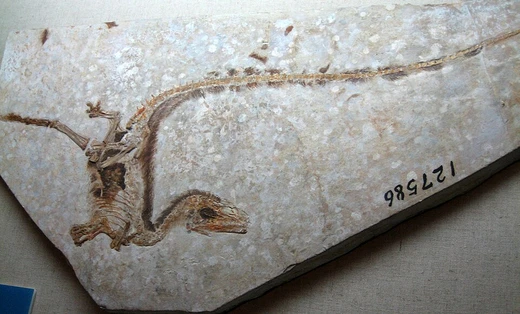
Staurikosaurus
Early herrerasaurid dinosaur from the Late Triassic of Brazil.
Staurikosaurus is a genus of herrerasaurid dinosaur from the Late Triassic of Brazil, found in the Santa Maria Formation. Its name means "Southern Cross lizard," referring to the constellation visible from the Southern Hemisphere. It is notable as one of the earliest known dinosaurs, living approximately 225 million years ago.
Quick Facts
- Species
- pricei
Facts from the source article.
Did You Know?
- The mandible of Staurikosaurus may have had a sliding joint allowing backward and forward movement, though some authors question this due to poor preservation.
- The holotype of Teyuwasu barberenai has been referred as a second specimen of Staurikosaurus pricei.
Description
Staurikosaurus was a small, agile, bipedal predator. Its length is measured at 2.2 to 2.25 meters, though Gregory S. Paul gave a lower estimate of 2.1 meters and a body mass of 12 kilograms. The type specimen has long but relatively slender limb bones. The fossil record is very incomplete, consisting of most of the spine, the legs, and the large lower jaw.
Because it dates from such an early period, many of its features are considered primitive; it is usually depicted with five toes and five fingers. The legs indicate it was a quick runner for its size, and it had only two vertebrae joining the pelvis to the spine, a primitive condition. The available teeth are serrated, laterally compressed, and caudally curved, suggesting a carnivorous diet that involved catching and holding prey and slicing flesh.
The tail was relatively long, with more than 40 vertebrae, and was held straight off the ground. The rear part of the tail is stiffened, an adaptation thought to serve as a dynamic stabilizer for leaping and running.
Discovery and occurrence
The name Staurikosaurus, meaning "cross lizard," comes from the Southern Cross constellation, a star pattern visible only from the Southern Hemisphere and featured on Brazil's coat of arms. Its species name, pricei, honors Brazilian paleontologist Llewellyn Ivor Price, who found the first fossil in 1936. That specimen, cataloged as MCZ 1669, was unearthed at the Jazigo Cinco site in the Santa Maria Formation of Rio Grande do Sul, southern Brazil, in rocks dating to the mid-Carnian stage. Edwin Harris Colbert of the American Museum of Natural History described the dinosaur in 1970, a time when Southern Hemisphere dinosaur discoveries were rare. The scarcity of Staurikosaurus fossils may stem from the animal being uncommon during its life, or from living in a forested environment where fossils rarely form. However, newer evidence suggests the ecosystem was actually drier.
Classification
Staurikosaurus is classified within the clade Herrerasauridae, which also includes Herrerasaurus ischigualastensis. It differs from Herrerasaurus by its considerably smaller size (femur length of 23 cm versus 47 cm). The phylogenetic position of Staurikosaurus is constrained by its close relationship with the more complete Herrerasaurus. Some analyses have placed Staurikosaurus as a basal saurischian outside Theropoda and Sauropodomorpha, but the current scientific consensus assigns it to Herrerasauridae. A 2011 analysis by Sues and colleagues placed Chindesaurus and Herrerasaurus as more derived than Staurikosaurus. Other proposed members of Herrerasauridae include Sanjuansaurus from Argentina and possibly Caseosaurus from Texas, though relationships are not fully understood. Staurikosaurus was originally incorrectly assigned to Palaeosauriscidae by Colbert.
Paleoecology
During the Late Triassic, dinosaurs played only a minor role in terrestrial life. Staurikosaurus coexisted with large rauisuchian archosaurs like Rauisuchus, which were the top carnivores. Its paleocommunity included medium- to large-sized herbivorous rhynchosaurs and dicynodonts, as well as medium-sized omnivorous aetosaurs and cynodonts. Other dinosaurs present were the herrerasaurids and the basal sauropodomorph Saturnalia. The region was arid to semi-arid, characterized by seed ferns, ferns, cycads, and conifers, and subjected to major uplift. A U-Pb dating found the Santa Maria Formation dated around 233.23 million years ago, making it approximately equal to the Ischigualasto Formation as the earliest dinosaur localities.
More in Dinosaurs of Brazil
Spotted an error? Know more?
Reader corrections go straight into our review queue. Suggest an edit · How this site is sourced