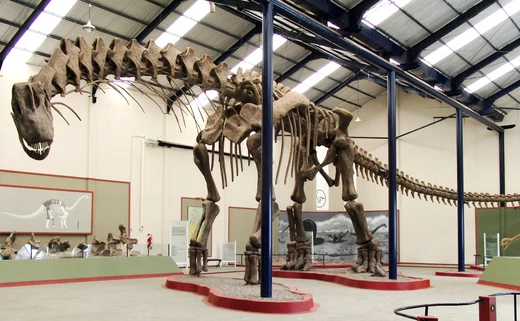
Bonapartesaurus
A hadrosaurid dinosaur from the Late Cretaceous of Argentina.
Bonapartesaurus is a genus of herbivorous ornithopod dinosaur belonging to Hadrosauridae. It lived in what is now Argentina during the Campanian and Maastrichtian stages of the Late Cretaceous. The genus was named in honor of paleontologist José Bonaparte.
Quick Facts
- Type species
- Bonapartesaurus rionegrensis
Facts from the source article.
Discovery and naming
Remains were excavated by Jaime Powell and collaborators in 1984 and described by him in 1987 as a possible indeterminate lambeosaurine, compared with Hypacrosaurus and Barsboldia due to large neural spines. In 2010, Rubén D. Juárez Valieri and team erected Willinakaqe salitralensis from materials at Salitral Moreno and Islas Malvinas in the Allen Formation, designating Powell's specimen as paratype. In 2016, Penélope Cruz-Caballero and Rodolfo Coria reviewed the material and concluded it represented more than one taxon, with non-diagnostic characteristics, making Willinakaqe salitrensis a nomen vanum. In a 2017 study, Cruzado-Caballero and Powell reassigned the paratype to its own genus and species, Bonapartesaurus rionegrensis, rendering the former name invalid.
Description
The holotype, MPCA-Pv SM2/1-71, is a partial skeleton from the Salitral Moreno site in Río Negro province, from the lower member of the Allen Formation. It includes four dorsal vertebrae, a complete sacrum, eight anterior and nine medial caudal vertebrae, two blocks of five medial caudal vertebrae each, eighteen haemal arches, three dorsal ribs, a distal fragment of the right scapula, a distal fragment of the left humerus, a left ulna, a right ilium, a nearly complete left pubis, distal fragments of both ischia, both femurs, tibias, and fibulae, a left astragalus, a right calcaneus, an almost complete articulated left foot, and two blocks with tendons.
Bonapartesaurus is characterized by a combination of unique features, including neural spine height to centrum height ratio greater than 3.5 in sacral vertebrae, extremely long neural spines in anterior caudal vertebrae (three and a half to four times centrum height), a pre-acetabular process flexed ventrally at an angle greater than 150°, and an asymmetric lateral profile of the supraacetabular process.
Paleopathologies
In 2021, researchers examined the Bonapartesaurus holotype with CT scans and found three ancient bone conditions. Two tail vertebrae had broken spinous processes; one break showed signs of infection from a blow, while the other's cause remains unclear. A growth on the left second metatarsal was likely a malignant tumor like osteosarcoma. These issues probably caused pain and limited movement but did not kill the animal.
More in Dinosaurs of Argentina
Spotted an error? Know more?
Reader corrections go straight into our review queue. Suggest an edit · How this site is sourced