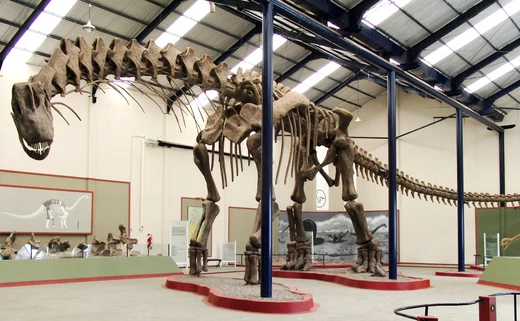
Amargatitanis
A short-necked sauropod from Early Cretaceous Argentina.
Amargatitanis is a genus of dicraeosaurid sauropod dinosaur from the Barremian-aged La Amarga Formation of Neuquén, Argentina. It is known from a single incomplete postcranial skeleton that was originally thought to be a titanosaur but later reclassified as a dicraeosaurid. The genus name means 'Amarga giant' and the species name honors the Museo Argentino de Ciencias Naturales.
Quick Facts
- Species
- macni
Facts from the source article.
Discovery and naming
In 1983, from March 11 to 16, a team from the Museo Argentino de Ciencias Naturales, led by paleontologist José Bonaparte, gathered fossils at four locations along the La Amarga stream in Neuquén, Argentina. At the first site, Bonaparte uncovered a connected skeleton of a large sauropod, which he recorded in his field journal. He first thought the bones came from the Pichi Picún Leufú Formation, but they were later correctly identified as belonging to the La Amarga Formation.
The remains, cataloged as MACN PV N53, were stored at the museum. This skeleton was not formally studied until 2007, when Argentine researcher Sebastián Apesteguía gave it the name Amargatitanis macni. The genus name combines "Amarga," the location, with "titanis," meaning titan. The species name "macni" honors the Museo Argentino de Ciencias Naturales (MACN).
In his description, Apesteguía mistakenly included a scapula (MACN PV N34) and six tail vertebrae (MACN PV N51) with the holotype, even though those fossils came from different rock layers and were collected in 1986. Based on the shape of the scapula and tail bones, he classified Amargatitanis as a titanosaur. However, a 2016 reanalysis of the holotype by Pablo Gallina showed that Amargatitanis was actually a dicraeosaurid diplodocoid. Gallina’s study also removed the scapula and tail vertebrae from the holotype, reassigning them to an indeterminate titanosauriform, and recognized only the dicraeosaurid bones as belonging to the genus. Since that paper, multiple phylogenetic analyses have consistently placed Amargatitanis within Dicraeosauridae.
Description
Amargatitanis belonged to a group called dicraeosaurids, which included better-known dinosaurs like Dicraeosaurus and Amargasaurus. These animals had shorter necks than most other sauropods and featured long neural spines along their neck and back vertebrae. Amargatitanis was a relatively small sauropod; one study calculated its mass at 11.406 metric tons, a bit more than the same study’s estimate for Amargasaurus at 10.195 metric tons. However, mass estimates for Amargasaurus vary widely depending on the method used, and other techniques not yet applied to Amargatitanis have placed Amargasaurus between 3.304 and 4.376 metric tons.
The known tail vertebrae of Amargatitanis are similar to those of other dicraeosaurids. Their centra, or vertebral bodies, are typical of flagellicaudatans, with gently concave front faces and flat rear faces. Unlike other sauropods, the prezygapophyseal centrodiapophysial fossae on these vertebrae contain a thin vertical sheet of bone. The tail bones also resemble those of Pilmatueia but differ from most dicraeosaurids in lacking ventrolateral ridges.
The ischium is generally like that of other flagellicaudatans, though it shares with the brachiosaurid Giraffatitan a straight posterior margin for much of its length.
Classification
When Amargatitanis was first described in 2007, it was thought to be a titanosaur, based on features in its thigh and shoulder bones. Later researchers argued those features were actually the result of broken fossils, and by 2012 it was considered a nomen dubium, with the bones possibly belonging to different animals. A 2016 study changed that view, pointing to a lack of a lateral bulge on the femur and vertebrae that were concave in front and convex behind.
These traits placed Amargatitanis in Dicraeosauridae, usually near the base of that family. In 2022, scientists proposed that South American dicraeosaurids formed their own group, with Amargatitanis closely related to Pilmatueia and Bajadasaurus. They also suggested the family originated in North America, with Suuwassea and Smitanosaurus as the earliest known members. A 2023 analysis recovered Amargatitanis as an advanced dicraeosaurid, in an unresolved group with Pilmatueia and a cluster containing Brachytrachelopan, Dicraeosaurus, and Amargasaurus.
Paleoenvironment
Amargatitanis is known from the La Amarga Formation, a set of sedimentary rocks in the Neuquén Basin that were laid down during the Barremian and late Aptian stages of the Early Cretaceous. Most fossils from this formation, including Amargatitanis, come from its lowest and oldest layer, the Puesto Antigual Member. This member is about 29 meters thick and consists mostly of sandstones left by braided rivers. The formation hosted a varied group of sauropods: the early rebbachisaurid Zapalasaurus, the dicraeosaurid Amargasaurus, and some unnamed basal titanosauriforms.
This diversity likely meant different sauropods ate different plants to avoid competing with each other. Basal titanosauriforms had longer necks, longer front legs, and wider tooth crowns than dicraeosaurids and rebbachisaurids, which points to them feeding at greater heights. Amargatitanis and Amargasaurus probably fed above ground, reaching up to 2.7 meters high, based on their neck and inner ear structure. Rebbachisaurids like Zapalasaurus likely fed at ground level, while basal titanosauriforms ate from even higher spots.
Other dinosaurs from the La Amarga Formation include an unidentified stegosaur. Predators include the small ceratosaur Ligabueino, and teeth suggest a large tetanuran was also present. Beyond dinosaurs, the formation is notable for the cladotherian mammal Vincelestes, the only mammal known from the Early Cretaceous of South America. Crocodylomorphs are represented by the trematochampsid Amargasuchus.
More in Dinosaurs of Argentina
Spotted an error? Know more?
Reader corrections go straight into our review queue. Suggest an edit · How this site is sourced