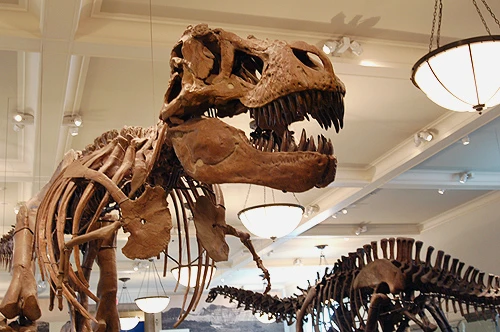
Efraasia
A lightly built sauropodomorph from the Late Triassic of Germany.
Last updated
Efraasia is a genus of basal sauropodomorph dinosaur from the Late Triassic of Germany. It lived during the middle Norian stage, around 210 million years ago, and was a herbivore. The genus was named in 1973 after Eberhard Fraas, who collected the original type specimens in the early twentieth century.
Scientific classification
- KingdomAnimalia
- PhylumChordata
- ClassReptilia
- CladeDinosauria
- CladeSaurischia
- Clade†Sauropodomorpha
- Genus†Efraasia
Named by Galton, 1973
Sources: Wikipedia taxobox: Efraasia (CC BY-SA 4.0)
Quick Facts
- Type species
- Efraasia minor
Facts from the source article.
Discovery and naming
The material now assigned to Efraasia was first uncovered in 1902 when Albert Burrer, a court master stonemason at Maulbronn, began working the Weiße Steinbruch quarry near Pfaffenhofen in Württemberg. To reach a layer of hard white sandstone, Burrer removed a 6 m thick overburden of softer marl, which contained many vertebrate fossils. This stratum belonged to the Stubensandstein Member of the lower Löwenstein Formation, dating to the Norian. In 1907–1908, Friedrich von Huene described a specimen, SMNS 11838, as a new species of Teratosaurus: T. minor, based on hip vertebrae, a right hindlimb, and a pubic bone.
In the same publication, he named Sellosaurus fraasi for a partial skeleton from slightly older rocks. In 1912, Eberhard Fraas reported two partial skeletons, SMNS 12667 and SMNS 12684, which he assigned to a new species of Thecodontosaurus: T. diagnosticus, but he never described them, leaving the name a nomen nudum. Von Huene later redescribed these as Paleosaurus (?) diagnosticus in 1932. In 1959, Oskar Kuhn pointed out that Paleosaurus was preoccupied and renamed the genus Palaeosauriscus.
Allen Charig in 1967 used the combination Palaeosauriscus diagnosticus, but that name was itself a junior homonym of Palaeosauriscus fraserianus. In 2003, the three species were combined into a single valid species: Efraasia minor.
Description
Efraasia was once thought to be a small dinosaur of about 2 to 3 m in length, but this was based on juvenile fossils. Yates in 2003 estimated adult length at 6.5 m, with the largest specimen, SMNS 12843, having a femur length of 627 mm. The animal was lightly built with gracile hands and feet. It may have been partially bipedal and partly quadrupedal, possessing long fingers and mobile thumbs for grasping food, though the shape of its wrists might have allowed easy quadrupedal walking.
Some researchers argue that the lower arm could not pronate, making it an obligate biped. The skull is small, pointed, and triangular, with four teeth in the premaxilla. The neck is moderately elongated and thin, and the tail has low neural spines. The second finger is longer than the third, and the first toe is not strongly reduced.
Von Huene identified a cluster of gastroliths associated with specimen SMNS 12667. Yates identified two autapomorphies: a raised crescent-like ridge on the upper inner side of the pubis shaft, and a vaulted bony web between the processus basipterygoidei with a raised central bony platform on top.
Classification
Efraasia was first thought to be a meat-eating dinosaur, placed in the Palaeosauridae family under Carnosauria in 1932. By 1965, researchers recognized it as a plant-eating sauropodomorph.
In 1973, it was grouped with the Anchisauridae, a paraphyletic set of early sauropodomorphs. Today, phylogenetic work shows Efraasia is a basal sauropodomorph, more advanced than Thecodontosaurus but less so than true prosauropods or sauropods. It sometimes appears as the closest relative to the common ancestor of those two major groups.
More in Dinosaur genera
Sources
Compiled from Wikipedia and the sources listed below. Text from Wikipedia is available under CC BY-SA 4.0; this entry is adapted from it.
- Wikipedia: Efraasia (CC BY-SA 4.0).
- Word definitions: the , each quoted from its Wikipedia article.
Spotted an error? Know more?
Reader corrections go straight into our review queue. Suggest an edit · How this site is sourced