Go First Dice
Dice sets ensuring equal chance for each rank.
Last updated
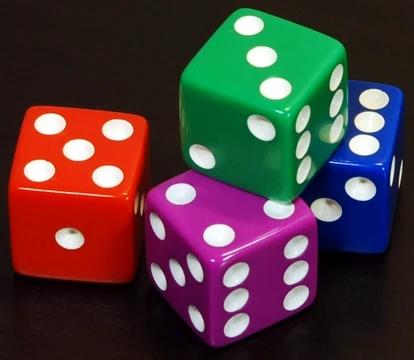
When all dice in a Go First Dice set are rolled simultaneously, every individual die has the same probability of achieving any particular rank, from highest to lowest.[1] Different optimization criteria for these dice sets include minimizing the least common multiple, reducing the total number of sides across all dice, or minimizing the side count of the die with the most faces.[2]
Quick Facts
- Notable contributors
- Robert Ford
- Eric Harshbarger
- James Grime
- Brian Pollock
- Paul Meyer
Facts from the source article.
Key facts and history
Harshbarger's initial "serpentine" numbering method for eight 6-sided dice did not produce fair probabilities for arbitrary subsets.[3] Harshbarger exhaustively searched the 4d6 space and ruled out the existence of a go-first-fair set of four 6-sided dice.[3] Eric Harshbarger found a permutation-fair solution for a mixed set of five dice in 2023.[4] In 2010, Robert Ford discovered a permutation-fair arrangement using three dice, each with six sides, which is considered optimal.[2]
Also in 2010, Robert Ford found an optimal permutation-fair configuration for a set of four dice, each having twelve sides.[2] James Grime and Brian Pollock identified a solution for five dice with sixty sides each, but this solution does not achieve permutation-fairness.[4] Through exhaustive computational search, optimal configurations for groups of up to four dice have been confirmed.[2]
What the cited sources add
Harshbarger's webpage states that the 4d12 set is "go first fair" for any subset of up to four players.[3] The Go First Dice Wiki records that a set of five 30-sided dice is "place fair," showing that permutation-fairness cannot be disproven via weaker fairness types.[5] Harshbarger's webpage explains that a set can be "place-fair" without being "permutation-fair," meaning some overall orderings are more likely than others.[3] According to The Guardian article, the set of four twelve-sided dice has the characteristic that numbers on opposite faces add up to 49, mirroring how standard six-sided dice have opposite faces summing to 7.[6]
References
- Wikipedia, "Go First Dice" (CC BY-SA 4.0), which cites: Harshbarger, "Go First Dice", 2015; Bellos, "Puzzler develops game-changing Go First dice", The Guardian, 18 Sep 2012 (we also read that source) en.wikipedia.org
- Wikipedia, "Go First Dice" (CC BY-SA 4.0), which cites: Harshbarger, "Go First Dice", 2015 (we also read that source) en.wikipedia.org
- Harshbarger, "Go First Dice", 2015. facts only, no text reused. ericharshbarger.org
- Wikipedia, "Go First Dice" (CC BY-SA 4.0), which cites: https://intapi.sciendo.com/pdf/10.2478/rmm-2023-0004 (original not read by us) en.wikipedia.org
- "significant_solutions", Go First Dice Wiki. facts only, no text reused. gofirstdice.ericharshbarger.org
- Bellos, "Puzzler develops game-changing Go First dice", The Guardian, 18 Sep 2012. facts only, no text reused. theguardian.com
Each numbered sentence above was checked against the source it cites before publication. Sentences citing Wikipedia adapt text from the English Wikipedia article Go First Dice (contributors), used under CC BY-SA 4.0; this entry is available under the same licence. Other sources were used for facts only; no text or images are copied from them.
More in Dice
Sources
Compiled from Wikipedia and the sources listed below. Text from Wikipedia is available under CC BY-SA 4.0; this entry is adapted from it.
- Wikipedia: Go First Dice (CC BY-SA 4.0).
Spotted an error? Know more?
Reader corrections go straight into our review queue. Suggest an edit · How this site is sourced