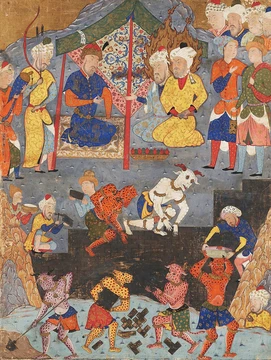
Oghuz Khagan
Legendary khan and eponymous ancestor of the Oghuz Turks.
Last updated

via Wikipedia: Oghuz Khagan · see source
Oghuz Khagan, also called Oğuz Khan, is a legendary ruler of the Turkic people and the namesake ancestor of the Oghuz Turks. Various Turkic groups trace their ethnic and tribal origins through his story. Multiple manuscript versions of the narrative exist, published in many languages, and are generally referred to as the Oghuzname.
These accounts describe his many exploits and conquests, sometimes overlapping with other Turkic epics like the Seljukname and The Book of Dede Korkut. Oghuz Khan belonged to the Balga tribe and was the son of Qara Bey (also called Oğuz Bey) before becoming a khan. Scholars have linked Oghuz Khan to Modu Chanyu, a Xiongnu leader, because of parallels between his mythological biography and Modu’s life as recorded in Chinese histories—a connection first suggested by the Russo-Chuvash sinologist Hyacinth.
Legend
Oghuz was born in Central Asia as the son of Qara Khan, leader of the Turkic people. He began speaking at birth, refused his mother's milk after the first time, and asked for kymyz and meat. He grew supernaturally fast, reaching young adulthood in forty days. At that time, a dragon named Kiyant preyed upon the Turkic lands.
Oghuz armed himself, set a trap by hanging a freshly killed deer in a tree, and killed the dragon with a bronze lance, cutting off its head with a steel sword. After this feat, he became a hero and formed a warrior band from the forty sons of forty Turkic begs, gathering the clans. His Chinese stepmother and half‑brother, the heir, convinced Qara Khan that Oghuz planned to dethrone him. Qara Khan plotted to assassinate Oghuz at a hunting party, but Oghuz learned of the plan and killed his father instead, becoming khan.
The stepmother and half‑brother fled to Chinese lands. Later, while praying alone on the steppes, Oghuz saw a circle of light from the sky with a supernaturally beautiful girl inside; he married her and had three sons: Gün, Ay, and Yıldız. While hunting, he saw another mesmerizing girl inside a tree, married her, and had three more sons: Gök, Dağ, and Deniz. Oghuz Khan then held a great feast for his begs and sent letters to the Kings of the Four Directions, declaring himself Khan of the Turks and demanding their obedience.
Descendants
The Seljuks came from the Kinik branch of the Oghuz Turks, who in the 9th century lived north of the Caspian and Aral Seas within the Yabghu Khaganate of the Oghuz confederacy. In the 11th century, under Toghrul Beg and Chaghri Beg, they founded the Great Seljuk Empire. The Anushteginids, ruling as Khwarazmshahs from 1077 to 1231, traced their origins to the Begdili tribe of the Oghuz Turks; their dynasty began with Anush Tigin Gharchai, a former Turkic slave of the Seljuk sultans.
The Qara Qoyunlu confederation, active in the 14th–15th centuries across Western Asia, came from the Yiva Oghuz tribe. The Aq Qoyunlu sultans claimed descent from Bayindir Khan, a grandson of Oghuz Khagan. Ottoman historian Şükrullah noted that Ertuğrul’s lineage led to Gökalp, a son of Oghuz Khagan. Yazıcıoğlu Ali traced Osman’s genealogy to Oghuz Khagan through his senior grandson, giving the Ottoman sultans primacy among Turkish rulers.
Bayezid I used this claim against Timur, and Cem Sultan linked their line to Oghuz Khagan as a legitimizing tool from the 16th century onward.
Historical precursor and legacy
According to Abulgazi, Oghuz Khan may have lived four thousand years before the Prophet Muhammad, during the era of the legendary king Keyumars. The 18th-century French scholar J.-S. Bailly dated his life to the 29th century BC, while the Russian geographer P. Rychkov and Soviet historian O. Tumanovich placed it in the 7th century BC. The Encyclopaedia of Diderot and d'Alembert notes that Oghuz Khan lived well before the Persian king Cyrus II. Philip Johan von Strahlenberg, relying on the ancient Greek historian Diodorus Siculus, argued that Oghuz Khan led the ancient Scythians in conquering large parts of the Middle East, Southeast Europe, and Egypt.
Strahlenberg also observed that among Central Asian peoples, Oghuz Khan was as renowned as Alexander the Great or Julius Caesar. In academic work, Oghuz Khagan is often linked to Maodun, because N.Ya. Bichurin first noticed strong parallels between their biographies in Turkic-Persian manuscripts and Chinese records, including a father-son feud, patricide, and the order of conquests. More recent preliminary research suggests Oghuz Khan may have lived in the 6th to 7th centuries CE, possibly as a leader of the Tiele subgroup Kibir (Qibi), and perhaps as a close relative of the Qibi chief Geleng.
He is sometimes regarded as the legendary founder of most Turkic peoples, and the Oghuz sub-branches are still organized according to his six sons and twenty-four grandsons. His image appears on the 100 manat banknote.
Did You Know?
- Oghuz started talking as soon as he was born and stopped drinking his mother's milk after the first time, asking instead for kymyz and meat.
- The grey wolf that guided his army was an avatar of Tengri.
More in Dhu'l-Qarnayn
Sources
Compiled from Wikipedia and the sources listed below. Text from Wikipedia is available under CC BY-SA 4.0; this entry is adapted from it.
- Wikipedia: Oghuz Khagan (CC BY-SA 4.0).
Spotted an error? Know more?
Reader corrections go straight into our review queue. Suggest an edit · How this site is sourced