Luna 1
First human-made object in heliocentric orbit.
Last updated
Luna 1, also called Mechta (Dream), E-1 No.4 and First Lunar Rover, was the first spacecraft to reach the vicinity of Earth's Moon, the first to leave Earth's orbit, and the first to be placed in heliocentric orbit. Launched as part of the Soviet Luna programme in 1959, it was initially intended as a Moon impactor but missed the Moon by 5,900 km due to a ground-based control system malfunction. It became known as 'Artificial Planet 1' and the 'First Cosmic Ship' for achieving Earth escape velocity.
Spacecraft
The satellite and its rocket were originally called the Soviet Space Rocket by the Soviet press; Pravda writer Alexander Kazantsev named it Mechta (Dream), and Moscow citizens unofficially called it Lunik. It was renamed Luna 1 in 1963. The spherical satellite was powered by mercury-oxide batteries and silver-zinc accumulators. Five antennas—four whip-style and one rigid—were on one hemisphere for communication.
Radio equipment included a tracking transmitter and telemetry system; there was no propulsion system. Designed to impact the Moon, it carried two metallic pennants with the Soviet coat of arms. Six instruments were aboard: a triaxial flux-gate magnetometer measuring ±3000 gammas to detect lunar magnetic fields; two micrometeorite detectors developed by Tatiana Nazarova; four ion traps for solar wind and plasma measurements developed by Konstantin Gringauz; two gas-discharge Geiger counters; a sodium-iodide scintillation counter; and a Cherenkov detector. The upper stage held a scintillation counter and 1 kg of sodium for a gas-dispersion experiment.
Launch
Luna 1 launched at 16:41 GMT on 2 January 1959 from Site 1/5 at Baikonur Cosmodrome on a Luna 8K72 rocket. The first three stages operated normally. Soviet engineers communicated engine burn commands via radio rather than trusting automated systems.
A delayed signal to stop the Block E stage engine caused an extra 175 m/s, making the spacecraft miss the Moon by 5995 km. It passed within 5995–6400 km of the lunar surface on 4 January after 34 hours of flight, then left Earth's orbit on 6 January 1959. Luna 1 and its 1472 kg upper stage became the first artificial objects to reach Earth escape velocity and heliocentric orbit; the craft remains in orbit between Earth and Mars, completing a circuit every 450 days.
Experiment results
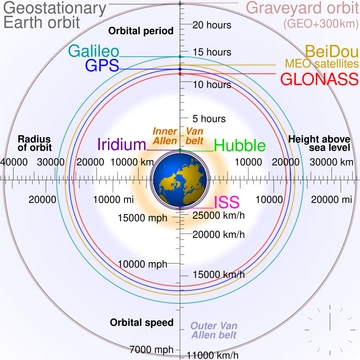
The glowing orange trail, visible over the Indian Ocean at sixth-magnitude brightness for a few minutes, was photographed by Mstislav Gnevyshev near Kislovodsk. While passing through the outer Van Allen radiation belt, the scintillator detected a small number of high-energy particles. The mission provided new data on Earth's radiation belt and outer space.
No lunar magnetic field was detected, setting an upper limit at 1/10,000th of Earth's. The first direct observations and measurements of solar wind were made: ionized plasma concentration was about 700 particles per cm³ at altitudes of 20,000–25,000 km and 300–400 particles per cm³ at 100,000–50,000 km. The spacecraft also achieved the first radio communication at a half-million-kilometer distance.
Reaction
Some doubted the Soviet claim of mission success; Lloyd Mallan wrote about it in The Big Red Lie. Many in the West did not receive transmissions from the spacecraft, though the Soviets had publicized them before the flight. In May 1959, hearings on Soviet Space Technology before the Committee on Science and Astronautics and the Special Subcommittee on Lunik Probe of the U.S. House of Representatives attested to the mission's achievements and its sophisticated guidance technology. The Soviet Union issued commemorative stamps.
More in Derelict Satellites in Heliocentric Orbit
Sources
Compiled from Wikipedia and the sources listed below. Text from Wikipedia is available under CC BY-SA 4.0; this entry is adapted from it.
- Wikipedia: Luna 1 (CC BY-SA 4.0).
Spotted an error? Know more?
Reader corrections go straight into our review queue. Suggest an edit · How this site is sourced