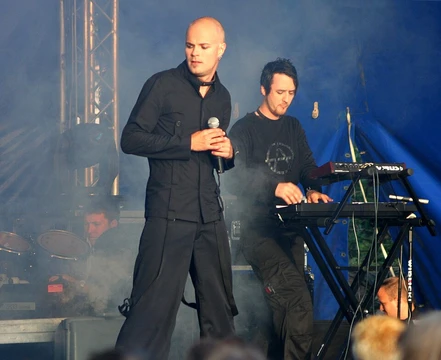
Tim Skold
Swedish musician and producer in industrial and metal acts.

via Wikipedia: Tim Skold · see source
Tim Skold is a Swedish musician and record producer known for his solo work and collaborations with groups such as Shotgun Messiah, KMFDM, Marilyn Manson, and Motionless in White. He was born Thim Sköld on 14 December 1966 in Skövde, Sweden, and grew up in Timmersdala. Influenced by the New Wave of British Heavy Metal, he got his first bass guitar at age 12 and played in cover bands. After meeting guitarist Harry "Harry Cody" Kemppainen at a New Year's Eve party, the two formed a creative partnership with a shared dream of becoming rock stars in the United States.
Quick Facts
- Birth name
- Thim Sköld
- Also known as
- Tim Tim, Skold
- Born
- 14 December 1966
- Birthplace
- Skövde, Sweden
- Genre
- Industrial rock
- industrial metal
- electro-industrial
- Instrument
- Guitar
- bass
- keyboards
- programming
- vocals
- Occupation
- Musician, record producer
- Years active
- 1985–present
Facts from the source article.
Did You Know?
- Kingpin's single "Shout It Out" reached number 1 on Swedish charts in 1987.
- Shotgun Messiah's self-titled debut album sold almost 500,000 copies and reached the Billboard top 100.
- The demo for Skold's unreleased second album, originally called Disrupting the Orderly Routine of the Institution, had only 10 copies made; six songs leaked online without his permission.
Biography
Tim Skold spent his childhood in Timmersdala, a small town near Skövde. The New Wave of British Heavy Metal sparked his interest in music, and he picked up his first bass guitar when he was twelve, soon joining several cover bands. At a New Year's Eve party, he crossed paths with guitarist Harry "Harry Cody" Kemppainen, and the two hit it off, sharing a goal of making it big as rock stars in the United States. When Skold turned seventeen, having completed two years of Process Engineering studies at a boarding school, he got his own apartment and started working at a factory that produced military gear.
Half a year later, the military drafted him. He took his bass along to the base and would sneak into the shower stalls after lights out to practice. On weekends, he kept rehearsing with Cody. After his army service ended, he held a string of odd jobs—library assistant, Volvo employee, and gardener at a bathhouse.
In the early 1980s, Skold and Cody formed the glam metal band Kingpin back in Skövde. They drew inspiration from the flashy hard rock acts coming out of Los Angeles and UK bands like Sigue Sigue Sputnik and Zodiac Mindwarp. They soon brought in vocalist Zinny J. Zan and drummer Stixx Galore to round out the lineup. Kingpin dropped their first single, "Shout It Out," in 1987, and it shot to number one on Swedish charts.
The following year, they put out their sole album, Welcome to Bop City, then packed up and moved to Los Angeles. Cliff Cultreri signed them to Relativity Records, but they had to change their name to Shotgun Messiah because a San Francisco band already owned the rights to Kingpin. They remixed and repackaged Welcome to Bop City as a self-titled album, releasing it as their international debut in 1989. It sold nearly half a million copies and cracked the Billboard top 100.
The videos for "Don't Care 'Bout Nothin'" and "Shout It Out" became regular fixtures on MTV's Headbanger's Ball. While working on a follow-up, the band let Zan go. At Cody's suggestion, Skold took over lead vocals, and they brought in New York City bassist Bobby Lycon. Their second album, Second Coming, came out in October 1991 to strong reviews, with singles "Heartbreak Blvd." and "Living Without You."
In November 1992, Shotgun Messiah released the five-track EP I Want More, which featured two new punk cover tracks and a re-recorded "Babylon" punk cover, along with a re-recorded "I Want More" edit and an acoustic version of "Nobody's Home." Soon after, Stixx and Lycon departed. Still under contract with Relativity Records, Skold and Cody returned to Sweden to record the third Shotgun Messiah album, Violent New Breed, which leaned towards the industrial end of heavy metal.
Released in September 1993 to mixed reviews and continued public indifference due to the popularity of grunge, the album convinced Skold and Cody to end the band. Skold then embarked on a solo project. Writing all songs and playing all instruments himself, his self-titled debut album, Skold, was released in 1996 by RCA, co-produced with Scott Humphrey. Promoting it, Skold and the live SKOLD band went on a short tour with Genitorturers.
Songs from the album were used in movies like Disturbing Behavior ("Hail Mary"), Universal Soldier: The Return ("Chaos"), and the PlayStation game Twisted Metal 4 ("Chaos"). During his solo career, Skold also provided remixes for Prong, Nature, and Drown, and met KMFDM front-man Sascha Konietzko in the studio. Around 2002, Skold recorded a follow-up demo with 10 songs, known as the Dead God EP (though Skold says it was called Disrupting the Orderly Routine of the Institution).
Six of the 10 songs were released on file sharing networks without his permission: "Burn", "Dead God", "I Hate", "Believe", "The Point", and "Don't Pray". All 10 songs were eventually officially released in 2022 as the album Dead God. On 3 November 2009, "I Will Not Forget", "A Dark Star", and "Bullets Ricochet" were released as new SKOLD singles. On 10 May 2011, SKOLD released Anomie.
The album The Undoing was originally slated for self-release in April 2014, but problems arose and it was halted until 2016 when SKOLD rejoined with Metropolis Records to release it. In support, SKOLD began "The Undoing Tour 2016" in May 2016 with the western United States; the live lineup featured Tiffany Lowe on keyboards and Eli James on drums. This was followed by a cross-US North American tour in November and December 2016. In 2018, SKOLD released a cover of "White As Chalk" by Leæther Strip on the compilation Heært Combine.
On 5 April 2019, SKOLD released Never Is Now on Cleopatra Records. On 5 March 2021, SKOLD released Dies Irae on Cleopatra Records. In 2022, Dead God received a proper release. On 28 July 2023, SKOLD released Seven Heads with the single "Rat King", also on Cleopatra Records.
After a short-lived solo career, Skold joined KMFDM in 1997. His first involvement was on the album Symbols, where he wrote and sang the song "Anarchy", which became a hit in clubs. His next album with KMFDM, Adios, was released in 1999. Skold took a more prominent role as co-vocalist, co-writer, bassist, producer, engineer, and programmer alongside Sascha Konietzko.
Due to turmoil, Konietzko and Skold ended KMFDM in 1999 and restarted as MDFMK the following year. They released one album, MDFMK, in 2000 by Universal Records, featuring Lucia Cifarelli. Their song "Missing Time" was used in the animated movie Heavy Metal 2000. In 2002, the trio reformed KMFDM along with Raymond Watts and released Attak.
Afterwards, Skold departed the band. Due to a commitment to produce Marilyn Manson's album The Golden Age of Grotesque, Skold was unable to join KMFDM's 2002 Sturm & Drang tour, though he made two guest appearances at shows in June. On 16 December 2008, the KMFDM website announced that Skold and Konietzko would release an album together, titled Skold vs. KMFDM, released on 24 February 2009. Skold did production and instrumentation work on KMFDM's album Blitz, released 24 March 2009.
Later that year he contributed a remix to Left Spine Down's Voltage 2.3: Remixed and Revisited, as well as 16volt's album Amer.
Musical equipment
Skold has used several different instruments and equipment from different manufacturers. In a Behind the Player video released in 2008, he stated that he uses Gibson Les Paul guitars in the studio and Gibson Firebird models live with Marshall amps, and Gretsch Broadkaster basses with Ampeg amps. His listed guitars include a black Gibson Les Paul, cream white and black Gibson Firebird V models, a red Gibson Firebird VII, a white Jackson X Series Kelly KEXM, and a Roland G-707 Guitar Synthesizer. His basses include Gretsch Broadkaster G6119B models in orange, walnut stain, red, bamboo, and black finishes. He also uses King doublebasses in white with black flames and wood finishes, D'Addario XL Strings, Dunlop Tortex Picks, and various Dunlop and BOSS effects pedals and units, along with Ampeg SVT-4PRO head and SVT-810E cabinet, Blankenship Variplex units, Marshall Amps, and BIAS MINI.
More in Dependent Records Artists
Spotted an error? Know more?
Reader corrections go straight into our review queue. Suggest an edit · How this site is sourced