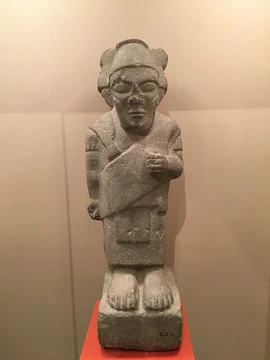
El (deity)
Northwest Semitic supreme god and father of deities.
The Northwest Semitic term "El" can denote any deity or serve as the specific name for a prominent ancient Near Eastern god.[1] Within the ancient Canaanite religion, the supreme deity was referred to as El, Al, or Il.[2] The Hittites used the name Elkunirša for the god El.[3]
Quick Facts
- Other names
- Adon Ilim
- Deity of
- Father of gods
- Venerated in
- Ancient Semitic religion
- Abode
- Mount Lel
- Region
- Levant (particularly Canaan) and Anatolia
- Consort
- Asherah/Athirat; Other wives
- Children
- Anat
- Ashtar
- Baal
- Mot
- Shahar
- Shalim
- Shapash
- Yahweh
- Yam (Ugarit religions)
- Athtart?
- Hadad?
- 70 sons in total
Facts from the source article.
Key facts and history
The word El derives from the Proto-Semitic *ʔil-, with a rarer predicate form ila appearing in Old Akkadian and Amorite.[1] El is listed at the head of many pantheons and played a role as father of the gods, of creation, or both in some Canaanite and Ugaritic sources.[4][5] He fathered many gods, most importantly Baal, Yam, and Mot.[6] El had a variety of epithets including ṯr il ('Bull El'), ʾil milk ('El the King'), bny bnwt ('Creator of creatures'), and ʾab ʾadm ('father of man').[7]
He is described as the grey-bearded ancient one, full of wisdom, and called lṭpn ʾil d pʾid ('the Gracious One, the Benevolent God').[8] The worship of El became a foundational element in the formation of the Iron Age Israelite identity.[9]
What the cited sources add
Francesca Stavrakopoulou has argued that Yahweh was originally a storm-warrior deity operating under the authority of the patriarch-god El, and that through a process she terms "pantheon reduction," Yahweh gradually assumed El's status and characteristics within Israelite religion.[10][11] In Syria, the name Ba’al refers to "the master" – the deity cast in the Bible as the archetypal false god who lures Israel into apostasy.[10] Stavrakopoulou contends that early biblical portrayals of Yahweh included a fully human-like, sexualized form, sometimes with bull horns, which was later transformed into an immaterial being under Greek-Platonic influence.[11] She points to inscriptions mentioning "Yahweh and his Asherah" as evidence that Yahweh once had a divine consort, similar to El's spouse.[11]
References
- Wikipedia, "El (deity)" (CC BY-SA 4.0), which cites: Cross 1997, p. 14; Kogan, Leonid (2015), Genealogical Classification of Semitic: The Lexical Isoglosses. Berlin: De Gruyter. p. 147. (original not read by us) en.wikipedia.org
- Wikipedia, "El (deity)" (CC BY-SA 4.0), which cites: Matthews 2004, p. 79 (original not read by us) en.wikipedia.org
- Wikipedia, "El (deity)" (CC BY-SA 4.0), which cites: Gelb 1961, p. 6; Cross, "Canaanite Myth and Hebrew Epic: Essays in the History of the Religion of Israel", Harvard University Press, September 1, 1997, p. 13-14 (original not read by us) en.wikipedia.org
- Wikipedia, "El (deity)" (CC BY-SA 4.0), which cites: Smith 2001, p. 135 (original not read by us) en.wikipedia.org
- Wikipedia, "El (deity)" (CC BY-SA 4.0), which cites: Leeming 2005, p. [https://archive.org/details/oxfordcompaniont0000leem/page/118 118] (original not read by us) en.wikipedia.org
- Wikipedia, "El (deity)" (CC BY-SA 4.0), which cites: Kugel 2007, p. 423 (original not read by us) en.wikipedia.org
- Wikipedia, "El (deity)" (CC BY-SA 4.0), which cites: Cross, "Yahweh and the God of the Patriarchs", The Harvard Theological Review, 1962, p. 225–259; Cassuto, Umberto. The Goddess Anath: Canaanite Epics on the Patriarchal Age. Bialik Institute, 1951, pp. 42–44 (in Hebrew); ; Cassuto, Umberto. The Goddess Anath: Canaanite Epics on the Patriarchal Age. Bialik Institute, 1951, pp. 42–44 (in Hebrew); Cross, "Yahweh and the God of the Patriarchs", The Harvard Theological Review, 1962, p. 225–259 (original not read by us) en.wikipedia.org
- Wikipedia, "El (deity)" (CC BY-SA 4.0), which cites: Cassuto, Umberto. The Goddess Anath: Canaanite Epics on the Patriarchal Age. Bialik Institute, 1951, pp. 42–44 (in Hebrew); ; Lewis, "The Origin and Character of God: Ancient Israelite Religion through the Lens of Divinity", Oxford University Press, 2020, p. 73–118 (original not read by us) en.wikipedia.org
- Wikipedia, "El (deity)" (CC BY-SA 4.0), which cites: Lewis, "The Origin and Character of God: Ancient Israelite Religion through the Lens of Divinity", Oxford University Press, 2020, p. 73–118 (original not read by us) en.wikipedia.org
- Williams, "When God was an alpha male", New Statesman, 2021-10-13. facts only, no text reused. newstatesman.com
- Wikipedia, "El (deity)" (CC BY-SA 4.0), which cites: Williams, "When God was an alpha male", New Statesman, 2021-10-13; McEntire, "Monotheism and narrative development of the divine character in the Hebrew Bible", Cambridge University Press, 2023, p. 25–26; "An Unexpected Case for an Anthropomorphic God", Interpreter Foundation; Williams, "When God was an alpha male", New Statesman, 2021-10-13 (we also read that source) en.wikipedia.org
Each numbered sentence above was checked against the source it cites before publication. Sentences citing Wikipedia adapt text from the English Wikipedia article El (deity) (contributors), used under CC BY-SA 4.0; this entry is available under the same licence. Other sources were used for facts only; no text or images are copied from them.
More in Deities in the Hebrew Bible
Spotted an error? Know more?
Reader corrections go straight into our review queue. Suggest an edit · How this site is sourced