
Kansas City Scouts
Brief NHL franchise that moved to become the Colorado Rockies.

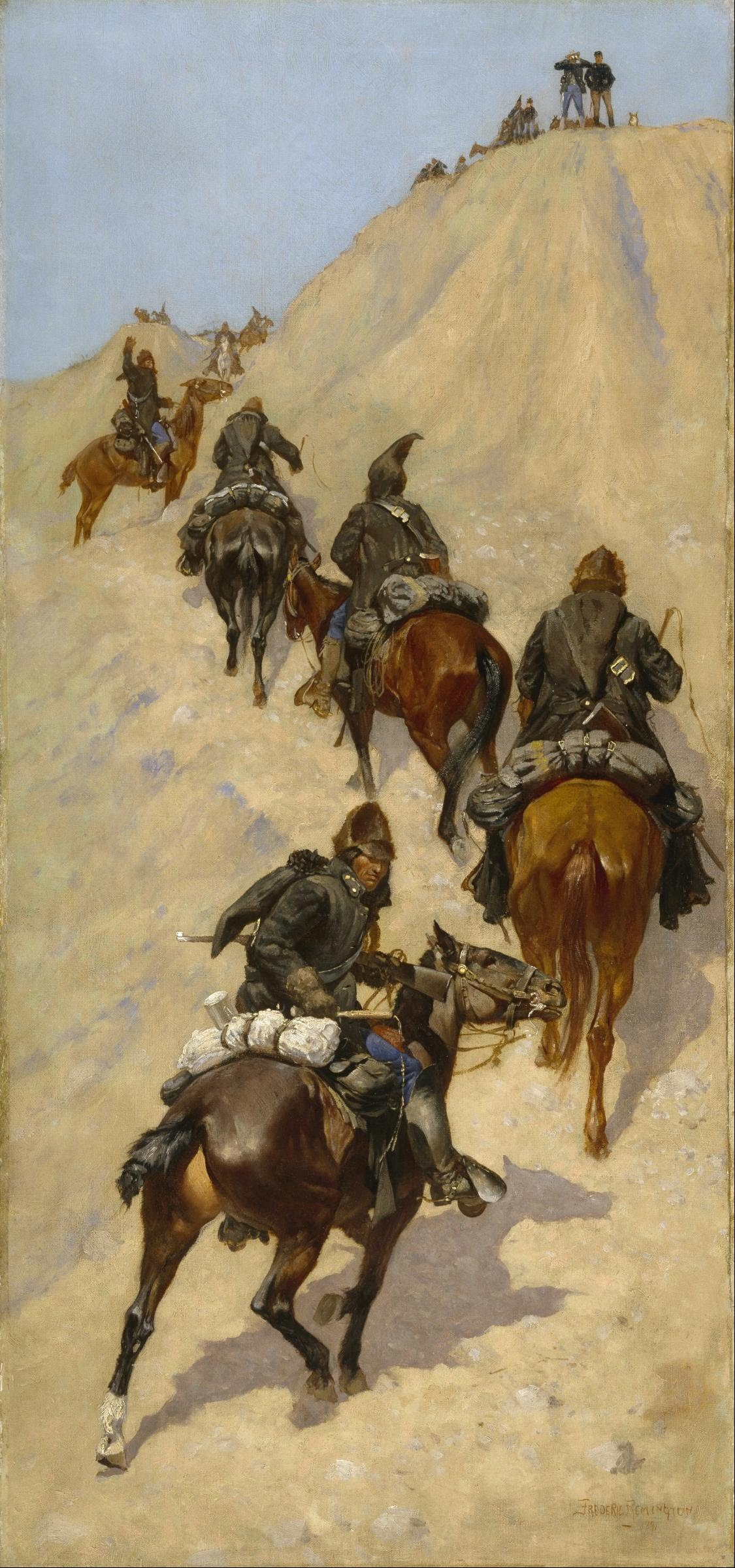
Frederic Remington · Public domain
The Kansas City Scouts were a professional ice hockey team in the National Hockey League (NHL) from 1974 to 1976. The franchise relocated to Denver in 1976 to become the Colorado Rockies, and later moved to New Jersey in 1982 to become the New Jersey Devils. The Scouts are notable as one of the first NHL teams to relocate since the 1934–35 season, and for their brief, unsuccessful tenure in Kansas City.
- Years active
- 1974–1976
- Home arena
- Kemper Arena
- Record 1974 75
- 15–54–11 (41 points)
- Record 1975 76
- 12–56–12 (36 points)
- Total wins
- 27 wins in 160 games
- Average attendance
- 8,218 per game
- Last game
- April 18, 1976 (exhibition win vs. Washington Capitals in Japan)
Lore & Background
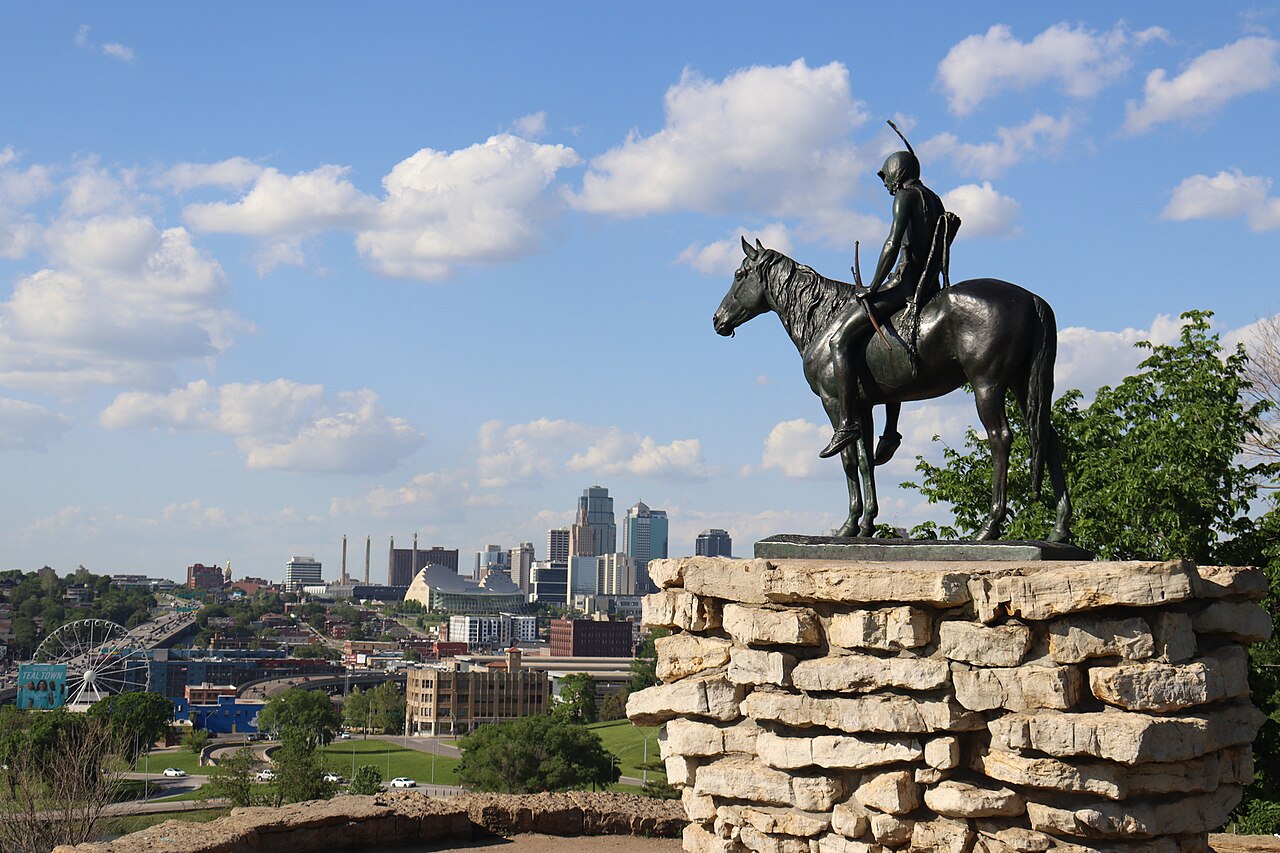
The Kansas City Scouts were awarded an NHL franchise on June 8, 1972, as part of the league's expansion that added teams in Kansas City and Washington, D.C. The ownership group, Kansas City Hockey Associates, was led by managing general partner Edwin G. Thompson and originally consisted of 22 investors. The team was originally to be named the 'Kansas City Mohawks,' but the Chicago Black Hawks objected due to similarity. A contest resulted in the name 'Scouts,' after The Scout statue in Penn Valley Park. The logo was designed by Gary Sartain of Hallmark Cards. The Scouts played their home games at Kemper Arena, which they shared with the NBA's Kansas City Kings.
The Scouts debuted on October 9, 1974, losing 6–2 to the Toronto Maple Leafs. Their first victory came on November 3, 1974, against the Washington Capitals. The team performed poorly, finishing with 41 points in their inaugural season and 36 points in their second season. The 1975–76 season saw a promising start, but the team collapsed, going winless for long stretches. The last four games the Scouts ever played were exhibition games in Japan, where they won their final contest on April 18, 1976. The team went through three coaches—Bep Guidolin, Sid Abel (interim), and Eddie Bush—and had two captains, Simon Nolet and Guy Charron.
Reader's Guide
The Kansas City Scouts' significance lies in their role as a cautionary example of the challenges faced by NHL expansion teams in the 1970s. The team struggled with poor performance, inflated player costs, undercapitalized ownership, an economic downturn in the Midwest, and weak attendance, averaging only 8,218 fans per game in a 17,000-seat arena. The franchise's failure to secure more season tickets led the owners to sell to a Denver-based group led by oilman Jack Vickers. The Scouts' relocation to Denver as the Colorado Rockies in 1976, and later to New Jersey as the Devils in 1982, marked the first NHL relocations since the 1934–35 season. The New Jersey Devils, who eventually found stability, make almost no mention of their past as the Scouts or Rockies in their media guide or website history. The Scouts' legacy in Kansas City is that of a minor league hockey town, with subsequent teams like the Kansas City Blades and Kansas City Mavericks.
Did You Know?
- The team's logo was designed by Gary Sartain of Hallmark Cards for $2,000.
- The Scouts played their last four games in Japan, winning their final contest on April 18, 1976.
- The franchise won only 27 of 160 games, with a 7–66–7 record away from home.
From Mohawks to Scouts: A Franchise Finds Its Identity
The path to the Scouts' identity was far more convoluted than most fans realize. When the NHL closed out its 1967-era expansion wave by awarding a franchise to Kansas City in June 1972, the Kansas City Hockey Associates group, under the direction of Edwin G. Thompson and a syndicate of twenty-two investors, edged out three rival bidding groups. The ownership circle initially envisioned a team called the 'Mohawks,' a clever mashup of Missouri's postal abbreviation and Kansas's Jayhawkers moniker. Chicago's Black Hawks, however, objected to the near-identical naming, forcing a public contest. The winning entry drew from The Scout, a beloved statue perched in Penn Valley Park overlooking the downtown skyline. That same figure became the centerpiece of the club's logo, sketched in 1973 by lettering artist Gary Sartain, a Hallmark Cards employee who took the commission as freelance work and reportedly pocketed a modest two-thousand-dollar fee. The Scouts would share their newly built Kemper Arena with the NBA's Kansas City–Omaha Kings, a pairing that underscored how the city was staking its identity on professional sports in the mid-seventies.
Two Seasons, One Collapse: The On-Ice Story
The Scouts' on-ice story reads like a cautionary tale about expansion hockey in the mid-seventies. Their October 9, 1974, debut at Toronto's Maple Leaf Gardens ended in a 6–2 loss, though rookie captain Simon Nolet etched his name into the record books with the franchise's first goal. Because Kemper Arena was still under construction, the opening eight contests were all played on the road, yielding seven defeats and a single draw. The home opener on November 2 fell 4–3 to Chicago, and the following day brought the first win—a 5–4 thriller over Washington with Peter McDuffe between the pipes. The 1974–75 campaign closed at 15–54–11, respectable for an expansion club. But 1975–76 began with genuine hope: a December 28 victory over California left Kansas City just a single point behind St. Louis for a playoff berth. What followed was a catastrophic slide. A fourteen-game winless stretch gave way to a solitary February 7 victory, then a 0–21–6 tailspin that left the season at 12–56–12 and 36 points—the worst mark in the franchise's entire history. Three coaches, two captains, and a league-leading penalty-minute total by Steve Durbano could not mask the reality that the talent pool, diluted by the WHA's thirty-two-team landscape, simply was not enough.
Empty Seats and Empty Pockets: The Financial Unraveling
Beyond the scoreboard, the Scouts were hemorrhaging money from the moment the franchise was awarded. The ownership group, which had grown to thirty-seven investors by the time of the move, carried a debt load that no amount of on-ice success could have erased. Attendance told the steepest story: in a seventeen-thousand-seat Kemper Arena, the Scouts drew an average of just 8,218 fans per game, a figure roughly half the league-wide average of thirteen thousand. A season-ticket drive mounted by the investors managed to sell only two thousand additional passes before the group concluded the venture was no longer financially sustainable. Compounding the problem were inflated player costs, an undercapitalized ownership structure, and a broader economic downturn gripping the Midwest. The NHLPA itself began questioning whether the Scouts could cover payroll. In 1976, the franchise was shipped to Denver and rebranded as the Colorado Rockies. Six years later, in 1982, the Rockies departed for New Jersey, where they have carried the name New Jersey Devils ever since. The Scouts' brief existence thus became the opening chapter of a franchise that would eventually find genuine stability on the East Coast.
A Farewell in the Far East: The Japan Exhibition Series
The Scouts' final chapter was written thousands of miles from Kansas City, on Japanese ice. After the 1975–76 regular season concluded, the team traveled to the Pacific for a four-game exhibition series against the Washington Capitals. The first two contests took place in Sapporo, the host city of the 1972 Winter Olympics, while the remaining two were staged in Tokyo at Yoyogi National Gymnasium, the very venue that had hosted swimming and diving at the 1964 Summer Games. Washington took the first three meetings, but on April 18, 1976, the Scouts delivered a 4–2 victory that gave Kansas City a winning final game in franchise history. The result, of course, carried no weight in the NHL standings—it was purely an exhibition—but it offered a small, bittersweet note of closure for a club that had won just twenty-seven of its one hundred sixty regular-season games. The journey to Japan also served as a symbolic farewell: the Scouts would never again don that logo, never again hear their name called in Kemper Arena. Within weeks, the franchise was packed up and headed for Denver, and the Kansas City era was officially over.
Gallery
More in Defunct Ice Hockey Teams 1-24
Spotted an error? Know more?
Reader corrections go straight into our review queue. Suggest an edit · How this site is sourced