
Colorado Rockies (NHL)
Short-lived NHL franchise that became the New Jersey Devils.

RickDikeman · CC0
The Colorado Rockies were an NHL team based in Denver from 1976 to 1982. The franchise began as the Kansas City Scouts, an expansion team that joined the league for the 1974–75 season. After six seasons in Colorado, the team moved to East Rutherford, New Jersey, for the 1982–83 season and became the New Jersey Devils. Denver went without an NHL team until the Quebec Nordiques relocated there after the 1994–95 season and became the Colorado Avalanche. The MLB team also called the Colorado Rockies, which started play in 1993, took its name from this earlier hockey franchise.
The team’s origins trace back to Ivan Mullenix, owner of the Denver Spurs of the Central Hockey League, who had been granted a conditional NHL franchise for 1976–77. With McNichols Sports Arena already built by 1975, he sought to enter the NHL a year early. The league tried to broker a deal where Mullenix would buy the struggling California Golden Seals and move them to Denver, while the Pittsburgh Penguins would be sold to a Seattle group with a conditional franchise. That plan fell through, and the NHL canceled its 1976–77 expansion. Mullenix then moved the Spurs to the World Hockey Association for the 1975–76 season, but Denver fans did not see the WHA as major league and attendance was poor. By December, rumors that the NHL would move either the Seals or the Kansas City Scouts to Denver convinced Mullenix he could not compete, so he relocated the Spurs to Ottawa mid-season. The renamed Ottawa Civics lasted only two weeks before folding.
Meanwhile, the Scouts were in financial trouble despite entering the NHL only two years earlier. They had a 12-win season in 1975–76 but still performed better on the ice than the Washington Capitals, their fellow expansion team. However, Capitals owner Abe Pollin had far more financial backing than the 37-member consortium that owned the Scouts, and he had the patience for an expansion team’s typical struggles. The Scouts were also hurt by an economic downturn in the Midwest. Facing nearly $1 million in debt, the owners decided to sell after a season ticket drive sold only 2,000 tickets. A Denver group led by Jack Vickers bought the Scouts, moved them to Denver, and renamed them the Colorado Rockies.
- Years active in denver
- 1976–1982
- Original franchise
- Kansas City Scouts (1974–1976)
- Division
- Smythe Division, Campbell Conference
- Playoff appearances
- 1
- Best playoff result
- First-round loss (two-game sweep) in 1977–78
- Head coaches in four years
- 7
- Ownership changes in four years
- 2
Lore & Background
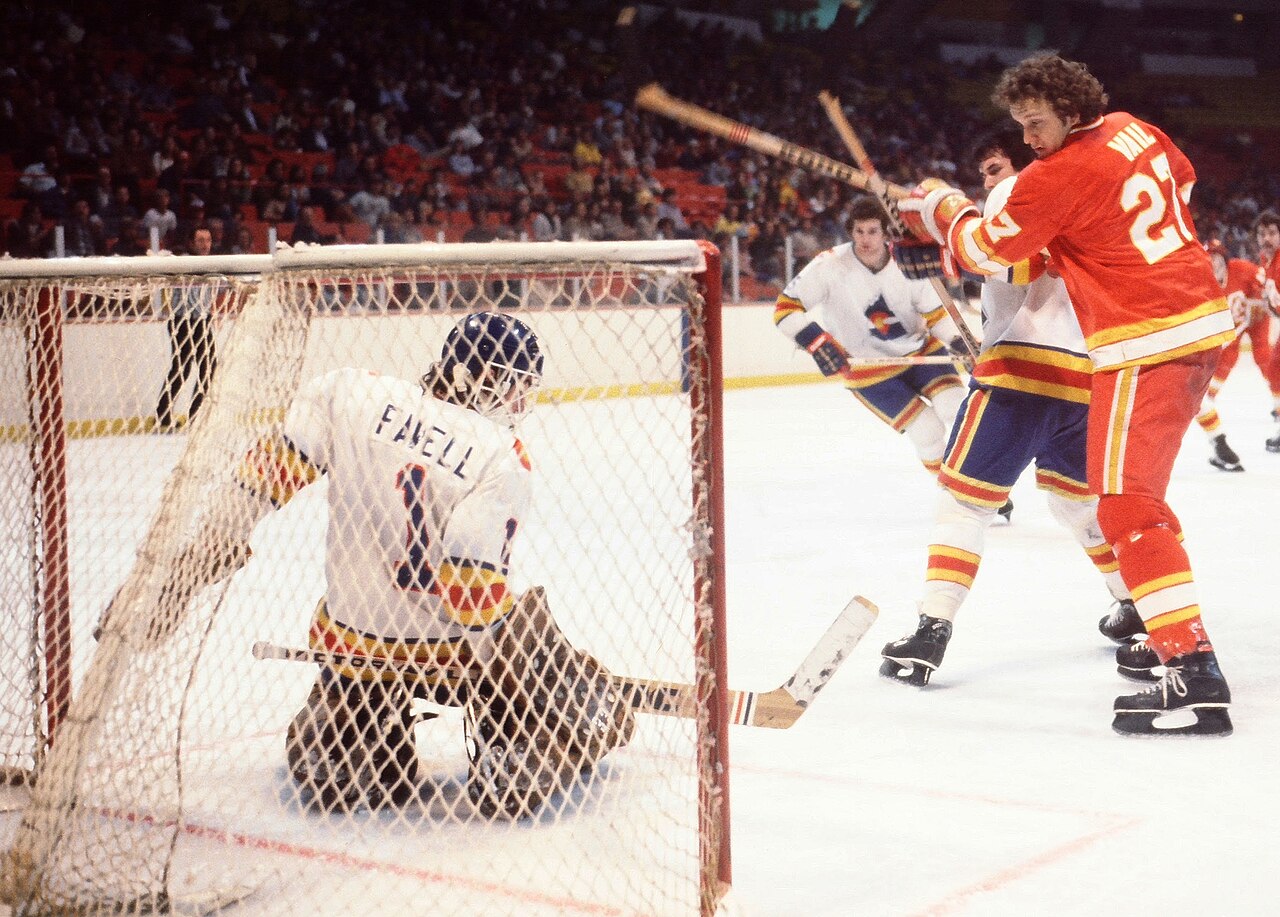
The Colorado Rockies were born from the relocation of the struggling Kansas City Scouts, which were purchased by a Denver-based group headed by Jack Vickers. The team retained the Scouts' colors of blue, red and gold, as they matched the Colorado state flag. Despite a new city, the Rockies continued to struggle, making the Stanley Cup playoffs only once, in 1977–78, when they finished with the sixth-worst record in the league but won a weak Smythe Division. They were swept in the first round by the Philadelphia Flyers.
The franchise was marked by instability: seven coaches in four years, none lasting more than one full season, and ownership changed hands twice. One notable highlight was the 1979–80 season under head coach Don Cherry, who adopted the motto 'Come to the fights and watch a Rockies game break out!' plastered on billboards. Cherry feuded with general manager Ray Miron over goaltending, and the team finished tied for the worst record in the league, yet drew its highest average attendance of 9,787. In his final game, Cherry wore a cowboy hat and boots as players formed a stick arch for him.
Ownership troubles persisted. Jack Vickers sold the team in 1978 to Arthur Imperatore Sr., who intended to move it to New Jersey. Imperatore then sold to Peter Gilbert, who promised not to move the team. By 1982, the franchise was sold to John McMullen, who relocated it to New Jersey for the 1982–83 season, renaming it the New Jersey Devils.
Reader's Guide
The Colorado Rockies represent a brief and troubled chapter in NHL history, notable primarily as a precursor to the New Jersey Devils. The franchise's six seasons in Denver were marked by consistent on-ice failure—only one playoff appearance, never finishing less than 20 games below .500—and off-ice instability, with seven coaches and two ownership changes in four years. Despite this, the team had brief star power in players like Barry Beck and Lanny McDonald, and drew respectable attendance under Don Cherry's flamboyant coaching. The Rockies' legacy is largely defined by their relocation: the franchise moved to New Jersey in 1982 and became the Devils, while Denver went without an NHL team until the Quebec Nordiques relocated to become the Colorado Avalanche after the 1994–95 season. The Rockies' name was later adopted by a Major League Baseball team in Denver that began play in 1993. The last Rockies player on the Devils' active roster was Aaron Broten, traded in 1990, and the last active NHL player who had played for the Rockies was Joe Cirella, who retired after the 1995–96 season.
Did You Know?
- The Colorado Rockies made the Stanley Cup playoffs only once, in 1977–78, and were swept in the first round by the Philadelphia Flyers.
- The Rockies' colors of blue, red and gold were retained from the Kansas City Scouts because they matched the Colorado state flag.
A Franchise Born of Desperation
The Colorado Rockies trace their roots to one of the NHL's most turbulent expansion stories. The franchise began as the Kansas City Scouts, a team that entered the league in 1974–75 but quickly found itself in financial freefall. A 37-member ownership consortium struggled to keep the club afloat, and by the 1975–76 season the Scouts had posted just 12 wins while carrying nearly a million dollars in debt. A season-ticket drive that netted only 2,000 sales sealed the group's decision to sell. Meanwhile, in Denver, Ivan Mullenix had been handed a conditional NHL franchise and had the newly completed McNichols Sports Arena ready, but a proposed swap involving the California Golden Seals collapsed, and the league scrapped its 1976–77 expansion plans. Mullenix's WHA detour lasted barely a season before he fled to Ottawa, where the renamed Civics folded after two weeks. Into this chaos stepped Jack Vickers, a Denver-based buyer who purchased the struggling Scouts, relocated them to Colorado, and gave them a new identity: the Rockies. The team kept its old blue, red, and gold palette—colors that mirrored the Colorado state flag—and remained in the Smythe Division of the Campbell Conference.
A Season of Faint Hope
For the better part of a decade, the Rockies were a perennial bottom-feeder. Across their six Denver seasons, the club never finished fewer than 20 games below a .500 mark, and they qualified for the Stanley Cup playoffs exactly once. That lone appearance came in 1977–78, when the team posted the sixth-worst record in the entire league yet still squeaked into the postseason because the Smythe Division was so weak that only the Chicago Black Hawks managed a winning record. Denver edged Vancouver by a mere two points to claim the division's second seed. The celebration was short-lived: the Philadelphia Flyers dispatched the Rockies in a two-game sweep, and the franchise would not return to the playoffs until 1987–88, six years after it had become the New Jersey Devils. On the ice, the Rockies did flash occasional talent. Barry Beck set a rookie defenseman goal record in his first year, and Hall of Famer Lanny McDonald arrived via trade from Toronto. Chico Resch, Wilf Paiement, Rene Robert, Rob Ramage, and Bobby Schmautz all wore the blue, red, and gold at various points. Yet chronic depth problems meant trades often traded quality for quantity, and the roster never coalesced into a contender.
Cherry's Cowboy Finale
The 1979–80 campaign remains the most colorful chapter in Rockies lore, largely because of Don Cherry. The former Jack Adams Award winner had just been let go by the Boston Bruins when Denver tapped him to helm the squad. Cherry immediately went viral by local standards, plastering the slogan 'Come to the fights and watch a Rockies game break out!' across billboards throughout the city. His tenure was marked by open friction with general manager Ray Miron, who refused to move goaltender Hardy Astrom despite Cherry's scathing nickname for him: 'The Swedish Sieve.' Cherry once recalled a game in which his forwards had fired ten shots without scoring, only for Astrom to concede on the opposition's very first attempt. The season ended with 51 points—tied for the worst in the league—yet average attendance hit 9,787, the franchise's highest mark. In the final home game, a 5–0 victory over Pittsburgh, Cherry donned a cowboy hat and boots for his last NHL appearance. After the buzzer, his players formed two lines and raised their sticks into an arch, letting their coach walk through while the crowd roared.
A Name That Outlived the Team
The Rockies' Denver tenure ended as abruptly as it began. Jack Vickers' petroleum business collapsed, leaving him unable to cover the McNichols Arena lease, and the franchise's arena deal had been structured so unfavorably that the team never saw revenue from parking or concessions. After six seasons, the club relocated to East Rutherford, New Jersey, for the 1982–83 campaign and was rebranded as the New Jersey Devils. Denver was left without an NHL franchise for over a decade, a void that finally filled after the 1994–95 season when the Quebec Nordiques relocated and became the Colorado Avalanche. Yet the Rockies' name refused to die. In 1993, the Major League Baseball expansion club that opened in Denver chose the same moniker, directly borrowing the identity of the defunct hockey team. The NHL franchise itself would not taste another playoff berth until 1987–88, its sixth season in New Jersey—a full five years after leaving Colorado. For Denver fans, the Rockies endure less as a roster of names and more as a symbol of a city that briefly hosted an NHL team, lost it to financial mismanagement, and had to wait a generation for the next one.
Gallery
More in Defunct Ice Hockey Teams 1-24
Spotted an error? Know more?
Reader corrections go straight into our review queue. Suggest an edit · How this site is sourced