
Cleveland Barons (NHL)
Short-lived NHL team born from the California Golden Seals.

Nhl4hamilton | Chit-Chat · Public domain
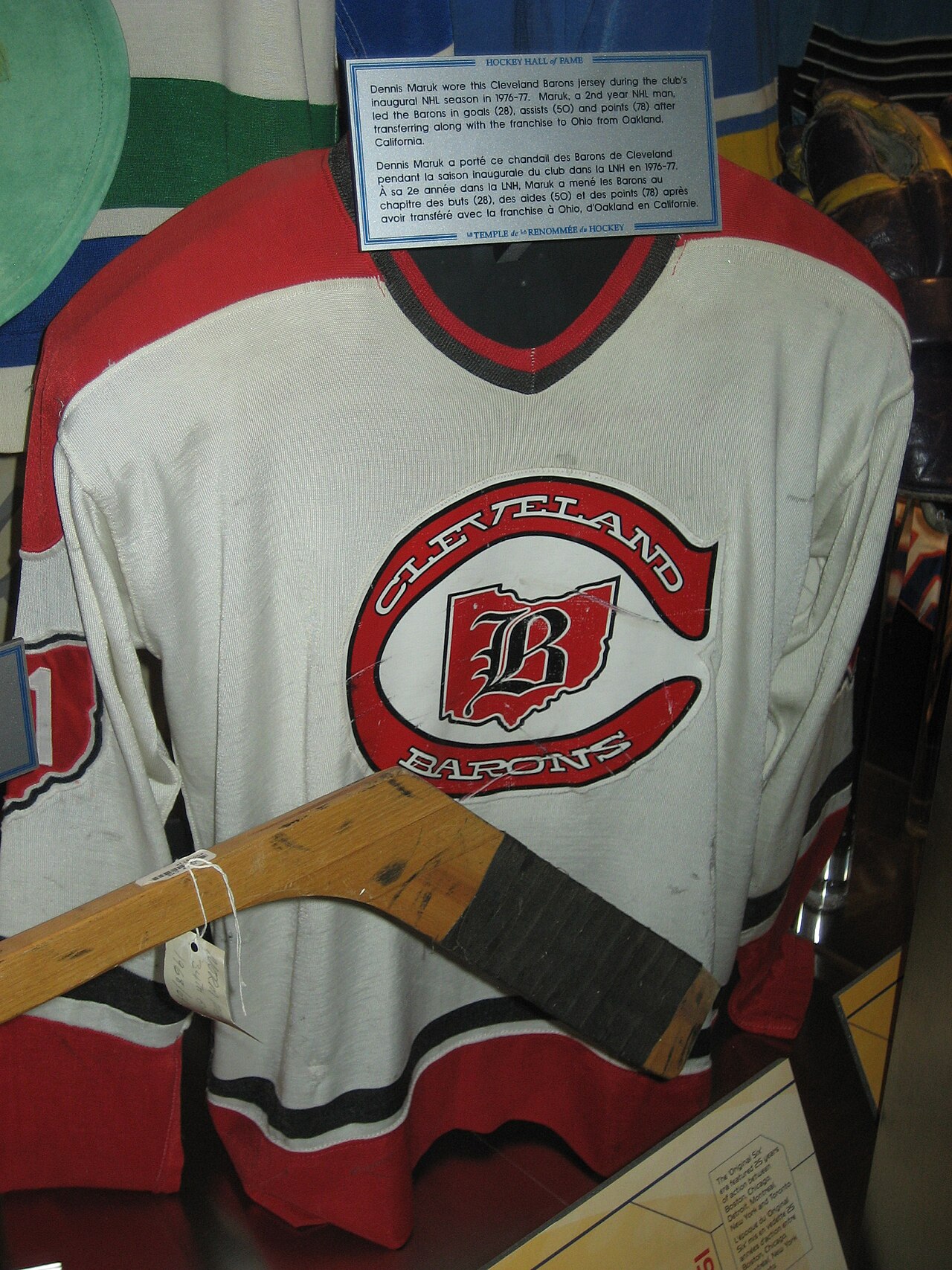
The Cleveland Barons were a professional ice hockey team based in Richfield, Ohio, that competed in the National Hockey League (NHL) as a member of the Adams Division in the Prince of Wales Conference from 1976 to 1978. They are notable as the relocation of the California Golden Seals franchise and for merging with the Minnesota North Stars after just two seasons, making them the last NHL franchise to cease operations until 2024.
Quick Facts
- Team Name
- Cleveland Barons
- Text Color
- #000000
- Founded
- 1967
- History
- California Seals / 1967 / Oakland Seals / 1967–1970 / Bay Area Seals (briefly) / California Golden Seals / 1970–1976 / Cleveland Barons / 1976–1978
- Arena
- Richfield Coliseum
- City
- Richfield, Ohio
- Team Colors
- Red, black, white / #C8102E #111111 #FFFFFF
Facts from the source article.
Lore & Background
The Barons originated as the California Golden Seals, one of the six teams added in the 1967 NHL expansion. The Seals were the least successful of those teams, never posting a winning record and making the playoffs only twice. After multiple sales and poor attendance, owner Melvin Swig moved the franchise to Cleveland for the 1976–77 season, naming it the Barons in honor of the successful American Hockey League team that had won nine Calder Cup titles. The team played at Richfield Coliseum, which had the largest seating capacity in the NHL at 18,544.
The move to Cleveland was approved on July 14, 1976, but details were not finalized until late August, leaving little time for promotion. The Barons never recovered from this lack of visibility; their home opener drew only 8,900 fans, and they drew 10,000 or more in only seven of 40 home games. Attendance was worse than in Oakland. During the 1976–77 season, Swig hinted the team might not finish the season due to payroll difficulties, and players threatened to strike. A last-minute deal involving Swig, the league, and the NHLPA covered salaries. After the season, Swig sold his interest to the Gund brothers.
For 1977–78, the Gunds poured money into the team, and the Barons briefly showed promise, stunning the defending Stanley Cup champion Montreal Canadiens in November 1977 and defeating three top teams in January 1978. However, they crumbled to last place again. The Gunds aggressively marketed the team but attracted only 7,000 total fans during a three-game winning streak. The local economy, hit by the steel crisis, also affected the team.
Reader's Guide
The Cleveland Barons' significance lies in their brief existence as the last NHL franchise to cease operations until 2024. Their two-season tenure was marked by financial instability, poor attendance, and a merger with the Minnesota North Stars that reduced the NHL to 17 teams for the 1978–79 season. The team's struggles reflected broader challenges: the franchise had been the least successful of the 1967 expansion teams, and the move to Cleveland failed to revive it due to insufficient promotion, an unfavorable lease, and a struggling local economy. The Barons' legacy includes being the final NHL team in Ohio until the Columbus Blue Jackets joined in 2000, 22 years later. The article notes that the Barons never came close to filling the Coliseum and that their attendance was worse than in Oakland. The merger with the North Stars ultimately led to the Dallas Stars of today, making the Barons a footnote in NHL history as a failed relocation that could not overcome its origins.
Did You Know?
- The Barons were named after the successful American Hockey League team that won nine Calder Cup titles in Cleveland from 1929 to 1973.
- The team's home opener on October 6, 1976, drew only 8,900 fans to the 18,544-seat Richfield Coliseum.
- During the 1976–77 season, players threatened to strike over unpaid salaries, leading to a last-minute deal involving Swig, the league, and the NHLPA.
- The Barons stunned the defending Stanley Cup champion Montreal Canadiens on November 23, 1977, winning 2-1 before a crowd of 12,859.
From California to Cleveland: A Franchise in Search of a Home
The Cleveland Barons did not begin life in Ohio. They were the California Golden Seals, one of six expansion franchises added to the NHL in 1967 and based in Oakland. The Seals were the weakest of that expansion class, never posting a winning record and reaching the postseason only twice. Off the ice, the situation was even more troubled: the club changed hands three times and spent much of 1974 and 1975 under the direct stewardship of the league. Attendance was so dismal that relocation talk surfaced as early as the franchise's first season, though the NHL's television deal with CBS kept two California teams on the books. In 1975, San Francisco hotel magnate Melvin Swig purchased the Seals for $3.5 million and briefly negotiated a move to a new 17,000-seat arena in San Francisco with Mayor Joseph Alioto. When that plan collapsed, minority owner George Gund III persuaded Swig to relocate the club to his hometown of Cleveland for the 1976–77 campaign. The new team took the name Barons in tribute to the storied AHL franchise that had dominated Cleveland hockey from 1929 to 1973, capturing nine Calder Cup titles before its owner, Nick Mileti, departed for the WHA.
A Coliseum That Never Filled
The Barons played their home games at Richfield Coliseum, a suburban arena in Richfield, Ohio, situated halfway between Cleveland and Akron. The facility had originally been built for the WHA's Cleveland Crusaders and the NBA's Cleveland Cavaliers, and at the time it held the largest seating capacity in the NHL at 18,544. On paper, the move to the Midwest should have revitalized the franchise. Cleveland had been discussed as a potential NHL city as far back as 1935, when the struggling Montreal Canadiens considered relocating there, and the city had been passed over for expansion teams three times during the 1950s and 1960s. The Barons would also sit within striking distance of the Pittsburgh Penguins, Buffalo Sabres, and Detroit Red Wings, offering the potential for natural rivalries. In practice, none of that materialized. The NHL approved the relocation on July 14, 1976, but details were not locked down until late August—less than six weeks before the season opened. There was virtually no time or budget for promotion. The home opener on October 6, 1976, a 2-2 tie with the Kings, drew just 8,900 fans. Across all 40 home games, the Barons drew 10,000 or more in only seven. Attendance was worse than in Oakland and fell short of what the WHA's Crusaders had once pulled at the same venue. An unfavorable lease with the Coliseum compounded the financial strain.
The 1977 Payroll Crisis
The first season in Cleveland nearly ended in the most dramatic fashion possible. During the January 1977 All-Star break, owner Melvin Swig hinted to the Board of Governors that the Barons might not be able to finish the season due to payroll difficulties, requesting a bailout. The board rejected the request almost immediately, as league officials did not believe the situation was as dire as Swig portrayed. In the NHL's history, no team had folded mid-season since the Montreal Wanderers disbanded during the 1917–18 inaugural campaign after their arena burned down. Yet the situation rapidly worsened. The team was sitting on $2.4 million in losses, and workers went unpaid for two months. In February, Swig asked players to accept a 27 percent pay cut. They refused, and the club missed two payrolls. The league seriously considered dissolving the team and holding a dispersal draft, with some Barons players already being courted by rivals. By February 18, the players threatened to refuse to take the ice against the Colorado Rockies. To avert both a player walkout and a mid-season collapse, Swig, the league, and the NHLPA struck a last-minute deal: Swig contributed $350,000, the other 17 owners each put up $20,000, and the NHLPA lent the team $600,000 to cover salaries through the end of the season.
A Long Silence in Ohio
After finishing last in the Adams Division for a second consecutive year, Swig sold his interest to George Gund and his brother Gordon. For the 1977–78 season, the Gunds poured significant money into the roster, and the Barons showed flashes of promise, most notably stunning the defending Stanley Cup champion Montreal Canadiens with a 2-1 victory on November 23, 1977. Yet the franchise could not sustain the turnaround. After just two seasons in Cleveland, the Barons merged with the Minnesota North Stars, now the Dallas Stars, and the NHL operated with 17 teams during the 1978–79 season. The departure left Ohio without an NHL team for an extraordinarily long stretch. The state would not welcome another franchise until the Columbus Blue Jackets entered the league in 2000—a gap of 22 years. Until 2024, the Barons held the distinction of being the last NHL franchise to cease operations, a quiet footnote in the league's history that underscored how briefly and how painfully the team had existed. For the fans of the Richfield Coliseum, those two seasons remain a bittersweet memory of a franchise that arrived with high hopes and departed before it could truly take root.
Gallery
More in Defunct Ice Hockey Teams 1-24
Spotted an error? Know more?
Reader corrections go straight into our review queue. Suggest an edit · How this site is sourced