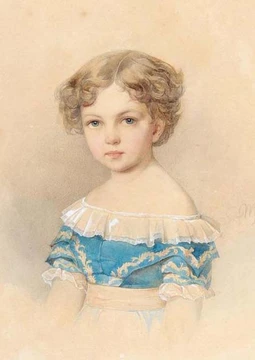
Grand Duchess Anna Petrovna of Russia
Eldest daughter of Peter the Great and mother of Peter III.
Last updated
Grand Duchess Anna Petrovna of Russia (1708–1728) was the eldest daughter of Emperor Peter I and Empress Catherine I. Although she never ascended the throne, her son Peter III became emperor in 1762. She was Duchess Consort of Holstein-Gottorp by marriage.
Early life
Anna Petrovna was born in Moscow on 27 January 1708, the fourth child of the future Catherine I and Peter the Great. All older siblings died in infancy. Her sister Elizabeth, later empress, was born in 1709. Both girls were born out of wedlock; their parents married in 1712, and the daughters were later legitimized.
Their earlier illegitimacy later complicated marriage prospects. Anna grew up in the households of Peter's sister Natalia and Prince Alexander Menshikov. She and Elizabeth were titled princess (tsarevna) on 6 March 1711 and crown princess (tsesarevna) on 23 December 1721. Peter planned to marry his daughters to foreign princes for alliances, so they were educated in literature, writing, embroidery, dancing, and etiquette.
Anna became an intelligent, well-read girl speaking French, German, Italian, and Swedish. Her shyness was noted early: at age fourteen, she blushed when the duke of Holstein-Gottorp tried to kiss her during Easter kisses. Foreign visitors remarked on her uncommon beauty; she had dark eyes, resembled her father, and was considered more level-headed and intelligent than her fair-haired sister.
Marriage
Karl Friedrich arrived in Imperial Russia on 17 March 1721 to meet his future wife and father-in-law. He sought Russian support to retrieve Schleswig from Denmark and hoped for backing in his claims to the Swedish throne, but the Treaty of Nystad prevented Russian interference in Sweden. Another suitor, Prince Louis d’Orléans, Duke of Orléans, was ignored because of a difference in style of address: Anna was Her Imperial Highness, Louis was His Serene Highness.
Anna's name day (3 February) was made a national holiday in 1724, as she was a favorite child of Peter the Great. On 22 November 1724, a marriage contract was signed: Anna and Karl Friedrich renounced all rights to the Russian crown for themselves and their descendants, but a secret clause allowed the emperor to name a successor from any issue of the marriage. Some historians speculate he intended to leave the throne to Anna, but this is unconfirmed.
Catherine I
The wedding party crossed to the Summer Garden, where Mikhail Zemtsov designed a banqueting hall. Tables held delicacies including enormous pies; when the orchestra played, dwarves jumped from the pies and danced on the tables. Toasts were accompanied by cannon fire from a yacht and guards regiments.
The next day, festivities continued at Peterhof. The couple spent two years in Saint Petersburg. Catherine I made her son-in-law a lieutenant colonel of the Preobrazhensky Regiment and a member of the Supreme Privy Council.
He played an important role in Russian politics, and foreign diplomats predicted Anna would be named successor. A quarrel between the duke and Menshikov led to the couple's withdrawal to Holstein on 25 July 1727. Before leaving, Anna was asked to sign a receipt for her dowry, but the government long refused it because it used her old title of Tsesarevna.
Death
Anna gave birth to a son, Carl Peter Ulrich (the future Peter III), in Kiel Castle on 21 February 1728. A few days later, she contracted puerperal fever and died on 4 March 1728 at age twenty. Her husband founded the Order of St Anna in her memory.
Before death, she asked to be buried beside her father in Saint Petersburg. Two ships, the Raphael and the Cruiser, brought her body; the coffin was transported up the Neva on a galley with black crêpe trailing in the water. On 12 November 1728, she was interred next to her parents in the unfinished St Peter and St Paul Cathedral.
Did You Know?
- After arriving in Kiel, her husband Karl Friedrich became rude and drunken, leaving his pregnant wife alone.
- The Order of Saint Anna, established by her husband in 1735, had the motto 'Amantibus Justitiam, Pietatem, Fidem' and its festival day was 3 February.
More in Daughters of Russian Emperors
Sources
Compiled from Wikipedia and the sources listed below. Text from Wikipedia is available under CC BY-SA 4.0; this entry is adapted from it.
- Wikipedia: Grand Duchess Anna Petrovna of Russia (CC BY-SA 4.0).
Spotted an error? Know more?
Reader corrections go straight into our review queue. Suggest an edit · How this site is sourced