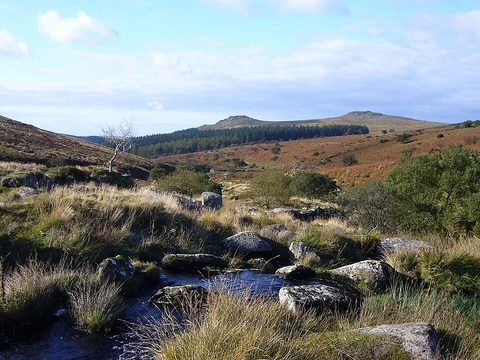
Buckland Beacon
Granite tor with carved Ten Commandments and a Jubilee Stone.

via Wikipedia: Buckland Beacon · see source
High on Dartmoor, the granite tor of Buckland Beacon rises 382 metres above the Dart Valley. Named for its historic role as a warning fire beacon, it overlooks the village of Buckland-in-the-Moor. Its southeastern edge is carved with the Ten Commandments Stones.
Quick Facts
- Elevation (m)
- 382
- Location
- Dartmoor, England
- Easiest route
- From Cold East Cross
Facts from the source article.
The Ten Commandments stones
The Ten Commandments carved into the rocks around Buckland Beacon were a project started in 1927 by William Whitley, the landowner and Lord of Buckland Manor who lived at Wellstor. Local sculptor WA Clement did the carving, using the current prayer book as his guide, and finished in 1928. Whitley, a staunch Protestant, ordered the stones after hearing about plans to change the Book of Common Prayer, which he felt would bring the Church of England closer to Catholic practices. The rocks also note the two dates the proposed revisions were defeated in the House of Commons, include a verse from a hymn and John 13:34, and record the carving’s start and end dates: December 15, 1927 to June 14, 1928. Weather has worn the lettering, requiring several recuts, the latest in 2016 costing £16,000.
Jubilee stone
A further carved rock on the summit, the Jubilee Stone, was inscribed for the Silver Jubilee of George V. Unlike the Ten Commandments rocks, it has not been maintained and is now barely visible. Its inscription states 1282ft, nearly 50 ft shorter than the actual height recorded by Ordnance Survey. The beacon was used for fire beacon chains for the millennium celebrations in 2000 and for subsequent jubilees of Queen Elizabeth II.
More in Dartmoor
Spotted an error? Know more?
Reader corrections go straight into our review queue. Suggest an edit · How this site is sourced