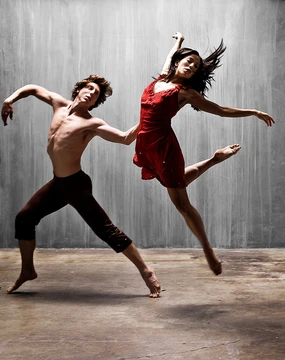
Social dance
Dances for participation, not performance, across cultures and eras.
Last updated
Dances with social functions and contexts are created for people to join in rather than to watch as a show.[1] While often done just for fun and to connect with others, these dances can also serve ceremonial, competitive, or erotic purposes.[1] What people dance at social events shifts along with the prevailing social attitudes.[2]
Key facts and history
During the Baroque Era court balls served to display social status.[3] A Brussels manuscript describes the basse dance, a Burgundian court dance that became popular across Europe.[3] Near the end of the Napoleonic Wars, the waltz reached Britain; it was a partner dance where couples held each other much closer than was previously thought proper.[3] A novel aspect of the waltz was that neither partner led, and individuals danced as equals.[3]
Dancing to recorded music became more common after the phonograph record was introduced, with radio stations, jukeboxes, and sock hops all using records for dancing.[4] During the 1950s, rock 'n' roll made social dancing more rebellious, particularly among teenagers.[3]
What the cited sources add
According to Young, salsa dancing today is the most popular partner dance in the world.[5] The Salsa Kings account states that Latin dance draws from a rich blend of indigenous American, Iberian, and West African influences.[6] A UCLA Frontera Collection article notes that the cha-cha-cha got its name from the sound of the dancers’ feet shuffling on the floor while doing the quick three-step section.[7] The United States Patent and Trademark Office account states that Johnny Pacheco popularized a New York version of Cuban dance music by founding Fania Records in the 1960s.[8]
The same source notes that Pacheco and his business partner selected the word "salsa" as the genre's convenient, memorable, marketable identifier in the late 1960s.[8]
References
- Wikipedia, "Social dance" (CC BY-SA 4.0), which cites: Origins; Dance Terminology Notebook. Skippy Blair. 1994. Altera Publishing. page 65. . (original not read by us) en.wikipedia.org
- Wikipedia, "Social dance" (CC BY-SA 4.0), which cites: Jonas, "Dancing", Abrams Books, p. 108–126; Powers, "Brief Histories of Social Dance", Social Dance at Stanford (we also read that source) en.wikipedia.org
- Wikipedia, "Social dance" (CC BY-SA 4.0), which cites: Powers, "Brief Histories of Social Dance", Social Dance at Stanford (we also read that source) en.wikipedia.org
- Wikipedia, "Social dance" (CC BY-SA 4.0), which cites: Borgerson, "Designed for Dancing: How Midcentury Records Taught America to Dance.", MIT Press, 2021 (we also read that source) en.wikipedia.org
- Young, "History of Salsa Dance: Origins of Salsa", Salsa Vida, 26 June 2023. facts only, no text reused. salsavida.com
- "Latin Dance: A Fusion of Culture, History, and Music", Salsa Kings. facts only, no text reused. salsakings.com
- "Genre History: Everybody Does the Cha-Cha-Cha", UCLA Frontera Collection, October 2016. facts only, no text reused. frontera.library.ucla.edu
- "Inventing salsa", United States Patent and Trademark Office. facts only, no text reused. uspto.gov
Each numbered sentence above was checked against the source it cites before publication. Sentences citing Wikipedia adapt text from the English Wikipedia article Social dance (contributors), used under CC BY-SA 4.0; this entry is available under the same licence. Other sources were used for facts only; no text or images are copied from them.
Also in the Codexery
More in Dance
Sources
Compiled from Wikipedia and the sources listed below. Text from Wikipedia is available under CC BY-SA 4.0; this entry is adapted from it.
- Wikipedia: Social dance (CC BY-SA 4.0).
Spotted an error? Know more?
Reader corrections go straight into our review queue. Suggest an edit · How this site is sourced