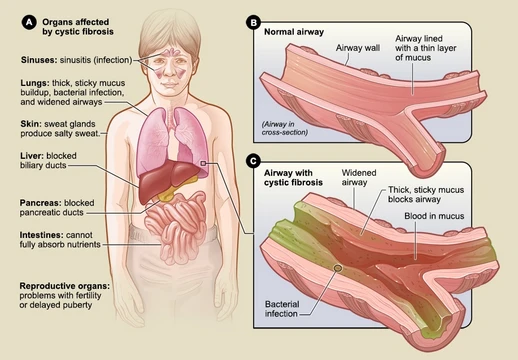
Cystic fibrosis transmembrane conductance regulator
Anion channel whose mutations cause cystic fibrosis.
The CFTR gene, discovered in 1989 by Lap-Chee Tsui’s team, encodes a protein that forms an anion channel in vertebrate cell membranes. This channel moves chloride and bicarbonate ions across epithelial surfaces. When mutations disrupt this channel, it upsets mucus transport in organs like the lungs and pancreas, leading to cystic fibrosis.
Quick Facts
- Gene location
- Chromosome 7, long arm at position q31.2, from base pair 116,907,253 to base pair 117,095,955
- Number of exons
- 27
- Most common mutation
- Delta F508 (ΔF508)
- Gene length
- Approximately 189 kb
Facts from the source article.
Did You Know?
- The CFTR gene is approximately 189 kb in length, with 27 exons and 26 introns.
- The ion channel only opens when its R-domain has been phosphorylated by PKA and ATP is bound at the NBDs.
- The combination vanzacaftor/tezacaftor/deutivacaftor (brand name Alyftrek) was approved for medical use in the United States in December 2024.
Tissue and intracellular localization
The CFTR protein is located in epithelial cells throughout the body, such as those in the lungs, liver, pancreas, digestive tract, and both male and female reproductive systems. In male reproductive tissues, it appears in the testis, Sertoli cells, spermatozoa, epididymis, and vas deferens. Within the lung airways, CFTR is most abundant in specialized pulmonary ionocytes. In the skin, it is heavily present in sebaceous and eccrine sweat glands, specifically on the apical membrane of the duct-lining epithelial cells.
Normally, CFTR moves negatively charged chloride, bicarbonate, and thiocyanate ions out of the cell into the airway surface liquid and mucus. Sodium ions then follow passively, raising the electrolyte concentration and drawing water out by osmosis. In bronchial and oviduct cells with motile cilia, CFTR sits on the apical membrane but not on the cilia themselves, while the ENaC channel lines the entire cilia. When CFTR is defective in sweat glands, it reduces sodium chloride and sodium thiocyanate transport in the resorptive duct, making sweat saltier—a basis for the diagnostic sweat test used alongside genetic screening.
Gene
The CFTR gene is found on chromosome 7, on the long arm at position q31.2, from base pair 116,907,253 to base pair 117,095,955. CFTR orthologs occur in jawed vertebrates. Each individual inherits two copies of the CFTR gene, but some inherited copies have been altered. So far, the CFTR gene has been associated with over 700 distinct mutations.
An individual with CF inherits two defective copies, which may be heterozygous (two different mutations) or homozygous (the same mutation). Delta F508 is the most common mutation, accounting for more than 70% of all mutations; those homozygous for Delta F508 are commonly affected by pancreatic insufficiency. The CFTR gene has been used as a nuclear DNA phylogenetic marker in animals, and large genomic sequences have explored the phylogeny of major mammal groups.
Nearly 1000 cystic fibrosis-causing mutations have been described. The vast majority of mutations are infrequent, and their distribution varies among populations, affecting genetic screening and counseling.
Location and function
The CFTR gene is made up of 27 exons and is found on the long arm of chromosome 7 at locus 31.2. CFTR functions as a phosphorylation and ATP-gated anion channel, increasing conductance for certain anions to flow down their electrochemical gradient. ATP-driven conformational changes open and close a gate to allow transmembrane flow of anions, in contrast to other ABC proteins where ATP-driven changes fuel uphill substrate transport. CFTR consists of five domains: two transmembrane domains, each linked to a nucleotide-binding domain, and a regulatory domain.
In CFTR, alternating between inward-facing and outward-facing conformations results in channel gating. NBD dimerization, favored by ATP binding, is coupled to transition to an outward-facing conformation forming an open transmembrane pathway for anions. Subsequent hydrolysis at the canonical active site destabilizes the NBD dimer and favors return to the inward-facing conformation, closing the anion permeation pathway.
Related conditions
Congenital bilateral absence of vas deferens: Males with this condition most often have a mild mutation in one copy of the CFTR gene and a cystic fibrosis-causing mutation in the other copy. Cystic fibrosis: More than 1,800 mutations in the CFTR gene have been found, but most have not been associated with cystic fibrosis. The most common mutation, ΔF508, is a deletion of one amino acid at position 508, causing the altered protein to be degraded shortly after it is made. All disease-causing mutations prevent the channel from functioning properly, blocking salt and water movement into and out of cells, leading to thick, sticky mucus that obstructs airways and glands. Cholera: ADP-ribosylation caused by cholera toxin increases cyclic AMP, which opens the CFTR channel, leading to oversecretion of Cl−; Na+ and H2O follow into the small intestine, causing dehydration and electrolyte loss.
More in Cystic Fibrosis
Spotted an error? Know more?
Reader corrections go straight into our review queue. Suggest an edit · How this site is sourced