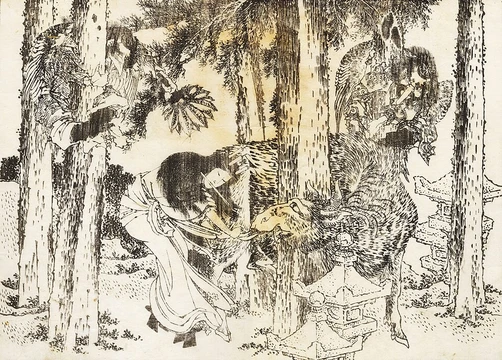
Cursing of the fig tree
A prophetic act of judgment against spiritual barrenness.
The fig tree incident appears in three of the four Gospels, but not in John. In Mark and Matthew, it is a miracle that occurs around the time Jesus enters Jerusalem. In Luke, it is told as a parable. The fig tree was an Old Testament symbol for Israel, so the story in Mark and Matthew, along with the parallel in Luke, is understood as a symbolic criticism of the Jewish people who rejected Jesus as the Messiah.
Commentary
In Jewish scripture, the fig tree’s fruit often symbolizes the bond between God and his people. A barren fig tree stands for sterility, while the messianic age is envisioned as a time when each person can sit safely under their own fig tree. The sages of the Mishna and Talmud interpreted the phrase “a land flowing with milk and honey” as referring to fig sap or milk. The accounts in Mark and Matthew of Jesus cursing a fig tree, along with Luke’s parallel story, are therefore seen as symbolic acts aimed at Jews who rejected Jesus as king. At first glance, destroying a fig tree seems out of character for Jesus—Bertrand Russell even used this tale to question Jesus’ greatness—but these miracle stories target property, not people, and function as a prophetic act of judgment.
John McEvilly, a Catholic commentator, views the episode as a prophetic parable. He notes that Jesus had previously performed miracles to show his merciful benevolence, but here he also strengthens his disciples’ faith by revealing the severity of his justice. By cursing the fig tree, Jesus demonstrates his justice toward sinners who fail to produce the expected fruits of grace. Although one normally expects fruit from a tree only in its season, God always has the right to expect righteousness and piety from humanity. McEvilly adds that as punishment for our sterility, God may strike us with even greater spiritual barrenness and decay.
The fruit of the Tree of the Knowledge of Good and Evil has traditionally been identified as a fig, based on the passage in Genesis where Adam and Eve sew fig leaves to make clothing. Some commentators link this to Jesus cursing the fig tree, interpreting it as an attack on the source of sin and death—an act occurring just days before the Crucifixion, when Jesus conquers death, as referenced in 1 Corinthians 15.
More in Curses
Spotted an error? Know more?
Reader corrections go straight into our review queue. Suggest an edit · How this site is sourced