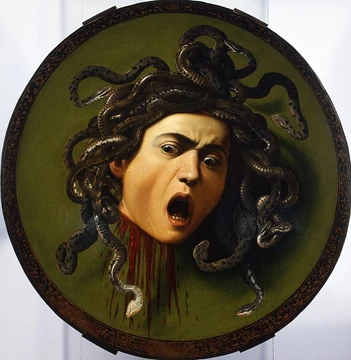
Perseus with the Head of Medusa
Cellini's bronze of Perseus triumphing over Medusa.
Perseus with the Head of Medusa is a bronze sculpture created by Benvenuto Cellini between 1545 and 1554. Commissioned by the second Florentine duke, Cosimo I de' Medici, it stands in the Loggia dei Lanzi in Florence's Piazza della Signoria. The work is notable for its innovative use of bronze and its political connections to the other sculptures in the piazza.
Quick Facts
- Artist
- Benvenuto Cellini
- Date
- 1545–1554
- Medium
- Bronze
- Location
- Loggia dei Lanzi, Piazza della Signoria, Florence, Italy
- Commissioned by
- Cosimo I de' Medici, second Florentine duke
- Public unveiling
- 27 April 1554
- Subject
- Perseus beheading Medusa
Facts from the source article.
Background
Cellini was the first to incorporate narrative relief into the sculpture of the piazza. The Perseus, installed in the Loggia, influenced the dimensions of later pedestals there, such as that of Giambologna's Rape of the Sabine Women. The sculpture added to the assembly of Olympian gods protecting the Medici. The pedestal beneath the round sculpture may not have been Cellini's original intent, as the relief was still being completed after the bronze above was revealed.
The Medici dominated the pedestal's theme, with Perseus serving as an allegory for Duke Francesco Medici. The politics of the Medici and Florence dominate the piazza, referencing the first three Florentine dukes. Duke Alessandro I's Hercules and Cacus received a poor public reception in 1534. Cosimo I was cautious about the reaction to Cellini's Perseus, but the public received it well as he watched from a window in the Palazzo Vecchio.
The third duke is linked to the relief panel: Perseus symbolizes Duke Francesco, and Andromeda his Habsburg bride, Giovanna. Andromeda also allegorizes Florence, with Perseus representing the Medici saving the city. Cellini depicted the sad side of Andromeda's story, focusing on the Medici as saviors. Every sculpture in the piazza relates politically or artistically to one another and to the Medici.
The work
When Cellini began work on his Perseus, bronze had not been used for a large-scale statue in about fifty years. He deliberately chose this material because the act of pouring molten metal into the mold felt like giving the sculpture life-giving blood, and the greatest challenge was to complete the entire cast in a single pour. Donatello’s Judith and Holofernes, already standing in the Loggia dei Lanzi, was also bronze but had been cast in separate pieces and joined.
Cellini was competing with marble giants like Michelangelo’s David and wanted to make a statement for both himself and his patron, Cosimo I. According to Cellini’s own account, his assistants let the metal clot, and only his intervention saved the work from ruin. One scholar argues that Cellini did more than revive the piece—he raised it from the dead, meaning his salvation came from remelting the bronze. Cellini also compared his act to Christ, breathing life into the sculpture.
Casting Perseus was not just about fulfilling Cosimo’s commission; it was Cellini proving himself to Florence in a medium he had revived. The work had two purposes: to respond to the other statues in the piazza, using Medusa’s power to turn men to stone, and to represent the Medici family through Perseus, both in the main statue and the relief below. Cellini also made a personal statement through the casting process itself. A bronze copy was made in the early 1800s and placed at Trentham Gardens in Staffordshire, England around 1840, where it is now a Grade II listed structure.
More in Cultural Depictions of Medusa
Spotted an error? Know more?
Reader corrections go straight into our review queue. Suggest an edit · How this site is sourced