America on Parade
A bicentennial parade with telescoping floats and a Sherman Brothers song.
Last updated
America on Parade was a parade created for Disneyland and the Magic Kingdom to commemorate the United States Bicentennial, as well as the 20th anniversary of Disneyland and the 5th anniversary of the Magic Kingdom. It was directed by Disneyland's Director of Entertainment, Bob Jani, with float units designed by New York theatrical designer Peter Larkin. The parade ran from the summer of 1975 through 1977, traveling the full length of each park.
Quick Facts
- Created for
- Disneyland and the Magic Kingdom
- Occasion
- United States Bicentennial
- Disneyland's 20th anniversary
- Magic Kingdom's 5th anniversary
- Director
- Bob Jani
- Float designer
- Peter Larkin
- First run
- Summer of 1975
- Original run through
- 1977
- Parade route (disneyland)
- From It's a Small World to Town Square
Facts from the source article.
Soundtrack
The Sherman Brothers, who had left Disney Studios for independent film companies, wrote a song for the American Bicentennial titled "The Glorious Fourth," performed as part of the parade. The parade featured synchronized music with set routines choreographed by Barnett Ricci and Marilyn Magness.
Performers wore costumes appropriate to their float and enormous heads supported by a custom apparatus, giving a carnival appearance. Don Dorsey created the soundtrack as his first Disney project, using synthesizers and antique carousel organs. During the parade's run, Dorsey conceptualized a system later developed by Disney as "Mickey Track," a computer-controlled system for parade music installed at Tokyo Disneyland in 1983, Disneyland Paris in 1992, and Hong Kong Disneyland in 2005.
Floats
On less busy days in 1975 and 1976, some non-holiday units were cut; the "School Days" float was cut during summer and December. The "Spirit of '76" starting float featured Mickey Mouse, Donald Duck, and Goofy standing on a drum next to an eagle float, with Mickey holding a variant of the Stars and Stripes; Donald played the flute and Goofy a hand-made drum. "Columbus's Ship" resembled a pirate ship. "The First Thanksgiving" was represented by a giant turkey puppet and shown after Columbus's Ship and Benjamin Franklin only in November.
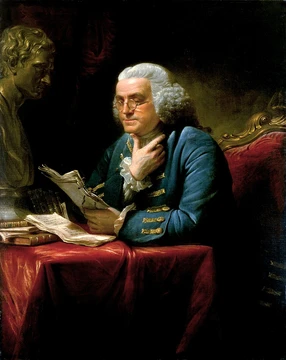
The "Salem Witch Trials" float featured two costumed characters about to be executed with another preparing the execution, shown after Columbus's Ship and Benjamin Franklin only in October. The "Benjamin Franklin" float depicted Franklin flying a kite without lightning, referencing his 1752 kite experiment. Other floats included Dunking Stall, Square Dancing, Giant Bell, Giant Cannons, Betsy Ross (raising the flag in June 1776), Rowing Boat, Riverboat, Stagecoach, Discovery of Gold, Voting Rights, Sunday Band Concert, School Days (cut in December and summer), Transportation, Sports, Sunday Picnic, Modern Tech, a Disney unit for the 20th anniversary (moved to Magic Kingdom for its fifth anniversary after 1976), Snow White and the Seven Dwarfs, Television, The Movie Industry, Circus Comes to Town, Hot Air Balloons, and Statue of Liberty and the Golden Eagle.
Accidents
In 1976, an unidentified woman sued the Disney Parks Corporation, claiming that one of the Three Little Pigs at the It's a Small World end of the parade route grabbed and fondled her. She alleged she gained 50 pounds as a result and sought $150,000 in damages for assault and battery, false imprisonment, and humiliation. The plaintiff dropped charges after Disney's lawyers presented a photo of the costume, which had only inoperable stub arms, a common feature among shorter characters later eliminated.
More in Cultural Depictions of Benjamin Franklin
Sources
Compiled from Wikipedia and the sources listed below. Text from Wikipedia is available under CC BY-SA 4.0; this entry is adapted from it.
- Wikipedia: America on Parade (CC BY-SA 4.0).
Spotted an error? Know more?
Reader corrections go straight into our review queue. Suggest an edit · How this site is sourced