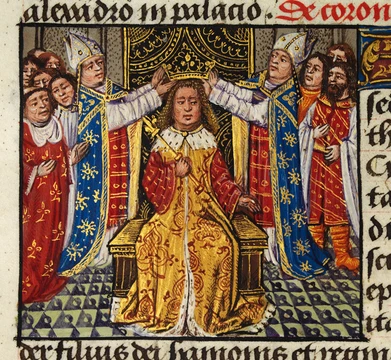
King Alisaunder
A Middle English romance of Alexander the Great.
Last updated

via Wikipedia: King Alisaunder · see source
King Alisaunder is a Middle English romance built from roughly 4,000 octosyllabic couplets, tracking Alexander the Great from his early years through his victories over the Persian king Darius and other foes, his exploration of Eastern marvels, and his sudden death. George Saintsbury called it “one of the most spirited of the romances,” while W. R. J. Barron praised its “shrewd mixture of entertainment and edification made appetizing by literary and stylistic devices of unexpected subtlety.”
Quick Facts
- Form
- Octosyllabic couplets
- Length
- About 4,000 couplets
- Surviving manuscripts
- 3
- Earliest print
- c. 1525
- Reference edition
- G. V. Smithers' Kyng Alisaunder (1951, 1957)
Facts from the source article.
Manuscripts
The romance survives in enough copies to show it had some popularity in late medieval England. The fullest and most trustworthy text sits in Bodleian Library MS. Laud Misc. 622. Two other manuscripts hold the poem: Lincoln's Inn Library MS.
150 and National Library of Scotland MS. Advocates' 19.2.1, known as the Auchinleck manuscript. A lone early print from about 1525 exists only as a very fragmentary copy bound into a volume called “The Bagford Ballads.”
Editions
Back in 1774 Thomas Warton wrote in his History of English Poetry that King Alisaunder “deserves to be published entire on many accounts.” Thomas Park and George Ellis planned to work together on such an edition but never finished it. Henry Weber first edited the poem in 1810 for his Metrical Romances of the Thirteenth, Fourteenth, and Fifteenth Centuries, relying mostly on the weaker Lincoln's Inn manuscript. G. V. Smithers' Kyng Alisaunder, issued by the Early English Text Society as volumes 227 and 237 of their Original Series (1951, 1957), drew on all three manuscripts plus the Bagford Ballads print and stays the reference edition.
Did You Know?
- The poem's length varies between its two main manuscripts.
- The author is unknown but probably lived in or around London.
- Some scholars think the same writer also composed Richard Coer de Lyon, Arthour and Merlin, and The Seven Sages of Rome.
- The romance is based on the Anglo-Norman Roman de Toute Chevalerie.
More in Cultural Depictions of Alexander the Great
Sources
Compiled from Wikipedia and the sources listed below. Text from Wikipedia is available under CC BY-SA 4.0; this entry is adapted from it.
- Wikipedia: King Alisaunder (CC BY-SA 4.0).
Spotted an error? Know more?
Reader corrections go straight into our review queue. Suggest an edit · How this site is sourced