Crystallographic defect
Imperfections in the regular atomic arrangement of crystalline solids.
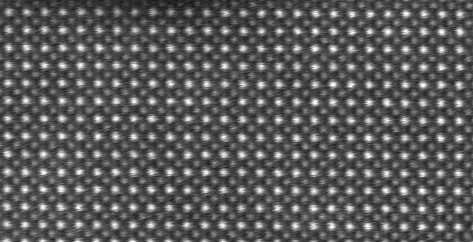
The positions and orientations of particles in crystals exhibit a periodic structure, but this is usually imperfect.[1] In crystalline solids, the regular atomic or molecular arrangement is sometimes broken, and such a break is termed a crystallographic defect.[1] Common categorizations of these imperfections include point, line, planar, and bulk defects.[1]
Quick Facts
- Known for
- Classification of point
- line
- planar
- and bulk defects in crystals
Facts from the source article.
Key facts and history
Disclinations were first noticed a century ago but had been considered "just a curiosity," according to Demkowicz.[2] The stress fields of disclinations "can be so strong, they actually reverse what an applied load would do," Demkowicz says.[2] A successful mathematical classification method for physical lattice defects is homotopy theory, a branch of topology.[3] Linear defects known as dislocations cause the atoms in a crystal lattice to be out of proper alignment.[4]
Edge and screw dislocations constitute the two fundamental categories of these linear defects.[4] When one follows the crystal's orientation around a disclination, a rotational change is observed.[5] According to recent findings, disclinations may play a part in solid materials, for instance by enabling cracks to self-heal.[5] Computer simulations of defects in solids frequently employ density functional theory, classical molecular dynamics, and kinetic Monte Carlo methods.[6]
What the research sources say
The tracer self-diffusion data for fcc and refractory bcc metals are briefly reviewed with respect to monovacancy formation and migration properties.[7] While the atomic-defect mechanism for low-temperature self-diffusion can be reliably attributed to monovacancies, the mechanisms for high-temperature mass transport are not so easily defined.[7] Both divacancies and interstitials must be seriously considered for high-temperature mass transport.[7]
References
- Wikipedia, "Crystallographic defect" (CC BY-SA 4.0), which cites: Ehrhart, P. (1991) Properties and interactions of atomic defects in metals and alloys , volume 25 of Landolt-Börnstein, New Series III, chapter 2, p. 88, Spring; Siegel, R. W. (1982) Atomic Defects and Diffusion in Metals, in Point Defects and Defect Interactions in Metals, J.-I. Takamura (ED.), p. 783, North Holland, Am; "Point Defects in Solids", Plenum Press, 1975; Watkins, G. D. (1997) "Native defects and their interactions with impurities in silicon", p. 139 in Defects and Diffusion in Silicon Processing, T. Diaz de la R (w en.wikipedia.org
- "Chandler, David L., Cracked metal, heal thyself, MIT news, October 9, 2013", 9 October 2013. facts only, no text reused. mit.edu
- Wikipedia, "Crystallographic defect" (CC BY-SA 4.0), which cites: Mermin, "The topological theory of defects in ordered media", Reviews of Modern Physics, 1979, p. 591–648 (we also read that source) en.wikipedia.org
- Wikipedia, "Crystallographic defect" (CC BY-SA 4.0), which cites: "Theory of dislocations", Krieger Pub Co, 1992 (we also read that source) en.wikipedia.org
- Wikipedia, "Crystallographic defect" (CC BY-SA 4.0), which cites: "Chandler, David L., Cracked metal, heal thyself, MIT news, October 9, 2013", 9 October 2013 (we also read that source) en.wikipedia.org
- Wikipedia, "Crystallographic defect" (CC BY-SA 4.0), which cites: Cai, "Intrinsic mobility of a dissociated dislocation in silicon", Phys. Rev. Lett., 2000, p. 3346–3349; Ashkenazy, "Irradiation Induced Grain Boundary Flow—A New Creep Mechanism at the Nanoscale", Nano Letters, 2012, p. 4084–9; Mayr, "Mechanisms of radiation-induced viscous flow: Role of point defects", Phys. Rev. Lett., 2003; Nordlund, "Strings and interstitials in liquids, glasses and crystals", Europhys. Lett., 2005, p. 625–631; Korhonen, "Vacancy formation energies for fcc and bcc transition metals", Phys. Rev. B, 1995, p. en.wikipedia.org
- Siegel, R. W. (1982) Atomic Defects and Diffusion in Metals, in Point Defects and Defect Interactions in Metals, J.-I. Takamura (ED.), p. 783, North Holland, Am. facts only, no text reused. osti.gov
Each numbered sentence above was checked against the source it cites before publication. Sentences citing Wikipedia adapt text from the English Wikipedia article Crystallographic defect (contributors), used under CC BY-SA 4.0; this entry is available under the same licence. Other sources were used for facts only; no text or images are copied from them.
More in Crystallography
Spotted an error? Know more?
Reader corrections go straight into our review queue. Suggest an edit · How this site is sourced