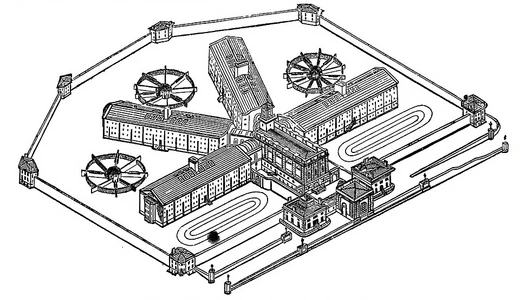
Punishment
Punishment is an imposed response to norm-breaking.
It is used both within criminal justice and in settings such as child discipline or relationships.[1][2] Punishments can range from reprimands and fines to incarceration and the death penalty.[3] An undesirable or unpleasant outcome is imposed on an individual or group as a response for breaking some norm or rule.[1]
Quick Facts
- Field
- Philosophy
- Psychology
- Sociology
- Evolutionary Biology
- Known for
- Justification and definition of punishment across disciplines
- Scope
- Criminal justice
- child discipline
- operant conditioning
- social cooperation
Facts from the source article.
Key facts and history
Philosophers have long debated whether legal punishment can be justified, with abolitionist theorists arguing it should be replaced rather than justified.[4] Retributivist accounts hold that punishment is justified as a deserved response to wrongdoing.[5] Positive retributivism states that an offender's desert provides a reason in favor of punishment.[4] Negative retributivism provides a constraint: punishment should be imposed only on those who deserve it and in proportion to their desert.[5]
In psychology, B.F. Skinner introduced a more restrictive definition where punishment is determined by a reduction in behavior.[6][7] In operant conditioning, punishment does not require pain or fear; a spoken disapproval that decreases behavior qualifies.[7] Punishment has been observed in all species of social animals and is considered an evolutionarily stable strategy.[8] Legal punishment, as described in one source, involves imposing something intended to be both burdensome and reprobative on a supposed offender for a supposed crime, by a person or body claiming authority to do so.[5]
Consequentialist accounts justify punishment as a cost-effective means to certain independently identifiable goods.[4]
What the cited sources add
It also notes that legal punishment expresses censure or condemnation that the offender's crime warrants.[5] Consequentialist punishment faces objections that crime-reductive efficiency does not suffice to justify a system.[4] A more recent objection charges that consequentialist systems treat offenders as dangerous outsiders who must be threatened or incapacitated.[4] Free will skepticism holds that people's behavior is product of determinism or chance, undermining desert-based punishment.[4]
The Stanford Encyclopedia adds that some argue offenders forfeit certain rights, legitimizing treatment that would normally be wrong.[4] Legal punishment presupposes crime as that for which punishment is imposed, a criminal law that defines crimes, and a state with political authority to make and enforce law and impose punishments.[5]
References
- Wikipedia, "Punishment" (CC BY-SA 4.0), which cites: Edwards, "The salvation of all men strictly examined: and the endless punishment of those who die impenitent : argued and defended against the objections and reasonings of the late Rev. Doctor Chauncy, of Boston; in his ; Bingham, "Volume 1 of A Scholastical History Of The Practice of the Church In Reference to the Administration of Baptism By Laymen", A Scholastical History of the Practice of the Church in Reference to the Administration; P., "Two definitions of punishment.", The Behavior Analyst Today, 2005, p. 43–47; Grotius, "H. Grotius en.wikipedia.org
- Wikipedia, "Punishment" (CC BY-SA 4.0), which cites: Lee Hansen, "Old Fort Snelling, 1819-1858", Mid-America Series, 1918, p. 124 (original not read by us) en.wikipedia.org
- Wikipedia, "Punishment" (CC BY-SA 4.0), which cites: J.M., K.M, P.H., "Incapacitation and just deserts as motives for punishment.", Law and Human Behavior, 2000, p. 659–683; Ross, "Reintegrative Retributivism", Modern Law Review, 2025; W.M., "Skin conductance response to punishment as a predictor and correlate of learning to avoid two classes of punishment.", Journal of Abnormal Psychology, 1976, p. 498–504; J.A., "A discrimination based on punishment.", The Quarterly Journal of Experimental Psychology, 1952, p. 27–45; M. E., F. D., "The influence of punishment during learning upon retroactive en.wikipedia.org
- Hoskins, "Legal Punishment", Stanford Encyclopedia of Philosophy, 2024. facts only, no text reused. plato.stanford.edu
- Hugo, "Punishment, Crime and the State", February 19, 2010. facts only, no text reused. plato.stanford.edu
- Wikipedia, "Punishment" (CC BY-SA 4.0), which cites: W, J.C, "Affective consequences of social reinforcement, punishment, and neutral behavior.", Developmental Psychology, 1980, p. 100–104; J. P., "Learning theory and identification: II. The role of punishment.", The Journal of Genetic Psychology: Research and Theory on Human Development, 1954, p. 201–210 (original not read by us) en.wikipedia.org
- Wikipedia, "Punishment" (CC BY-SA 4.0), which cites: Leaf, "Concerns About ABA-Based Intervention: An Evaluation and Recommendations", Journal of Autism and Developmental Disorders, June 2022, p. 2838–2853; I, "The effect of the initial chances for right responses upon the efficacy of intensified reward and of intensified punishment.", Journal of Experimental Psychology, 1933, p. 362–373; Church, "The varied effects of punishment on behavior", Psychological Review, 1963, p. 369–402 (original not read by us) en.wikipedia.org
- Wikipedia, "Punishment" (CC BY-SA 4.0), which cites: T.H., G.A., "Punishment in animal societies", Nature, 1995, p. 209–216; "Corrections: A Text/Reader", Sage, 2008, p. 3; Fehr, Gätcher, "Altruistic punishment in humans", Nature, 10 January 2002, p. 137–140 (original not read by us) en.wikipedia.org
Each numbered sentence above was checked against the source it cites before publication. Sentences citing Wikipedia adapt text from the English Wikipedia article Punishment (contributors), used under CC BY-SA 4.0; this entry is available under the same licence. Other sources were used for facts only; no text or images are copied from them.
More in Crime & Justice
Spotted an error? Know more?
Reader corrections go straight into our review queue. Suggest an edit · How this site is sourced