Soyuz 22
Earth sciences mission with a modified ASTP backup spacecraft.
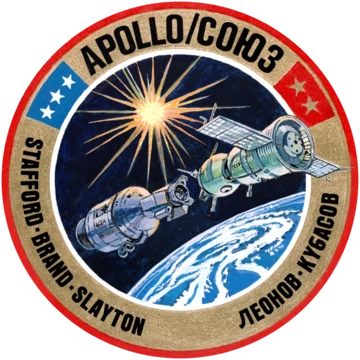
Soyuz 22 was a Soviet crewed spaceflight launched in September 1976, dedicated to Earth sciences. It used a refurbished Soyuz spacecraft that had been a backup for the Apollo-Soyuz Test Project. The mission carried cosmonauts Valery Bykovsky and Vladimir Aksyonov, who spent a week photographing the Earth's surface.
Quick Facts
- Operator
- Soviet space program
- Mission duration
- 7 days 21 hours 52 minutes 17 seconds
- Orbits completed
- 127
- Spacecraft
- Soyuz 7K
- Manufacturer
- NPO Energia
- Launch mass
- 6,570 kg / 14,484 lb
- Landing mass
- 1,200 kg / 2,646 lb
- Launched
- 15 September 1976; 09:48:30 UTC
Facts from the source article.
Mission highlights
Soyuz 22 launched to an unusually high inclination of 64.75°, not used since the Voskhod program. However, the MKF-6 multispectral camera, built by Carl Zeiss-Jena, which took six simultaneous photographs, indicated to others that reconnaissance was a minor part. The inclination maximized ground coverage, especially of East Germany. Two orbit changes occurred within 24 hours: the first on the fourth orbit adjusted the orbit to 250 by 280 km, and the second on the sixteenth orbit circularized it to 251 by 257 km. Stated objectives were to check and improve methods for studying geological features for the Soviet and East German economies. The vehicle replaced the APAS-75 docking system with the MKF-6 camera. One cosmonaut controlled the camera from the Orbital module while the other changed orientation from the Descent module.
More in Crewed Soyuz Missions
Spotted an error? Know more?
Reader corrections go straight into our review queue. Suggest an edit · How this site is sourced