Frequently Asked Questions
The most-asked questions about crewed shenzhou missions.
What exactly are the crewed Shenzhou missions?
They are China's series of human spaceflight operations, run by the China National Space Administration, that carry taikonauts to and from low Earth orbit. The program kicked off with Shenzhou 5 in 2003 and has since become the standard way to deliver crews to the Tiangong space station.
Who are the taikonauts and who oversees the program?
Taikonauts are China's astronauts, drawn from a competitive pool of military test pilots and aerospace engineers. The program is managed by CNSA, and mission command typically rotates among crew members who have already completed multiple flights.
Where do Shenzhou spacecraft launch from?
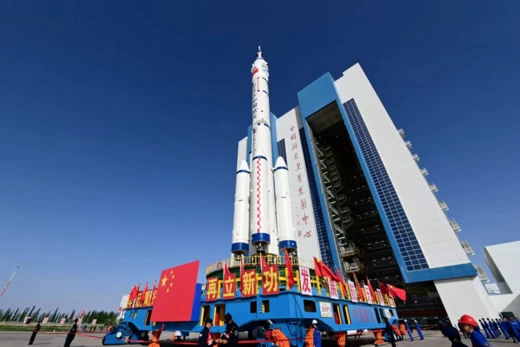
Crewed Shenzhou flights lift off from the Jiuquan Satellite Launch Center in the Gobi Desert of northwestern China. They ride on a Long March 2F two-stage rocket built specifically for human-rated missions.
What is the Tiangong space station and how does Shenzhou connect to it?
Tiangong is China's modular orbital station, now made up of three primary modules. Shenzhou capsules act as the crew ferry, shuttling three-person teams up to the station and bringing them home when their rotation ends.
How long do a typical Shenzhou crew stay in space?
Now that the station is in regular operation, crew stints usually run about six months, though early and special-purpose flights were much shorter. The capsule's life-support design caps its in-orbit endurance at roughly 30 days.
Who was the first Chinese person in space?
Yang Liwei piloted Shenzhou 5 in October 2003, completing a single Earth orbit in about 21 hours and making China the third country to independently send a human into orbit. His flight is the program's foundational milestone.
How many people ride in a Shenzhou capsule?
The standard crew is three taikonauts seated in a tandem row inside the pressure vessel. That three-person layout has held steady from the earliest crewed flights through the current generation of hardware.
What are some standout moments fans point to in Shenzhou history?
Beyond the 2003 debut, common highlights include Zhai Zhigang's first Chinese spacewalk in 2008, Wang Yaping becoming the first female taikonaut in 2013, and the 2022 crew handover in which two three-person teams briefly cohabited the station. Shenzhou 12 in 2021 was also the first crew to live aboard the completed core module.
How does a Shenzhou crew get back to Earth?
The capsule undocks, fires its deorbit engines, and re-enters the atmosphere at roughly 7.9 km/s before deploying parachutes for a soft touchdown. The landing site has traditionally been the grasslands of Inner Mongolia, where recovery teams await the crew.
Where should a newcomer begin if they want to follow Shenzhou missions?
Watching a live launch-and-splashdown broadcast is the most accessible entry point, since it captures the full arc from countdown to landing in one sitting. From there, reading individual mission summaries and taikonaut biographies helps trace the program's growth from a single orbital flight to routine station operations.