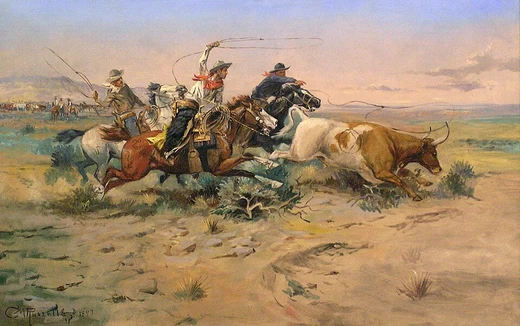
Cowboy hat
Last updated
The cowboy hat is a high-crowned, wide-brimmed, soft-felt hat that became emblematic of the American West. Its design draws on Mexican sombreros, eastern US farm hats, and United States Cavalry headgear. The first western model was the open-crowned "Boss of the Plains", followed by the front-creased Carlsbad style.
Quick Facts
- First western model
- Boss of the Plains
- Subsequent prominent style
- Carlsbad
- Year of first creation
- 1865
Facts from the source article.
History
The cowboy hat, like the Mexican sombrero, was built for hot, sunny climates. Its high crown traps air for insulation, while the wide brim blocks the sun. These practical features appear in many cultures across history, from the ancient Greek petasos to the conical hats of Asia and the headgear of 13th-century Mongolian horsemen. American cowboy hat styles grew out of Mexican designs such as the sombrero charro, torro hats, and sombreros calentanos.
Later, modern Mexican cowboys took the American style and gave it smaller brims and higher crowns. Lucius Beebe claimed the bowler, not the cowboy hat, was the hat that won the West, since it was the most common hat in the region. The working cowboy’s wide-brimmed, high-crowned hat likely came from Civil War slouch hats worn by Confederate soldiers, and may also have been influenced by Mexican vaqueros. John Batterson Stetson is credited with creating the modern American cowboy hat.
Design
Modern cowboy hats are made from fur-based felt, straw, or less often leather, with a tall rounded crown and a wide flat brim. Inside is a simple sweatband to stabilize fit; outside often has a small decorative hat band.
Hats are customized by creasing the crown and rolling the brim, and are also sold pre-creased and pre-rolled. Stampede strings or wind strings may be attached. Colors are most often beige, brown, and black; pastels appeared in the 1940s, especially on movie cowboy and rodeo hats.
Modern designs
The cowboy hat's core design has stayed largely the same since John B. Stetson first made it. It quickly marked the wearer as a Westerner, and within ten years Stetson's name meant "hat" everywhere west of the Mississippi. People would steam the hat soft, shape the crown and brim to their liking, then let it dry. This personalization was so common that a hat's crease could reveal its exact ranch of origin.
Popular creases include the Cattleman, Cool Hand Luke, Minick, Brick, and Gus. As Buffalo Bill and Western movies with stars like Tom Mix made the Wild West famous, the cowboy hat became a symbol of the American West. John Wayne called it the hat that won the West. The Boss of the Plains design influenced wide-brimmed hats for farmers and ranchers across the country, and later versions were adapted for law enforcement, the military, and films.
The Texas Rangers were the first police force to adopt it as part of their uniform, and in 2015 the Texas Legislature made it the official state hat.
Variations
The term "ten-gallon hat" for certain cowboy hats dates back to around 1925. One possible origin is a misunderstanding of the Spanish phrase "tan galán," meaning "so fine" or "really handsome." Another theory traces it to the Spanish word "galón," which refers to a narrow braided trim on the crown, a style possibly borrowed from Spanish cowboys. Texas cowboys may have confused "galón" with "gallon," creating a popular but incorrect legend.
According to Reynolds and Rand, the term originally described the width of a Mexican sombrero hatband, not how much water the hat could hold. The Calgary White Hat, a white felt cowboy hat, was created by Morris Shumiatcher of Smithbilt Hat Company and first appeared at the 1946 Calgary Stampede. Today, thousands of visitors take part in white hatting ceremonies run by Tourism Calgary and volunteer greeters at the Calgary International Airport. In 1983, this hat became part of the Calgary flag design.
More in Cowboy Culture
Sources
Compiled from Wikipedia and the sources listed below. Text from Wikipedia is available under CC BY-SA 4.0; this entry is adapted from it.
- Wikipedia: Cowboy hat (CC BY-SA 4.0).
Spotted an error? Know more?
Reader corrections go straight into our review queue. Suggest an edit · How this site is sourced