Saudi Aramco
The world's largest oil producer and a cornerstone of the global energy industry.

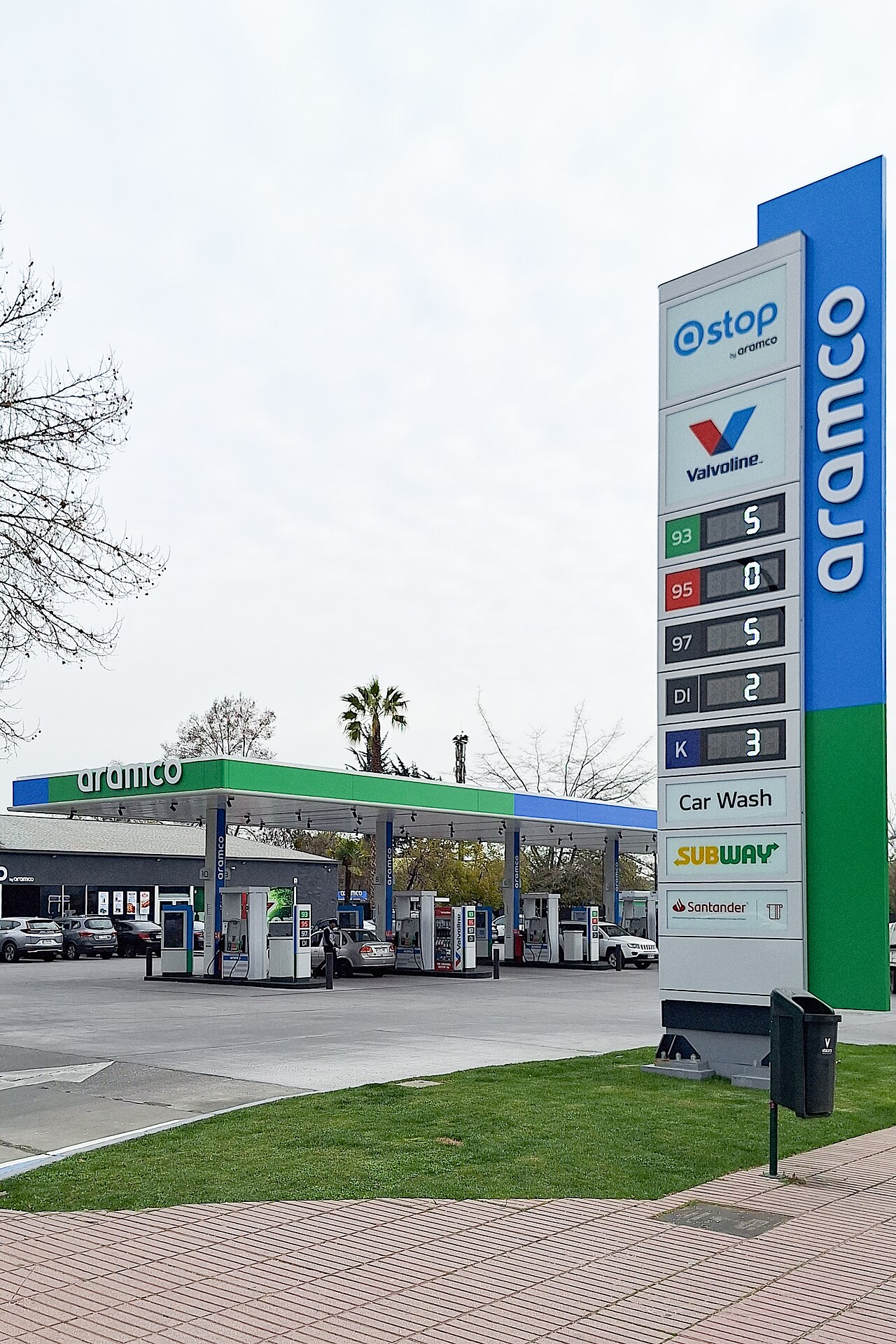
Carlos Figueroa Rojas · CC BY-SA 4.0
Saudi Aramco, officially the Saudi Arabian Oil Company, is the majority state-owned national oil company of Saudi Arabia, headquartered in Dhahran. It ranks as the fourth-largest company globally by revenue and holds the world’s largest proven crude oil reserves, exceeding 270 billion barrels, alongside the highest daily oil production of any oil-producing company. The company operates the Master Gas System, the largest single hydrocarbon network on earth. In 2024, its total output reached 12.7 million barrels of oil equivalent per day, and it manages over one hundred oil and gas fields within Saudi Arabia, including 288.4 trillion standard cubic feet of natural gas reserves. Notably, it runs the Ghawar Field, the world’s largest onshore oil field, and the Safaniya Field, the largest offshore oil field, both located in the Eastern Province.
The company’s origins lie in the aftermath of World War I, when Standard Oil of California (SoCal) secured a concession from the Saudi government in preference to a rival bid, assigning it to its subsidiary California-Arabian Standard Oil Company. After four years of fruitless exploration, the Dammam No. 7 well struck oil in 1938, producing over 1,500 barrels per day. The company was renamed Arabian American Oil Co. (Aramco) in 1944. In 1950, King Abdulaziz threatened nationalization, leading to a 50/50 profit-sharing agreement, and the headquarters moved from New York to Dhahran. Major discoveries followed, including the Safaniya Field in 1951 and confirmation of the Ghawar Field in 1957. Following the 1973 Yom Kippur War and US support for Israel, the Saudi government acquired a one-quarter participation interest in Aramco’s assets, increasing it to sixty percent by 1974. A 1988 royal decree created the current Saudi Arabian Oil Company to take control of the former Aramco assets.
In 2019, shares began trading on the Saudi Exchange, reaching a market capitalization of about US$1.88 trillion on the first day and surpassing US$2 trillion the next. By November 2025, the stock traded at 25.8 SAR, giving a market cap of approximately US$1.66 trillion, a fall of US$800 billion since 2022. In 2024, the company was the single largest emitter of CO2 globally, responsible for 1,653 Mt, or 4.28% of worldwide emissions, when including Scope 3 emissions from the oil it sells.
Last updated 2026-09-30 from the source article.
Quick Facts
- Industry
- Oil and gas, Petrochemicals
- Products
- Crude oil
- Natural gas
- Refined petroleum products
- Petrochemicals
- Lubricants
- Services
- Oil and gas exploration
- Oil refining
- Pipeline transport
- Owner
- Government of Saudi Arabia (82.19%)
- Public Investment Fund (12%)
- Sanabil (4%)
Facts from the source article.
Lore & Background
Saudi Aramco's origins trace to the oil shortages of World War I and the exclusion of American companies from Mesopotamia by the United Kingdom and France under the San Remo Petroleum Agreement of 1920. Standard Oil of California (SoCal) was among US companies seeking new sources of oil. In 1932, the Bahrain Petroleum Company, a wholly owned SoCal subsidiary, discovered the first oil field in the Persian Gulf outside of Iran. The Saudi Arabian government granted a concession to SoCal, which assigned it to a wholly owned subsidiary, California-Arabian Standard Oil Company (CASOC). In 1936, Texaco purchased a 50% stake. The first success came with Dammam No. 7 in 1938. On 31 January 1944, the company name changed to Arabian American Oil Co. (Aramco). In 1947, Standard Oil of New Jersey purchased 30% and Socony Vacuum purchased 10%, with SoCal and Texaco retaining 30% each. In 1950, King Abdulaziz threatened nationalisation, leading to a 50/50 profit-sharing agreement. In 1973, following US support for Israel during the Yom Kippur War, the Saudi government acquired a one-quarter participation interest, increased to 60% in 1974. In November 1988, a royal decree created the Saudi Arabian Oil Company (Saudi Aramco) to take control of former Aramco assets.
Reader's Guide
Saudi Aramco operates the world's largest single hydrocarbon network, the Master Gas System. In 2024, its oil production total was 12.7 million barrels of oil equivalent per day, and it manages over one hundred oil and gas fields in Saudi Arabia, including 288.4 trillion standard cubic feet of natural gas reserves. It operates the Ghawar Field (world's largest onshore oil field) and the Safaniya Field (world's largest offshore oil field). On 11 December 2019, shares commenced trading on the Saudi Exchange, rising to 35.2 SAR, giving a market capitalisation of about US$1.88 trillion. As of November 2025, the stock trades at 25.8 SAR, with a market capitalisation of approximately US$1.66 trillion. In 2024, Saudi Aramco was responsible for 1,653 Mt CO2 emissions, or 4.28% of global CO2 emissions. In the 2020s, it became a FIFA and Formula One partner, including constructor Aston Martin.
Origins & Family Stewardship
Founded in 1942 by the late Sheikh Ali bin Abdullah Al-Tamimi, the company is owned and managed by his heirs. The current chairman is Tariq Ali al-Tamimi.
From Oilfield Supplier to Multi-Sector Conglomerate
Beginning as a major parts supplier to oil giant Saudi Aramco, the Tamimi Group of Companies has several joint ventures, with companies as diverse as General Electric and Safeway. The Tamimi Group is active in the following sectors: Import and distribution: Tamimi Commercial Co. - TCCM (since 1949); Real estate development (since 1953); Power and industrial activities (since 1976); Food services and facility management (since 1977) and food industry (since 2009); Food retailing: Tamimi Markets (since 1979), with over 110 stores in Saudi Arabia; Construction (since 1998).
Retail Footprint & the Dammam Landmark
In 2018, Tamimi Markets opened its headquarters and largest store in Dammam. Tamimi Markets has been operating since 1979, with over 110 stores in Saudi Arabia. Food services and facility management have been running since 1977, and a food industry division was established in 2009.
Cross-Border Partnerships & Joint Ventures
The company is in partnership with Pakistani businessman and politician Sardar Tanveer Ilyas Khan. The Tamimi Group of Companies has several joint ventures, with companies as diverse as General Electric and Safeway. Tamimi Commercial Co. - TCCM has been active in import and distribution since 1949.
Gallery
Frequently Asked Questions
What does Saudi Aramco actually do?
Its core operations span petroleum and natural gas exploration, extraction, refining, and petrochemical manufacturing, making it a vertically integrated energy powerhouse.
Who owns Saudi Aramco?
The Saudi government holds the vast majority of shares, effectively making the company a sovereign instrument of the kingdom's fiscal policy.
More in Corporations & Conglomerates
Related in Corporations & Conglomerates
Links follow this subject's own source article.
Spotted an error? Know more?
Reader corrections go straight into our review queue. Suggest an edit · How this site is sourced