
Proportionality (law)
General legal principle balancing measures against aims.
Last updated

R222mmllo1 · CC BY-SA 4.0
Proportionality is a general principle in law that covers several separate but related concepts, serving as a criterion of fairness and justice in statutory interpretation, criminal law, international humanitarian law, and civil procedure. It originated in German administrative courts in the late 19th century and was later popularized by the Federal Constitutional Court of Germany, which applied it to constitutional law, requiring statutes limiting fundamental rights to satisfy a proportionality test.

Quick Facts
- Field
- Law
- Known for
- General principle of law balancing restriction and severity
- Origin
- German administrative courts, late 19th century
- Key court
- Federal Constitutional Court of Germany
Facts from the source article.
Lore & Background
The concept of proportionality that was testable in law was first developed in the German administrative courts in the late 19th century, notably the Prussian Oberverwaltungsgericht, to reign in police discretion. The proportionality test was later popularized by its application in the jurisprudence of the Federal Constitutional Court of Germany, which took its existence for granted and transferred it to the field of constitutional law, requiring statutes limiting fundamental rights to satisfy the test. In European Union law, there are generally four stages to a proportionality test: a legitimate aim, suitability to achieve the aim, necessity (no less onerous way), and reasonableness considering competing interests.
The European Court of Justice often merges the third and fourth criteria depending on the margin of discretion afforded to member states. Under the European Convention on Human Rights, proportionality is one of the main principles used by the European Court of Human Rights for scrutinizing actions restricting Convention rights, alongside the margin of appreciation. In criminal law, the principle of proportional justice describes the idea that punishment should fit the crime. In the United States, the Supreme Court proposed the Proportionality Doctrine in cases including Enmund v.
Florida, Solem v. Helm, and Tison v. Arizona, to clarify proportionality within the Cruel and Unusual Punishment Clause of the Eighth Amendment. In international humanitarian law, proportionality prohibits attacks expected to cause excessive incidental civilian harm relative to the concrete and direct military advantage anticipated.
German Origins and Constitutional Expansion
The testable legal concept of proportionality traces its roots to the late nineteenth century in Germany, where it emerged within the administrative courts to curb the broad discretionary powers that statutes had granted to police authorities. The Prussian Oberverwaltungsgericht, serving as the appeals court for general administrative jurisdiction, was instrumental in shaping this early framework. Over time, the principle gained broader recognition through the jurisprudence of Germany's Federal Constitutional Court, the Bundesverfassungsgericht.
That court treated proportionality as an established legal tool and extended its reach into the constitutional sphere, mandating that any statute restricting fundamental rights, as well as executive actions grounded in such statutes, must pass the proportionality test. This trajectory transformed what had been a narrow administrative check into a foundational criterion of fairness and justice across statutory interpretation, particularly in constitutional law. The German experience thus laid the groundwork for proportionality's later adoption across multiple legal systems and jurisdictions worldwide, establishing it as a logical method for balancing the severity of a prohibited act against the restriction imposed by any corrective measure.
The European Four-Stage Test and Human Rights Scrutiny
Within the European legal landscape, proportionality operates as a structured analytical framework. In EU law, courts generally apply a four-stage inquiry: a measure must pursue a legitimate aim, it must be suitable to achieve that aim (sometimes requiring evidentiary support), it must be necessary in the sense that no less burdensome alternative exists, and it must be reasonable when weighed against the competing interests of various groups.
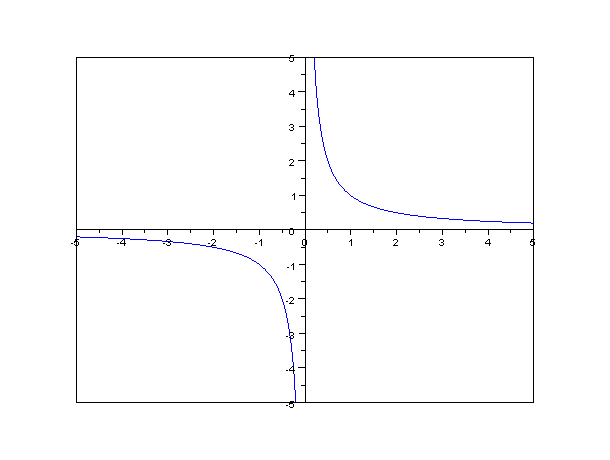
In practice, the European Court of Justice frequently folds the necessity and reasonableness stages into a single assessment, particularly where it recognizes a margin of discretion afforded to member states. This approach is visible in cases such as R (Seymour-Smith) v Secretary of State for Employment, where the Court acknowledged a member state's latitude in crafting unfair-dismissal policies to reduce unemployment, as well as in Mangold v Helm and Kücükdeveci v Swedex GmbH & Co KG. Under the European Convention on Human Rights, proportionality serves as one of two principal tools—alongside the margin of appreciation—through which the European Court of Human Rights examines whether national authorities have overstepped when restricting Convention-guaranteed rights.
Proportional Justice in Criminal Law and Self-Defense
The application of proportionality in criminal law centers on the principle that punishment must correspond to the gravity of the offense. Historical practice reveals wide divergence: seventeenth-century England's Bloody Code prescribed the death penalty even for relatively minor crimes, reflecting an absolute standard of guilt. The eighteenth century brought a shift when Cesare Beccaria published On Crimes and Punishments, grounding penology in a relative standard of culpability rather than rigid severity.
Jeremy Bentham subsequently proposed the panopticon, a system where surveillance replaced corporal punishment, though in practice it proved both cruel and ineffective. Some legal traditions interpreted proportionality through the lens of lex talionis, while others adopted it to restrict sentencing; every EU member state, for instance, has accepted a treaty obligation barring the death penalty for any crime. In self-defense contexts, the force a defender employs must be proportionate to the threat and must also be necessary.
The United States Supreme Court articulated a Proportionality Doctrine in the 1980s through Enmund v. Florida, Solem v. Helm, and Tison v. Arizona, clarifying the principle within the Cruel and Unusual Punishments framework.
Armed Conflict, Costs, and Australian Constitutional Interpretation
Proportionality extends well beyond domestic courts into the regulation of armed conflict and procedural justice. In international humanitarian law, the principle—codified in Additional Protocol I—prohibits attacks that could be expected to cause incidental civilian casualties, injury, or damage to civilian objects when such consequences would be excessive relative to the concrete and direct military advantage anticipated. Alongside distinction and necessity, proportionality forms a core factor in assessing whether the use of force satisfies military necessity.
In the United Kingdom, the Civil Procedure Rules require that legal costs be both proportionately and reasonably incurred, or proportionate and reasonable in amount, before they can be awarded as part of a court ruling. Australia presents a distinct context: there, proportionality functions primarily as a tool of constitutional interpretation, determining whether Commonwealth legislation falls under a head of power in section 51 of the Constitution. Judge Kirby observed that the test has not enjoyed universal favor, while Chief Justice Owen Dixon emphasized that the inquiry is one of connexion rather than appropriateness, and that once sufficient connexion is established, the Court should not judge whether the law is disproportionate.
Frequently Asked Questions
Which court is most associated with Proportionality?
The Federal Constitutional Court of Germany is the institution most closely linked to the principle, as it systematically applied the proportionality test to every statute that limits fundamental rights. This judicial practice spread the doctrine far beyond Germany's borders.
In which areas of law does Proportionality apply?
The principle shows up in constitutional law, criminal sentencing, international humanitarian law, European Union legislation, the European Convention on Human Rights, Australian constitutional disputes, and even United States legal analysis. Its reach spans both domestic and international legal systems.
Also in the Codexery
More in Constitutional And Rights Law
Sources
Compiled from Wikipedia and the sources listed below. Text from Wikipedia is available under CC BY-SA 4.0; this entry is adapted from it.
- Wikipedia: Proportionality (law) (CC BY-SA 4.0).
Spotted an error? Know more?
Reader corrections go straight into our review queue. Suggest an edit · How this site is sourced