Church of the Theotokos Kyriotissa (Constantinople)
Former Byzantine church with a domed Greek cross plan.
Last updated
Where it is
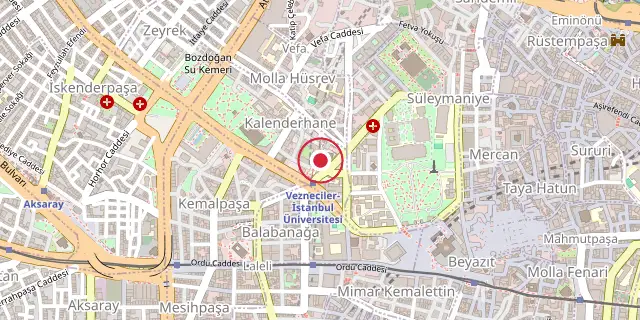
Coordinates: 41°00′47″N 28°57′36″E (41.0130, 28.9600) · Open in OpenStreetMap
Coordinates and connected clubs: the infobox of Wikipedia: Kalenderhane Mosque (CC BY-SA 4.0). Map: drawn by Codexery from OpenStreetMap tiles.
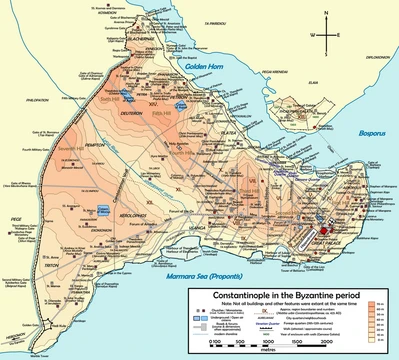
The Church of the Theotokos Kyriotissa, now known as the Kalenderhane Mosque, is a former Eastern Orthodox church in Istanbul, Turkey, converted into a mosque by the Ottomans. It is one of the few surviving Byzantine churches with a domed Greek cross plan. The building is also referred to as Kalender Haneh Jamissi and St. Mary Diaconissa.
History
The first building on the site was a Roman bath, followed by a sixth-century hall church with an apse against the Aqueduct of Valens. A larger church was built to the south, possibly in the seventh century. A third church, reusing the sanctuary and apse of the second, dates to the end of the twelfth century, during the late Comnenian period; it may date between 1197 and 1204, as Constantine Stilbes alluded to its destruction in a fire of 1197. Monastery buildings that surrounded the church disappeared entirely during the Ottoman period.
After the Latin conquest of Constantinople, the Crusaders used the building as a Roman Catholic church, partly officiated by Franciscan clergy. Following the conquest of Constantinople in 1453, Mehmed II assigned the church to the Kalenderi sect of the Dervish, who used it as a zaviye and imaret, giving it the name Kalenderhane. The waqf was endowed with properties in Thrace and hamams in Istanbul and Galata. Later, Arpa Emini Mustafa Efendi built a mektep and a medrese.
In 1746, Hacı Beşir Ağa, the Kizlar Ağası of the Topkapı Palace, added a mihrab, minbar and mahfil, completing the conversion into a mosque. The mosque was restored in 1855 and again between 1880 and 1890 after fire and earthquake damage. It was abandoned in the 1930s after the minaret collapsed due to lightning and the medrese was demolished. A ten-year conservation effort in the 1970s by Cecil L. Striker and Doğan Kuban restored the building to its twelfth-century condition, and the minaret and mihrab were rebuilt, allowing the mosque to reopen for worship.
The restoration also resolved the dedication: discovery of a donor fresco in the southeastern chapel and another over the main entrance to the narthex, both bearing the word Kyriotissa, makes it highly probable the church was dedicated to the Theotokos Kyriotissa.
Architecture and decoration
The building has a central Greek cross plan with deep barrel vaults over the arms, surmounted by a 16-ribbed dome. The brickwork is typical of the middle Byzantine period, with alternating layers of brick and stone. Entry is via an esonarthex and an exonarthex added later on the west side. An upper gallery over the esonarthex, similar to that in the Church of the Pantokrator, was removed in 1854.
The north and south aisles along the nave were also destroyed, possibly in the nineteenth century; the tall triple arches that connected them to the nave now serve as lower windows. The sanctuary is on the east side, but the reconstructed mihrab and minbar are placed in a corner to align with Mecca. Two small chapels, the prothesis and diakonikon, typical of middle and late Byzantine churches, survive. The interior retains much of its decoration, including colored marble panels, moldings, and elaborated icon frames.
The building holds two unique features in Istanbul: a one-meter-square mosaic of the Presentation of Christ, the only pre-iconoclastic religious mosaic surviving in the city, and a thirteenth-century fresco cycle in the southeastern chapel depicting the life of Saint Francis of Assisi, the oldest known representation of the saint, possibly painted only a few years after his death in 1226. Both have been detached and partially restored and are now in the Archaeological Museum of Istanbul.
Did You Know?
- The mosque is located immediately south of the easternmost extant section of the Aqueduct of Valens.
- The building lies less than one km southeast of the Vefa Kilise Mosque.
More in Constantinople
Sources
Compiled from Wikipedia and the sources listed below. Text from Wikipedia is available under CC BY-SA 4.0; this entry is adapted from it.
- Wikipedia: Kalenderhane Mosque (CC BY-SA 4.0).
Spotted an error? Know more?
Reader corrections go straight into our review queue. Suggest an edit · How this site is sourced