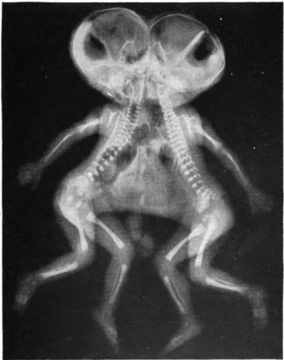
Ischiopagi
Conjoined twins united at the pelvis, often facing away from each other.
Ischiopagi is the medical term for conjoined twins united at the pelvis, derived from Greek words meaning hip and fixed. These twins are typically joined with their vertebral axes at 180 degrees, facing away from one another, and usually have four arms, two to four legs, and one external genitalia and anus.
Quick Facts
- Incidence
- 1 in every 100,000 live births
- Proportion among conjoined twins
- 1 out of 10 conjoined twin births
- Most prevalent variety
- Ischiopagus Tetrapus (68.75% of cases)
- Ischiopagus tripus frequency
- 31.25% of cases
- Ischiopagus dipus frequency
- 6.25% of cases
- Common geographic regions
- India and Africa
Facts from the source article.
Did You Know?
- Surgery to separate conjoined twins has allowed surgeons to study mechanisms of embryogenesis and physiological consequences of parabiosis.
- Ischiopagus is mostly confused with pygopagus, where twins are joined dorsally at the buttocks facing away, whereas ischiopagus twins are joined ventrally and caudally at the sacrum and coccyx.
- Parapagus twins are joined side-by-side, unlike ischiopagus twins whose spines connect at a 180-degree angle.
Classification
Ischiopagus dipus is the rarest variety, with twins sharing two legs and no lower extremities on one side. Ischiopagus tripus twins share three legs, the third often being two fused or non-functioning, and usually share one set of external genitalia. Ischiopagus tetrapus or quadripus twins have a symmetrical continuous longitudinal axis with lower extremities oriented at right angles to the thorax axes.
Embryology
Conjoined twins such as ischiopagi develop from monozygotic twinning, where a bi-laminar embryonic disc splits after formation of the inner cell masses, causing the twins to occupy the same amnion. Separation occurring between the seventh and thirteenth days results in monochorionic, monoamniotic identical twins sharing a yolk sac. If separation happens later, before the primitive streak and axial orientation appear, conjoined twins develop. The origin of ischiopagus is attributed to either incomplete fission or double overlapping inducing centers on the same germ disc. Mechanical disturbances such as shaking of blastomeres, exposure to cold or insufficient oxygen during early cleavage, grafting organizer onto gastrula, or constricting the blastula or early gastrula can cause incomplete separation, but these must occur at critical times in pregnancy.
Complications
Conjoined twins face high risk of stillbirth or death shortly after birth. In some cases, a healthy twin and a parasitic twin are born, with the parasitic twin having no hope of survival and requiring surgical separation. Ischiopagus twins share the pelvic region, gastrointestinal tract, and genital region, necessitating reconstructive surgery for normal bowel movements and reproductive possibilities. If both twins survive labor, one is often healthy and strong while the other is malnourished and weak, requiring careful surgical planning.
Treatment
Separation is the only treatment for ischiopagus. Success depends on the organs shared, how closely the twins are joined, and the risks of surgery. Since ischiopagus twins usually share a gastrointestinal tract and pelvic organs, months of planning are needed to weigh separation benefits against complications. Separating ischiopagus tripus twins typically leaves each with one leg.
More in Conjoined Twins
Spotted an error? Know more?
Reader corrections go straight into our review queue. Suggest an edit · How this site is sourced