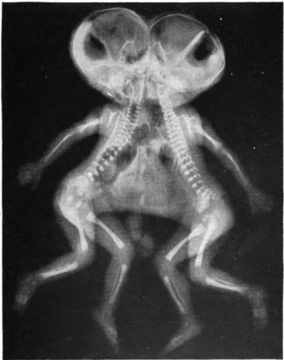
Ganga and Jamuna Shrestha
Nepali craniopagus twins separated in a landmark 2001 surgery.
Ganga and Jamuna Shrestha were Nepali conjoined twins who were surgically separated in Singapore in 2001 when they were 11 months old. Their separation was considered a notable medical achievement.
Quick Facts
- Born
- May 9, 2000
- Place of birth
- Khalanga, western Nepal
- Parents
- Sandhya Shrestha and Bhusan KC
- Type of conjoinment
- Craniopagus twins (joined at the top of the head)
- Separation surgery began
- April 6, 2001
- Duration of separation surgery
- 88 hours (Jamuna required 94 hours total; Ganga required 102 hours total)
- Lead surgeon
- Dr. Keith Goh
Facts from the source article.
Did You Know?
- The twins were named for India's sacred rivers, the Ganges and the Jamuna, which merge.
- Before separation, they were legally referred to as Ganga-Jamuna and shared a single passport.
- A 2016 fiction book, Ganga Jamuna by Sunita Lad Bhamray, was inspired by the twins; a portion of profits funded Jamuna's medical treatments.
Surgery
On October 11, 2000, the family arrived in Singapore, where a medical team under pediatric neurosurgeon Dr. Keith Goh began six months of preparation. The team conducted MRI, angiography, magnetic resonance angiography, and a three-dimensional CT scan. From these, advanced computer imaging—a first for Singapore—was created to assess whether the twins could be separated. Once confirmed, realistic plastic models of their heads were made for surgical planning and reference. A dextroscope allowed the team to practice virtual surgery on models of the babies’ bodies. Dr. Goh also consulted via teleconference with Dr. Ben Carson, who had led the first successful separation of craniopagus twins. The separation surgery started on April 6, 2001, with an expected 30-hour duration, but the girls were separated after 88 hours. The procedure was complicated by their fused brains and the need to rotate them multiple times. Funding came from donations by both Nepali-Singaporeans and non-Nepali Singaporeans.
Aftermath
Both twins survived the surgery, believed to be only the second successful operation of its kind, but with varying impairments. Before surgery, their mother described them as seeming like normal children. Afterward, Ganga had brain damage from a brain infection during surgery and could not sit up or speak, sleeping most of the time. Jamuna could not walk and had limited speech but was expected to develop normally. The twins became more susceptible to head injuries due to how their heads were repaired. Further surgeries included restructuring Ganga's head to accommodate her brain size and correcting a bone defect in Jamuna's skull with cranioplasty. The family relocated from their village to Kathmandu for medical care, straining them financially. Ganga died in July 2008 of pneumonia and meningitis in a Kathmandu hospital.
More in Conjoined Twins
Spotted an error? Know more?
Reader corrections go straight into our review queue. Suggest an edit · How this site is sourced