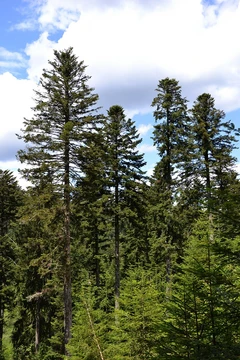
Pseudotsuga menziesii
Tallest tree in the pine family, native to western North America.

Pseudotsuga menziesii, commonly known as Douglas-fir, is an evergreen conifer species in the pine family, Pinaceae, and is the tallest tree in that family. Native to western North America, it is also called Douglas-fir, Douglas spruce, Oregon pine, and Columbian pine. Despite its common names, it is not a true fir, spruce, pine, or hemlock; the genus name Pseudotsuga means 'false hemlock.' The species includes three varieties: coast Douglas-fir, Rocky Mountain Douglas-fir, and Mexican Douglas-fir.
The tree can be medium-sized to extremely large, with coast Douglas-firs reaching heights near 100 meters, while other varieties are shorter. The largest coast specimens regularly live over 500 years, with some exceeding 1,300 years; Rocky Mountain Douglas-firs are less long-lived, usually under 400 years. Historical records describe former coast Douglas-firs that, if alive today, would be the tallest tree species on Earth, including specimens like the Lynn Valley Tree and the Nooksack Giant. The leaves are flat, soft, linear needles, generally resembling those of true firs but occurring singly rather than in bundles, and they completely encircle the branches. In dense forests, lower branches are lost as the tree grows, with foliage sometimes starting high off the ground; trees in more open environments retain lower branches. Young trees have thin, smooth, gray bark with resin blisters, while mature trees (over 80 years) develop very thick, corky bark up to a substantial thickness, with deep vertical fissures and multiple layers. This thick bark makes the Douglas-fir one of the most fire-resistant trees native to the Pacific Northwest. Male cones are yellowish red, while female cones are green when young, maturing to reddish-brown or gray, and are pendulous with persistent scales; they feature distinctive long, three-pointed bracts that protrude above each scale, resembling the back half of a mouse. The seeds are small with a longer wing. The species' massive genome was sequenced in 2017, revealing a specialized photosynthetic apparatus in the light-harvesting complex of genes. The common name honors Scottish botanist David Douglas, though the specific epithet *menziesii* honors Archibald Menzies, who first documented the tree on Vancouver Island in 1791. It is naturalized in Europe, Argentina, Chile, and New Zealand, where it is considered invasive but also widel
- Common names
- Douglas-fir, Douglas spruce, Oregon pine, Columbian pine
- Family
- Pinaceae
- Native range
- Western North America
- Maximum diameter
- Nearly 5 m (16 ft)
- Maximum age
- Over 1,300 years (coast variety)
- Varieties
- Three: coast, Rocky Mountain, Mexican
Lore & Background
The Douglas-fir is an evergreen conifer in the pine family, though it is not a true fir, spruce, pine, or hemlock; its scientific name *Pseudotsuga* means "false hemlock." It is native to western North America and includes three varieties: coast, Rocky Mountain, and Mexican. The tree is medium-sized to extremely large, reaching 20–100 meters in height, with coast Douglas-firs approaching the upper limit. Trunks commonly reach 8 feet in diameter, with exceptional specimens nearly 5 meters across. The largest coast individuals regularly live over 500 years, with the oldest exceeding 1,300 years, while Rocky Mountain trees usually do not surpass 400 years. Historical records describe coast Douglas-firs over 120 meters tall, which would make them the tallest tree species on Earth. The leaves are flat, soft, linear needles 1.5–4 cm long, resembling fir needles but occurring singly and encircling the branches. In dense forests, lower branches are lost, with foliage starting as high as 110 feet off the ground; in brighter environments, branches remain lower. Young trees have thin, smooth, gray bark with resin blisters. On mature trees over 80 years old, the bark becomes very thick and corky, up to 14 inches thick, with deep vertical fissures and a layered, brown and lighter-colored texture. This bark provides exceptional fire resistance. Male cones are yellowish red, 5–12 mm long; female cones are green when young, maturing to reddish-brown or gray, 6–10 cm long, pendulous, with persistent scales and distinctive long, three-pointed bracts that protrude above each scale, resembling the back half of a mouse. Seeds are 5 mm long with a longer wing. The species was first documented by Archibald Menzies on Vancouver Island in 1791, and later reported by David Douglas. It is naturalized in Europe, Argentina, Chile, and New Zealand, where it is both a common lumber tree and, in New Zealand, considered an invasive wilding conifer subject to control.
Reader's Guide
Pseudotsuga menziesii is ecologically and economically significant as the dominant tree west of the Cascade Mountains in the Pacific Northwest. Its thick bark provides exceptional fire resistance, and its seeds are a crucial food source for small mammals such as moles, shrews, and chipmunks. Mature Douglas-fir forest is the primary habitat for the red tree vole and the spotted owl. The species is also naturalised in Europe, Argentina, Chile, and New Zealand, where it is both a common lumber tree and, in New Zealand, considered an invasive wilding conifer. The coast Douglas-fir variety grows larger and faster than the interior Rocky Mountain variety, and it competes well on most parent materials and slopes. The species exhibits considerable morphological plasticity, adapting to both moist coastal climates and drier interior sites. Its historical record includes fossils from the Miocene and Pliocene of Europe.
Did You Know?
- Despite its common name, Douglas-fir is not a true fir (genus Abies), spruce (Picea), pine (Pinus), or hemlock (Tsuga); its genus name Pseudotsuga means 'false hemlock'.
- The female cones have distinctive three-pointed bracts that are said to resemble the back half of a mouse, with two feet and a tail.
Frequently Asked Questions
What is Pseudotsuga menziesii?
It is an evergreen conifer in the pine family (Pinaceae) native to western North America, best known by the common name Douglas-fir. It holds the record as the tallest tree in the entire pine family.
Is Douglas-fir actually a true fir?
No — despite names like Douglas-fir, Douglas spruce, Oregon pine, and Columbian pine, it belongs to none of those genera. The genus name Pseudotsuga translates to 'false hemlock,' a nod to the long-standing taxonomic mix-up.
What varieties of Douglas-fir are recognized?
Three varieties are acknowledged: coast Douglas-fir, Rocky Mountain Douglas-fir, and Mexican Douglas-fir. The coast variety is the one that attains the greatest heights and longest lifespans.
Why does Douglas-fir go by so many different common names?
The cluster of names (Douglas-fir, Douglas spruce, Oregon pine, Columbian pine) all refer to the same species and reflect early confusion about where it truly fit in the tree family. None of those labels are taxonomically correct, since it is in fact a 'false hemlock' in the genus Pseudotsuga.
More in Conifers 1-23
Spotted an error? Know more?
This is a living reference — every entry is fact-audited, and reader corrections feed straight into our audit queue. Suggest an edit · See this site's audit record