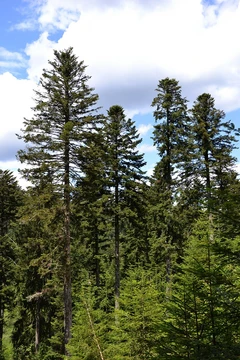
Cedrus libani
Large evergreen conifer native to the Eastern Mediterranean basin.

The cedar of Lebanon, or *Cedrus libani*, is a towering evergreen conifer from the pine family, native to the mountains around the eastern Mediterranean. Valued for its impressive height, long life, and resilient timber, this tree has carried deep cultural weight for thousands of years. It appears in ancient Mesopotamian stories, serves as Lebanon’s national symbol, and is a popular ornamental in parks and gardens.
A mature specimen can grow very tall, with a single, pillar-like trunk that may reach a substantial diameter. Older trees that grow in open spaces often split into several large, upright branches. The bark is dark grey to blackish-brown, rough, scaly, and marked by deep horizontal cracks that flake off in small chips. Young trees have upward-angled main branches, but these become massive and spread wide horizontally as the tree ages. Secondary branches are dense and grow flat. The crown starts out conical and, with age, becomes broad and table-like with level branches; trees in dense forests keep a more conical shape.
The tree has two types of shoots: long ones and short ones. New shoots are pale brown, while older shoots turn grey, grooved, and scaly. The vegetative buds are slightly resinous, oval, and wrapped in pale brown scales that fall off. Needle-like leaves grow in spirals on long shoots and in clusters of 15 to 35 on short shoots. Each needle is light green to bluish-green, rhombic in cross-section, and has stomatal bands on all four sides.
Cones first appear when the tree is between 20 and 40 years old. Male cones emerge in early autumn, solitary and upright, about a certain length, changing from pale green to pale yellow-brown. Female seed cones appear a few weeks later, also at the ends of short shoots. They are resinous, stalkless, and pale green at first, taking a full year after pollination to mature. Mature cones are woody, oval or barrel-shaped, green turning grey-brown, and open from top to bottom, releasing seeds until only the central stalk remains. The seed scales are thin, broad, and leathery. Seeds are oval, attached to a light brown, wedge-shaped wing. Growth is rapid until about age 45 to 50, then becomes extremely slow after 70.
The genus name *Cedrus* is Latin for true cedars. The species name *libani* refers to the Lebanon mountain range, where French botanist Achille Richard first described it. Three varieties are recognized, though not all experts agree on the third. *C. libani* var. *libani* grows in Lebanon, western Syria, and south-central Turkey. *C. libani* var. *stenocoma*, once considered a subspecies, is now treated as a variety or ecotype; it has a spreading crown that does not flatten, likely an adaptation to growing in dense stands with tall Cilician fir. *C. libani* var. *brevifolia*, the Cyprus cedar, is found on the Troodos Mountains. It grows slowly, has shorter needles, and tolerates drought and aphids better. Genetic studies, however, have not separated it as a distinct species.
*C. libani* var. *libani* is endemic to high mountains in Lebanon, Syria, and Turkey. It thrives in well-drained, rocky, calcareous soils on north- and west-facing slopes, in full sun, and prefers rich loam or sandy clay. Its natural climate features warm, dry summers and cool, moist winters with annual precipitation that can include heavy snow at higher elevations. In Lebanon and Turkey, it grows most abundantly between certain elevations, forming pure forests or mixing with Cilician fir, European black pine, Turkish pine, and junipers. In Turkey, it can occur as low as a certain altitude. The Cyprus cedar grows in similar conditions on the Troodos Mountains at medium to high elevations.
Historically, the ancient Phoenicians used cedar wood for shipbuilding and traded the trees with Egypt, Greece, Anatolia, Iberia, Carthage, Sicily, Rome, and ancient Iraq. In the Epic of Gilgamesh, the hero Gilgamesh and his friend Enkidu travel to the legendary Cedar Forest to kill its guardian and cut down its trees. Early versions of the story place this forest in Iran, but later Babylonian accounts set it in Lebanon.
- trunk_diameter
- up to 2.5 m (8 ft 2 in)
- cone_length
- 8 to 12 cm (3.1 to 4.7 in)
- native_region
- mountains of the Eastern Mediterranean basin
- national_emblem
- Lebanon
- first_described_by
- French botanist Achille Richard
Lore & Background
Cedrus libani can reach 40 m in height, with a massive monopodial columnar trunk up to 2.5 m in diameter. The rough and scaly bark is dark grey to blackish brown, run through by deep, horizontal fissures. The crown is conical when young, becoming broadly tabular with age. The leaves are needle-like, arranged in spirals and concentrated at the proximal end of long shoots, and in clusters of 15–35 on short shoots; they vary from light green to glaucous green. Cones are borne in autumn, with male cones appearing in early September and female cones in late September. Mature woody cones are 8 to 12 cm long and 3 to 6 cm wide, ovoid or barrel-shaped, and green ripening to grey-brown. The seeds are ovoid, 10 to 14 mm long, attached to a light brown wedge-shaped wing.
Reader's Guide
Cedrus libani has held profound significance for millennia. It features in the Epic of Gilgamesh, where the hero Gilgamesh and his friend Enkidu travel to the legendary Cedar Forest. The tree is mentioned several times in the Bible: Hebrew priests were ordered by Moses to use its bark in the treatment of leprosy; Solomon procured cedar timber to build the Temple in Jerusalem; and the prophet Isaiah used it as a metaphor for pride. In a rabbinic legend from the Talmud, the cedar appears symbolically in Yohanan ben Zakkai's meeting with the Roman general Vespasian. Historically, the ancient Phoenicians used cedar wood for shipbuilding and traded cedar trees with Ancient Egypt, Ancient Greece, Anatolians, Iberians, Punics, Sicilians, Romans, and Ancient Iraq. Cultivation dates back at least 3,200 years, when the Hittite Empire established two populations in northern Turkey.
Did You Know?
- The tree features in the Epic of Gilgamesh, where the hero travels to the legendary Cedar Forest.
- The Lebanon cedar is the national emblem of Lebanon and appears on the flag and coat of arms.
- Cultivation of Lebanon cedar dates back at least 3,200 years, when the Hittite Empire established populations in northern Turkey.
Frequently Asked Questions
Who is Cedrus libani?
Cedrus libani is a tall, evergreen coniferous tree belonging to the genus Cedrus within the pine family. It goes by several common names, most notably cedar of Lebanon, Lebanon cedar, or Lebanese cedar, and it is one of the most recognizable large conifers in the Eastern Mediterranean region.
What are Cedrus libani's key physical stats?
This species can grow to roughly 40 meters in height with a trunk diameter reaching about 2.5 meters. Its cones are relatively large for a conifer, spanning 8 to 12 centimeters, and the wood is prized for being both hard and remarkably long-lasting.
Where does Cedrus libani originate from?
The cedar of Lebanon is native to the mountain ranges of the Eastern Mediterranean basin, where it has thrived at altitude for thousands of years. It is not a widespread species but is instead tied to specific highland habitats in that region.
Why is Cedrus libani culturally important?
The tree has appeared in ancient Mesopotamian literary works and has long served as the national emblem of Lebanon. Its extraordinary lifespan, impressive stature, and durable timber made it a powerful symbol of endurance throughout Mediterranean history.
Who first formally described Cedrus libani?
The species was scientifically described by French botanist Achille Richard, who placed it within the genus Cedrus. His work established the formal taxonomic identity that modern botany still uses today.
More in Conifers 1-23
Spotted an error? Know more?
This is a living reference — every entry is fact-audited, and reader corrections feed straight into our audit queue. Suggest an edit · See this site's audit record