Frequently Asked Questions
The most-asked questions about cone snails.
What exactly is a cone snail?
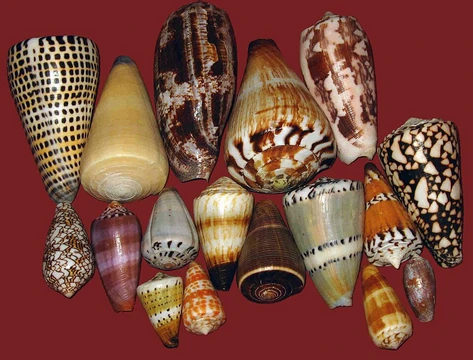
Cone snails are a family of marine gastropod mollusks (Conidae) known for their tall, pointed shells and predatory lifestyle. They inhabit tropical and subtropical waters worldwide, ranging from shallow reef flats to deep-sea sediments.
Which species are the most well-known or notable?
Conus geographus (the geography cone) is infamous for its lethal venom, while Conus textile (the textile cone) is the most commonly collected species in aquariums. Conus omaria, the largest living cone, and Conus gloriamaris, prized for its iridescent shell, also draw significant attention.
Where should a newcomer begin learning about cone snails?
Start with the basic anatomy and hunting mechanism—the harpoon-like radula tooth and venom delivery system—since nearly every other topic builds on it. From there, exploring the three main ecological guilds (fish-hunters, worm-hunters, and snail-hunters) gives a clear framework for understanding the family's diversity.
How do cone snails capture prey?
They fire a barbed radula tooth, loaded with venom, from a modified proboscis, anchoring the prey in place before digesting it externally. The venom is a complex cocktail of hundreds of peptides and proteins, many of which target specific ion channels in the prey's nervous system.
What is the medical or pharmaceutical significance of cone snail venom?
Conotoxins derived from various species have been developed into pain-relief drugs such as ziconotide (Prialt), which is roughly 1,000 times more potent than morphine without addictive properties. Ongoing research continues to mine the family's venom for novel analgesics and cardiovascular agents.
How large can cone snails grow?
Most species stay under 10 cm, but Conus omaria can exceed 28 cm in shell length, making it the largest living member of the group. In contrast, some deep-sea species are only a few millimeters long.
Are cone snails dangerous to humans?
Only a handful of species—most notably Conus geographus and Conus textile—produce venom potent enough to cause serious envenomation or death, and even then incidents are rare and usually result from handling rather than active attack. The vast majority of the roughly 900 described species are harmless to people.
How do cone snails reproduce?
Most are simultaneous hermaphrodites, each individual carrying both male and female reproductive organs and swapping roles during mating. A few deep-sea and tropical species have shifted to obligate parthenogenesis, producing offspring without fertilization.
What is the current conservation status of many cone snail species?
Heavy shell-collecting pressure and habitat loss from coastal development have pushed numerous species toward rarity, and several are listed as vulnerable or endangered on the IUCN Red List. CITES regulations now restrict international trade in many Conus species to curb over-collection.
How long can a cone snail live?
Lifespan varies by species, but many reef-dwelling cones are thought to live roughly 5–10 years, while larger, slower-growing species may persist longer. Exact figures remain uncertain because most data come from captive specimens rather than long-term field studies.