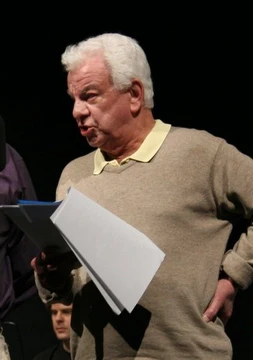
Phil Silvers
Canadian and American comedian, actor, screenwriter, and graphic designer.

via Wikipedia: Phil Hartman · see source
Phil Silvers (born Phillip Silver; May 11, 1911 – November 1, 1985) was an American entertainer and comedic actor, widely known as "The King of Chutzpah." His professional career spanned nearly six decades, beginning when he was just eleven years old. At that age, he would sing in movie theaters whenever the film projector broke down—a frequent occurrence at the time—and was eventually allowed free admission to continue performing during such interruptions. By thirteen, he was singing in the Gus Edwards Revue, later moving into vaudeville and burlesque comedy. Silvers found early film work at Warner Bros.' Vitaphone studio in Brooklyn, starting with a small role in the 1931 Jack Haley short *Success*. He returned to Vitaphone in 1937 for additional shorts, including *Ups and Downs* and *The Candid Kid*. His Broadway debut came in 1939 with *Yokel Boy*, where critics praised him as the highlight of an otherwise mediocre play. The 1941 revue *High Kickers* was based on his own concept. Silvers made his feature-film debut in *Hit Parade of 1941* (1940), and over the next two decades appeared in films for major studios such as Warner Bros., MGM, Columbia, and 20th Century Fox. Notable roles included *All Through the Night* (1942) with Humphrey Bogart, *Lady Be Good* (1941), *Coney Island* (1943), *Cover Girl* (1944) with Gene Kelly and Rita Hayworth, and *Summer Stock* (1950) with Kelly and Judy Garland. He also wrote the original lyrics for the jazz standard "Nancy (with the Laughing Face)," composed for Frank Sinatra. During World War II, Silvers entertained troops on USO tours alongside Sinatra. He achieved major fame starring as Master Sergeant Ernest Bilko in the 1950s sitcom *The Phil Silvers Show*, a military comedy set on a U.S. Army post. Silvers later appeared in the films *It's a Mad, Mad, Mad, Mad World* (1963) and *A Funny Thing Happened on the Way to the Forum* (1966). He won two Primetime Emmy Awards for his television work and two Tony Awards for his Broadway performances in *Top Banana* and *A Funny Thing Happened on the Way to the Forum*.
- died
- May 28, 1998
- field
- comedian, actor, screenwriter, graphic designer
- nationality
- Canadian and American
- known_for
- Saturday Night Live, NewsRadio, The Simpsons, Pee-wee's Big Adventure
Verified Timeline
Quick Facts
- Birth Name
- Phillip Silver
- Birth Date
- 1911-05-11
- Birth Place
- New York City, New York, U.S.
- Death Date
- 1985-11-01
- Death Place
- Los Angeles, California, U.S.
- Years Active
- 1922–1985
- Genre
- Character comedy
- Notable Works
- The Phil Silvers Show
- Spouse
- Jo-Carroll Dennison · 1945 · 1950 · end=div / Evelyn Patrick · 1956 · 1966 · end=div
- Children
- 5
Facts from the source article.
Lore & Background
Hartman's nickname at Saturday Night Live was "Glue," coined by Jan Hooks according to the book *You Might Remember Me: The Life and Times of Phil Hartman*. SNL creator Lorne Michaels explained the name: "He kind of held the show together. He gave to everybody and demanded very little. He was very low-maintenance." Hartman won the Primetime Emmy Award for Outstanding Writing for a Variety, Music or Comedy Program for SNL in 1989. He first performed his well-known Bill Clinton impression on an episode of *The Tonight Show*. When he met Clinton in 1993, Hartman remarked, "I guess I owe you a few apologies," and Clinton sent him a signed photo with the text: "You're not the president, but you play one on TV. And you're OK, mostly." Hartman copied the president's "post-nasal drip" and the "slight scratchiness" in his voice, as well as his open, "less intimidating" hand gestures.
Reader's Guide
After leaving SNL in 1994, Hartman starred as Bill McNeal in the sitcom *NewsRadio*. He also voiced Lionel Hutz and Troy McClure on *The Simpsons*, and appeared in the films *Houseguest* (1995), *Sgt. Bilko* (1996), *Jingle All the Way* (1996), and *Small Soldiers* (1998). Hartman co-wrote the script of the 1985 feature film *Pee-wee's Big Adventure* and had a cameo role as a reporter. He had considered quitting acting at the age of 36 due to the challenges of finding work, but the success of *Pee-wee's Big Adventure* changed his mind. After a creative disagreement with Paul Reubens, he left the Pee-Wee Herman project to pursue other roles. Hartman was posthumously inducted into Canada's Walk of Fame in 2012 and the Hollywood Walk of Fame in 2014.
Did You Know?
- Hartman designed more than 40 album covers for bands including Poco and America, as well as the logo for Crosby, Stills & Nash.
- His first television appearance was on an episode of *The Dating Game*, where he won.
- Hartman's original SNL characters include Eugene, the Anal Retentive Chef and Unfrozen Caveman Lawyer.
- Jay Leno offered Hartman the role of his sidekick on *The Tonight Show*, but Hartman opted to stay on SNL.
- Hartman was born Philip Edward Hartmann, the fourth of eight children.
Frequently Asked Questions
Who is Phil Silvers?
Phil Silvers (1911–1985) was an American comedian and actor widely nicknamed "The King of Chutzpah" for his brash, larger-than-life stage presence. He worked as a professional entertainer for nearly six decades across vaudeville, television, and film.
What is Phil Silvers most famous for?
He is best remembered for creating and starring as Master Sergeant Ernest "Ernie" Bilko on The Phil Silvers Show, a 1950s sitcom set on a U.S. Army post. The character's endless schemes and catchphrases made him a household name in American television.
What notable movies did Phil Silvers appear in?
Two of his most well-known film roles came in the ensemble comedy It's a Mad, Mad, Mad, Mad World (1963) and the musical A Funny Thing Happened on the Way to the Forum (1966). Both are frequently cited alongside his TV work when discussing his legacy.
What awards did Phil Silvers win?
He took home two Primetime Emmy Awards for his performance on The Phil Silvers Show. He also received additional television honors during the series' run in the mid-1950s.
How long did Phil Silvers's career last?
From his early vaudeville days to his final projects, Silvers remained active as a performer for close to sixty years. He passed away on November 1, 1985, at the age of 74.
More in Comedy Legends 1-24
Spotted an error? Know more?
This is a living reference — every entry is fact-audited, and reader corrections feed straight into our audit queue. Suggest an edit · See this site's audit record