Horace Capron
American advisor who modernized Hokkaido's agriculture and urban planning.
Horace Capron was an American businessman, agriculturalist, and Union officer who served as U.S. secretary of agriculture before becoming a foreign advisor to Japan's Hokkaido Development Commission. He is notable for introducing American farming methods and livestock to Hokkaido, contributing to the island's colonization and development.
Quick Facts
- Office
- 2nd United States Commissioner of Agriculture
- President
- Andrew Johnson; Ulysses S. Grant
- Took office
- December 4, 1867
- Left office
- July 31, 1871
- Predecessor
- Isaac Newton
- Successor
- Frederick Watts
- Born
- 31 August 1804
- Birthplace
- Attleboro, Massachusetts, U.S.
Facts from the source article.
Early life
Horace Capron was born in Attleboro, Massachusetts, to Seth Capron, a doctor, and Eunice Mann Capron. His sister Louisa Thiers became the first verified person to reach age 111 in 1925. Capron's father operated woollen mills in New York, and Horace later supervised cotton mills including Savage Mill in Maryland. In November 1834, he helped gather suspects and witnesses of two Laurel railroad murders, leading to the questioning of about 300 workers.
That same year, he married Louisa Victoria Snowden, whose late father owned Montpelier Mansion, bringing lands and property. The couple had six children before Louisa died in 1849; one son, Horace Capron Jr., received the Medal of Honor posthumously in the Civil War. Capron was instrumental in forming the Patuxent Manufacturing Company in 1836, which operated the Laurel Mill and helped found Laurel, Maryland. After the mill failed in 1851, he declared bankruptcy and obtained a presidential appointment to assist in the removal and resettlement of Native Americans from Texas following the Mexican–American War.
He then moved to a farm near Hebron, Illinois, where his mother and sister cared for his children. There he remarried Margaret Baker, took up farming, experimented with improvements, wrote articles, and received awards.
Military service
During the American Civil War, Capron established and later led the 14th Illinois Cavalry regiment, becoming the oldest cavalry officer in the Union Army. He was appointed lieutenant colonel on December 3, 1862, and promoted to colonel on February 6, 1863. Capron commanded multiple brigades within the XXIII Corps and the Cavalry Corps. He served in the Knoxville campaign from August to December 1863, leading his regiment at the Battle of Walker's Ford on December 2, where his 324 soldiers armed with Henry repeating rifles halted a Confederate brigade under William E. 'Grumble' Jones. At the Battle of Bean's Station on December 14, his brigade was driven off a hill by infantry under James Longstreet. Capron left the army with an injury in 1864 and was later awarded the rank of Brevet Brigadier General, dated to February 13, 1865.
Japan
Capron was recruited by Kuroda Kiyotaka, vice-chairman of the Hokkaido Development Commission, to serve as a special advisor for colonizing Hokkaido. He traveled there in 1870–71, receiving $10,000 plus expenses, a large sum at the time, which he needed because his son Osmond had been blinded in a hotel fire. Over four years, Capron introduced large-scale American farming methods and implements, imported seeds for western crops, and introduced Devon and Durham cattle.
He established experimental farms, surveyed land for minerals and farming, and recommended water, mill, and road improvements. His suggestion to plant wheat and rye due to climatic similarities led to the founding of Sapporo Beer. He contributed to Sapporo's urban planning with an American-style grid of right-angle streets. His tenure saw controversy, with articles attacking his work and competency, and he faced delays and rejections from conservative officials.
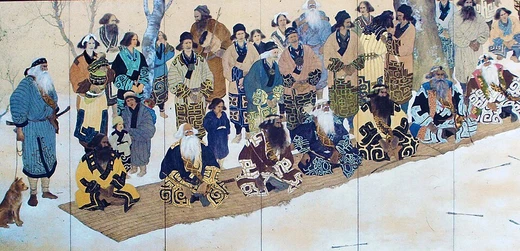
However, Kuroda became a close friend. Capron admired the Ainu, comparing them favorably to Native Americans, and regarded the Japanese as semi-barbaric, believing rapid Westernization was in Japan's interest. He returned home in 1875, frustrated but convinced he had set Japan on an agricultural revolution. He had three audiences with Emperor Meiji, and in 1884 received the Order of the Rising Sun (2nd class).
Later life
After returning from Japan, Capron maintained contacts there, acting as a purchasing agent for livestock and military equipment, and sold his Washington, D.C., house to become the site of Japan's first embassy. He worked on his memoirs. On February 21, 1885, he attended the dedication of the Washington Monument in extreme cold (12°F) and suffered a stroke, dying the following day. He is buried in Oak Hill Cemetery in Georgetown. His collection of Japanese art and antiques, amassed in Japan, was sold by his widow to the Smithsonian, forming a foundation of its Asian collection.
Frequently Asked Questions
When and where was Horace Capron born?
Horace Capron was born on 31 August 1804 in Attleboro, Massachusetts, U.S.
When did Horace Capron die?
Horace Capron died on 22 February 1885 in Washington, D.C., U.S.
More in Colonisation of Hokkaido
Spotted an error? Know more?
Reader corrections go straight into our review queue. Suggest an edit · How this site is sourced