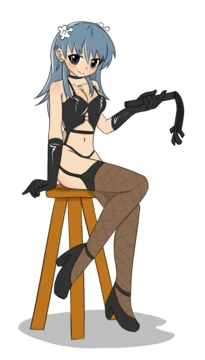
Top (clothing)
Upper body garment covering chest to waistline.

A top, also called topwear, is a garment that covers at least the chest and typically extends from the neck down to the waistline. The hem can be as short as the mid-torso or as long as the mid-thigh. Men usually wear tops with pants, while women pair them with pants or skirts. Common examples include t-shirts, blouses, and shirts.
Garments shaped like a T for the upper body have existed since ancient times, such as tunics. T-shirts likely come from the one-piece union suit of the 19th century; workers cut the top and bottom apart for more comfort. After World War II, T-shirts became acceptable as outerwear for men on farms and road crews. By the 1890s, most American women owned a shirtwaist blouse.
The neckline is the topmost edge of the garment, which can be as high as a hood covering the head or as low as the waistline or bottom hem. A top may fit loosely or tightly around the bust or waist. It can have sleeves, shoulder straps, spaghetti straps (also called noodle straps), or be strapless. The back may be covered or bare. Some tops have straps around the waist, neck, or over the shoulders.
- type
- Clothing item
- common_types
- T-shirts, blouses, shirts
- typical_coverage
- Chest to waistline
- bottom_length_range
- Mid-torso to mid-thigh
- pairing_men
- Pants
- pairing_women
- Pants or skirts
Lore & Background
T-shaped upper body garments have existed since antiquity in the form of tunics. T-shirts are thought to be derived from the one-piece union suit worn in the 19th century. To increase comfort, workers cut apart the top and bottom of the union suit. After World War II, T-shirts became somewhat acceptable as outerwear for men working on farms and road crews. By the 1890s, most American women had a shirtwaist blouse.
Reader's Guide
The top is a fundamental garment in human dress, with roots stretching back to ancient tunics. Its evolution reflects changes in labor and social norms: the T-shirt emerged from workers modifying union suits for comfort, and later gained acceptance as outerwear for men in manual occupations after World War II. The shirtwaist blouse became widespread among American women by the 1890s. Design features vary widely, including neckline height from hood to waistline, fit from loose to tight, and sleeve options from full sleeves to straps or strapless styles. The back may be covered or bare. Tops remain a versatile wardrobe staple, paired with pants for men and with pants or skirts for women.
Did You Know?
- T-shirts are thought to be derived from the one-piece union suit worn in the 19th century.
- After World War II, T-shirts became somewhat acceptable as outerwear for men working on farms and road crews.
- By the 1890s, most American women had a shirtwaist blouse.
- The neckline of a top may be as high as a head-covering hood or as low as the waistline.
Frequently Asked Questions
What is a Top (clothing)?
A top, also called topwear, is a garment designed to cover at least the chest area and typically extends over most of the upper body from the neck down to the waistline.
What are the most common types of tops?
The three most frequently cited categories of tops are t-shirts, blouses, and shirts, each serving slightly different style and formality purposes.
How long can the bottom of a top be?
The hem of a top can range anywhere from mid-torso all the way down to mid-thigh, giving a wide spectrum of lengths within the category.
What do you typically pair a top with?
Men's tops are generally worn with pants, while women's tops can be paired with either pants or skirts depending on the outfit.
What area of the body does a top cover?
By definition, a top covers at least the chest and usually spans the upper body between the neck and the waistline, distinguishing it from lower-body garments like pants or skirts.
More in Clothing Types 1-18
Spotted an error? Know more?
This is a living reference — every entry is fact-audited, and reader corrections feed straight into our audit queue. Suggest an edit · See this site's audit record