Basra
Last updated
Where it is
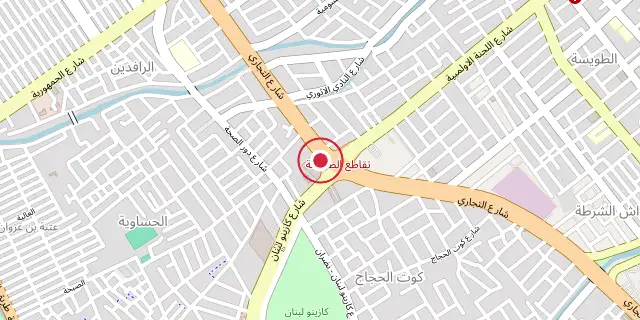
Coordinates: 30°30′54″N 47°48′36″E (30.5150, 47.8100) · Open in OpenStreetMap
Coordinates and connected clubs: the infobox of Wikipedia: Basra (CC BY-SA 4.0). Map: drawn by Codexery from OpenStreetMap tiles.
Basra is a predominantly Arab town located near the Šaṭṭ al-ʿArab river in southern Iraq, possessing a rich political, cultural, and economic history.[1] Around 17/638, the settlement of Basra was first created as a military camp and garrison for Arab tribal soldiers serving the early caliphs.[1] Throughout its existence, the settlement has been known by various names, with "Basrah" being the most frequent.[2]
Geography and history
The population of Basra was 101,535 in 1947, and reached 219,167 in 1957.[3] The year 636 marks the founding of Basra during the early Islamic period, when it started as a fortified camp for Arab tribal fighters.[4] Under Abbasid rule, Basra emerged as a hub of learning and hosted the renowned Basra School of Grammar.[5] The Zanj forces plundered Basra in the year 871.[5]
Mongol forces sacked Basra in 1258.[6] Portuguese authority over Basra began in 1526, after which the city came under Ottoman jurisdiction as part of the Basra Eyalet.[6] British military forces took Basra in 1914 during World War I.[6]
What the cited sources add
The Encyclopaedia Iranica account notes that Basra figured prominently in the political history of the early Islamic state because of its role as an important garrison town.[1] During the Omayyad period, the governorship of Basra was sometimes combined with that of Kufa in the hands of one governor.[1] The Encyclopaedia Iranica also records that Basra served as the administrative capital of considerable parts of Iran as well as southern Iraq for roughly a century.[1] Matthee's account explains that Basra's lively trade and its status as the only Ottoman outlet to the Indian Ocean was an important reason for Safavid interest in the area.[7]
Basra existed as much in the orbit of the Ottomans as that of the Safavids throughout the Safavid period.[7] A 2009 Radio Free Europe report states that there are only about 350 Mandaean families left in Basra, down from tens of thousands in the early 1990s.[8]
References
- Foundation, "Welcome to Encyclopaedia Iranica", iranicaonline.org. iranicaonline.org
- Wikipedia, "Basra" (CC BY-SA 4.0), which cites: Abdullah, "Merchants, Mamluks, and Murder: The Political Economy of Trade in Eighteenth-Century Basra", SUNY Press, 1 January 2001 (we also read that source) en.wikipedia.org
- Wikipedia, "Basra" (CC BY-SA 4.0), which cites: "Population of capital city and cities of 100,000 or more inhabitants", Demographic Yearbook 1955; "National Intelligence Survey. Iraq. Section 41, Population", Central Intelligence Agency, 1960 (original not read by us) en.wikipedia.org
- Wikipedia, "Basra" (CC BY-SA 4.0), which cites: "Basra, Iraq", meherbabatravels jimdo page!; "David Shepherd, military, Basra", www.davidshepherd.com; Petersen, A., 2023, Discovering Early Islamic Basra: the Origins and Development of Iraq's Southern Metropolis, Journal of Material Cultures of the Muslim World; Encyclopædia Iranica, E. Yarshater, Columbia University, p851; "Utbah ibn Ghazwan Companion of the Prophet Islamic History Sahaba Story", www.alim.org; "البَصْرَة: تعريف و شرح و معنى فی قاموس النور", qamus.inoor.ir (original not read by us) en.wikipedia.org
- Wikipedia, "Basra" (CC BY-SA 4.0), which cites: Andre Wink, Al-Hind: The Making of the Indo-Islamic World, Vol.2, 17.; Andre Wink, Al-Hind: The Making of the Indo-Islamic World, Vol.2, 17. (original not read by us) en.wikipedia.org
- Wikipedia, "Basra" (CC BY-SA 4.0), which cites: "Musul – Kerkük ile İlgili Arşiv Belgeleri (1525–1919)", T.C. Başbakanlık Devlet Arşivleri Genel Müdürlüğü, 1993, p. 306; Ceylan, "The Ottoman Origins of Modern Iraq: Political Reform, Modernization and Development in the Nineteenth Century Middle East", I.B. Tauris, 2011, p. 219 (original not read by us) en.wikipedia.org
- Matthee, "IRAQ iv. RELATIONS IN THE SAFAVID PERIOD", 2006, p. 556–560, 561. iranicaonline.org
- "Ethnic Mandaeans Killed In Iraqi Jewelry Store Robberies", Radio Free Europe/Radio Liberty, 2009-09-23. rferl.org
Each numbered sentence above was checked against the source it cites before publication. Sentences citing Wikipedia adapt text from the English Wikipedia article Basra (contributors), used under CC BY-SA 4.0; this entry is available under the same licence. Other sources were used for facts only.
More in Cities Of The World
Sources
Compiled from Wikipedia and the sources listed below. Text from Wikipedia is available under CC BY-SA 4.0; this entry is adapted from it.
- Wikipedia: Basra (CC BY-SA 4.0).
Spotted an error? Know more?
Reader corrections go straight into our review queue. Suggest an edit · How this site is sourced